Last Update: June 18, 2026. Learn how Michigan selects nominees for key statewide offices through...
Last update: September 28, 2026 Get informed about Michigan's 2026 judicial elections with our detailed voter guide covering the Supreme Court, Court of Appeals, and local trial courts.
This guide is designed for easy online navigation with clickable sections. If you'd rather download or print a copy, you can get the full PDF version.
Or Continue to the Online Navigation Below 👇
Table of Contents
- Executive Summary
- Michigan Judicial System Overview
- In the News
- Michigan Supreme Court
- Court of Appeals
- Trial-Level Courts
- How the Federal Courts Work (And How They’re Different)
- Why Voting for Judges Matters
- How to Vote in Michigan
Executive Summary
Every election year, Michigan voters choose judges — from the Michigan Supreme Court to local trial courts. Yet many skip those sections of the ballot simply because they don’t feel informed.
Michigan’s court system can feel complicated. Supreme Court justices run in nonpartisan races but are nominated at party conventions. Court of Appeals judges appear only in certain districts. Trial court judges are elected locally and may not show up on your ballot every year. Add in term lengths and vacancies — and it’s easy to feel overwhelmed.
When you vote in 2026, you are voting only for state-level judges — not federal judges. Understanding the difference helps clarify why some judges appear on your ballot and others don't, and which court system handles which types of cases.
This 2026 Michigan Judicial Voter Guide brings everything together in one place. The goal is simple: clarity. Here, you’ll find:
- An explanation of how Michigan’s court system is structured
- What each level of court does
- How judges are selected and elected
- Which seats are scheduled for the 2026 ballot
- How to find the judges who serve your community
- Where to look for updated candidate information
Judges make decisions that affect families, businesses, criminal justice, property rights, healthcare, education, and constitutional protections across our state. Understanding these roles helps you make informed decisions at the ballot box.
An informed voter is a confident voter. Walk into the voting booth knowing what you’re looking at — and why it matters.
Michigan Judicial System Overview
The Courts
Michigan’s Judicial Branch Links
Michigan's judicial branch is documented in one place by the State of Michigan at michigan.gov/som/government/branches-of-government/judicial-branch. The page covers:
Michigan Supreme Court
Website: Michigan Supreme Court
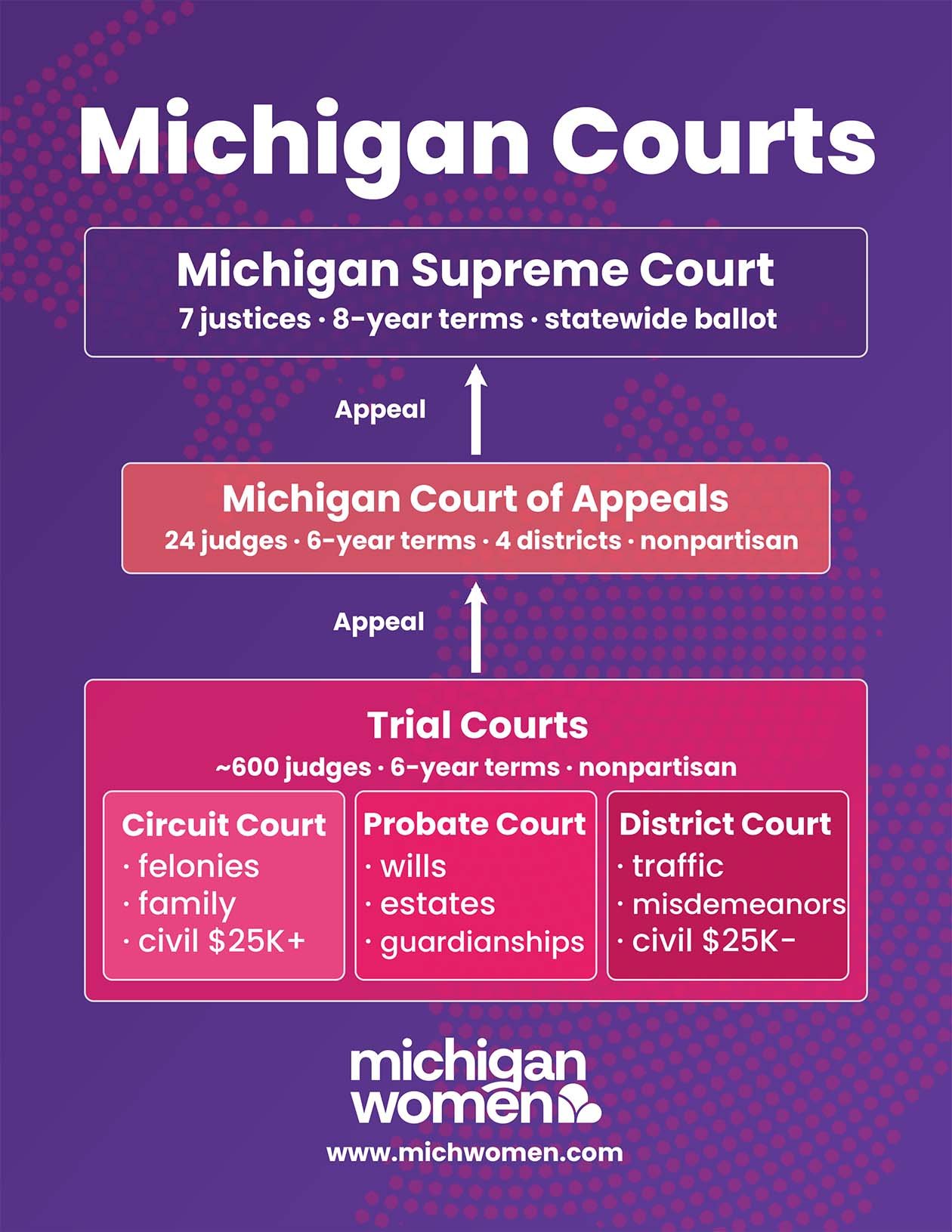
The Supreme Court is Michigan's highest court and the final word on how state law and the Michigan Constitution are interpreted. It receives more than 2,000 requests for review each year but accepts only about 70–80 cases — choosing only those with the broadest legal significance. Its decisions set binding precedent for every court in the state.
Court of Appeals
Website: Court of Appeals
The Court of Appeals is the required stop between a trial court and the Supreme Court. Judges don't hold new trials — they review the written record to decide whether the law was applied correctly. With 24 judges across four geographic districts, it's the court that handles the vast majority of appeals in Michigan, and most cases end here.
Trial courts
Website: Trial courts
Trial courts are where cases actually begin. Witnesses testify, evidence is presented, and a judge or jury makes the first decision. Michigan has three types — Circuit Courts handle serious criminal cases and major civil disputes; Probate Courts handle wills, estates, and guardianships; District Courts handle everyday matters like traffic violations, misdemeanors, and small civil claims. These are the judges most residents are likely to encounter.
How Courts Are Organized Across Michigan
Supreme Court
Michigan Supreme Court is statewide.
Court of Appeals
The Court of Appeals is divided into four districts: Michigan has a single statewide Court of Appeals divided into four geographic districts — located in:
- Detroit
- Troy (Clerk's Office permanently closed August 31, 2026 — cases now handled by the Detroit office)
- Grand Rapids
- Lansing
To find out which appellate district you're in, use the Court of Appeals Election District Map. Note: this is different from the trial court map — make sure you're using the election district map specifically.
Trial Courts
Trial courts are organized by circuit, district, and probate areas — you only vote on judges who serve the areas where you live. To find yours, use the Michigan Courts district map.
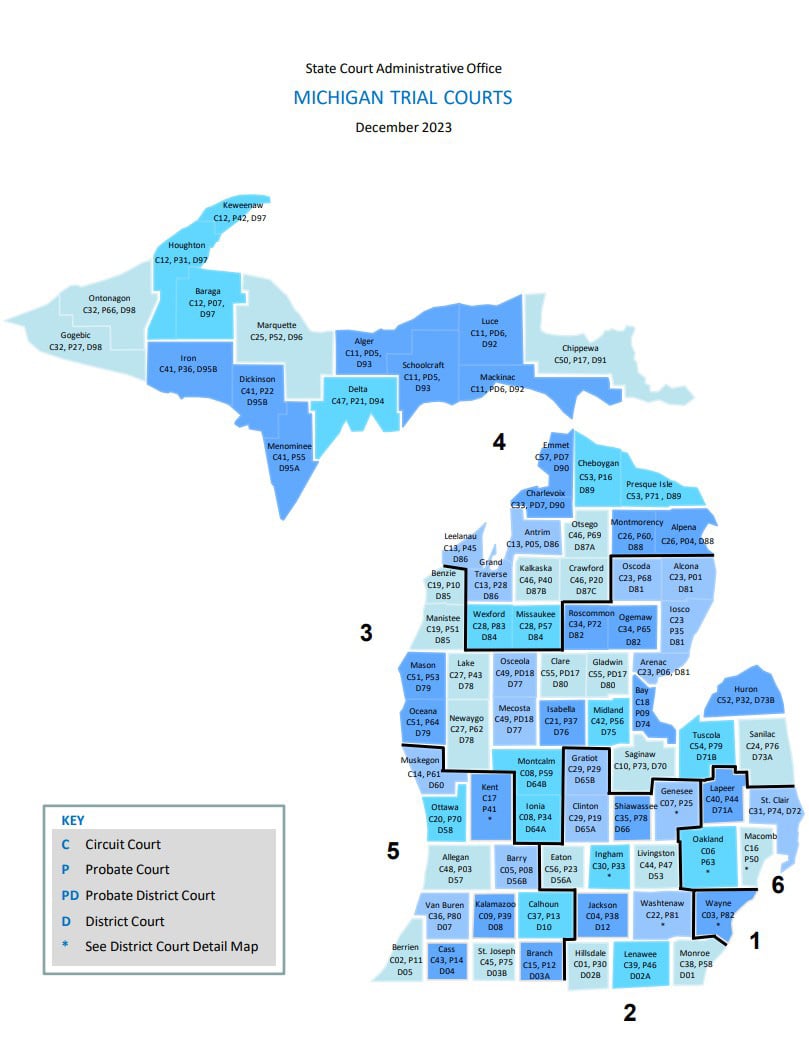
The map shows every county labeled with its Circuit Court (C##), Probate Court (P##), and District Court (D##) codes. Find your county to see which courts serve your area — and which judges appear on your ballot.
Example
Circuit Court 10, Probate Court 73, District Court 70
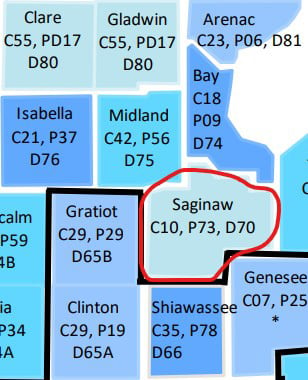
So when you see something like Saginaw — C10, that means: Saginaw County is part of the 10th Judicial Circuit, and voters there elect the Circuit Court judges who serve that circuit.
These boundaries determine which judge hears a case and which voters elect those judges.
The map also shows Michigan divided into 6 administrative regions used by the State Court Administrative Office (SCAO) — the agency that provides oversight and management support to trial courts statewide. These regions are administrative, not election districts.
In the News
Judicial races don't always make front page news — but the Michigan Supreme Court has been busy. Below is a curated collection of recent coverage from local and state outlets, including major rulings, candidate news, and accountability reporting. We don't pick sides; we pull the sources together so you can read for yourself.
Michigan Supreme Court
What Does the Michigan Supreme Court Do?
Website: https://www.courts.michigan.gov/courts/supreme-court/
The Michigan Supreme Court is the state’s highest court, responsible for interpreting the Michigan Constitution and laws, resolving major legal disputes, and setting binding precedent for all lower courts.
- Court of last resort
- Affirm or reverse Michigan Court of Appeals
- Remand a Case to Trial Court
- General administrative supervision of all state courts
- Rules for practice and procedure for all state courts
- Appointment and recommendation for Committees and Groups
The Michigan Supreme Court receives more than 2,000 requests each year asking it to review lower-court decisions, but it selects only about 70–80 cases for full argument and opinion.
The Court acts less like another appeals court and more like a policy-level referee, choosing only the cases that will shape Michigan law.
The Michigan Supreme Court has the final say on how the state constitution and laws are interpreted, meaning its decisions can shape policies affecting reproductive rights, criminal justice, education funding, business regulations, and the everyday legal rights of Michigan residents for years to come.
The Court in Action: 2026
Line 5 Tunnel — Environmental Review
In August 2026, the Court ruled 6-1 that state regulators improperly narrowed their environmental review when approving Enbridge's proposed Line 5 tunnel beneath the Straits of Mackinac. The ruling sends the project back to the Michigan Public Service Commission for a broader review that must consider alternatives and potential harm to the Great Lakes. A tribal coalition celebrated the decision as a victory for Michigan's public trust resources.
Consumer Protection Act — Insulin Pricing
In a 4-3 decision in August 2026, the Court restored the Michigan Consumer Protection Act's reach by overturning two previous rulings that had shielded certain businesses from the law. The case arose from Attorney General Dana Nessel's attempt to investigate insulin pricing practices. The ruling means the Consumer Protection Act can once again be used to investigate predatory and deceptive business practices statewide.
Courthouse Arrest Ban
In spring 2026, the Michigan Supreme Court adopted a new court rule prohibiting civil arrests at legal proceedings in Michigan state courts, including arrests by ICE using civil immigration warrants. The rule applies to Michigan courthouses and was designed to ensure that people feel safe accessing the state court system regardless of immigration status. It drew national attention and illustrates how the Court's administrative authority shapes who can access justice in Michigan.
Michigan Senate v. Michigan House: Nine Stalled Bills
The Michigan Supreme Court also resolved a long-running constitutional dispute — Michigan Senate v. Michigan House — over nine bills passed in late 2024 but never sent to the governor. In July 2026, the Court declined to hear the House's appeal, leaving in place a Court of Appeals ruling that the bills must be transmitted to Governor Whitmer. In a surprise twist, Whitmer vetoed all nine bills hours later, saying implementing them retroactively would create 'endless litigation' and overwrite law already in effect. The case established an important precedent: once both chambers pass a bill, the House cannot indefinitely withhold it from the governor.
Marijuana and Probation
In July 2026, the Court ruled unanimously that state courts cannot automatically ban marijuana use as a condition of probation. Because marijuana is legal in Michigan, the Court held that probation terms cannot prohibit something the state itself has legalized. The decision affects how judges across Michigan set probation conditions in criminal cases.
Sex Offender Registry — 20,000 Names Removed
In September 2026, the Michigan Supreme Court ruled that the state cannot enforce expanded sex offender registry requirements retroactively against people whose crimes were committed before July 1, 2011. Michigan State Police subsequently removed more than 20,000 names from the registry — reducing it by nearly half. The ruling found that applying post-2011 amendments to pre-2011 offenses amounted to unconstitutional punishment after the fact.
Oxford School Shooter — Sentence Sent Back for Review
The Michigan Supreme Court ordered the Court of Appeals to review the life sentence imposed on Ethan Crumbley, the Oxford High School shooter, including whether his trial attorneys mishandled a defense expert's testimony. The Court did not overturn his conviction or sentence — it gave him the right to present his case before the appeals court. The case illustrates the Supreme Court's role as a gatekeeper for what questions the appellate system must answer.
Who Are the Current Michigan Supreme Court Justices?
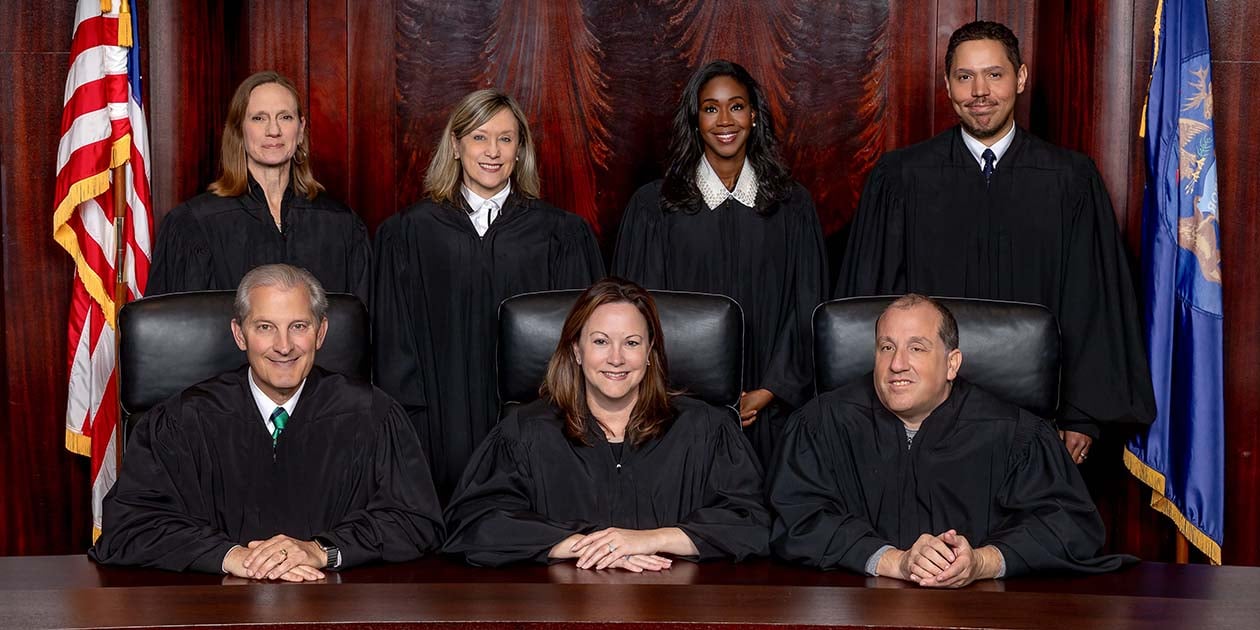
(Front row, L to R) Justice Brian Zahra, Chief Justice Megan Cavanagh, Justice Richard Bernstein (Back row, L to R) Justice Kimberly Thomas, Justice Elizabeth Welch, Justice Kyra Bolden, Justice Noah Hood
| Name | Nominating Party | Year Started on Court | Current Term | Next Election Year |
|---|---|---|---|---|
| Chief Justice Megan K. Cavanagh | Democratic | 2019 | 2019–2027 | 2026 |
| Justice Brian K. Zahra | Republican | 2011 | 2023–2031 | 2030 |
| Justice Richard Bernstein | Democratic | 2015 | 2023–2031 | 2030 |
| Justice Elizabeth M. Welch | Democratic | 2021 | 2021–2029 | 2028 |
| Justice Kyra H. Bolden* | Democratic | 2024 | 2023–2029 | 2028 |
| Justice Kimberly A. Thomas | Democratic | 2025 | 2025–2033 | 2032 |
| Justice Noah P. Hood* | Democratic | 2025 | 2025–2027 | 2026 |
* Filling the remainder of a vacated term.
Term and Term Limits
Supreme Court Justices are elected by voters to serve for 8-year terms. They run nonpartisan races, but are nominated to the ballot at Republican and Democratic party state conventions.
The Republican and Democratic party delegates vote for their chosen Supreme Court nominees. Once the nominees are selected, they appear on the nonpartisan section of the General Election ballot.
- Seats Open Every 2 Years: 2
- Term: 8 years
- Term limits: None, but must retire in the year they turn 70.
- To Get On the Ballot
- Incumbents: may file for re-election.
- Non-Incumbents: party nomination or nominating petition.
- Vacancy: Governor appoints a replacement until the next general election.
Candidates for Michigan Supreme Court
Two seats on the Michigan Supreme Court are scheduled for election in 2026. These seats will appear on the statewide November 2026 ballot.
Democratic-Endorsed Candidates
The Michigan Democratic Party endorsed both incumbents — Chief Justice Megan Cavanagh and Justice Noah Hood — at its April 19, 2026 convention in Detroit.
Chief Justice Megan K. Cavanagh (Incumbent)
 |
|
Positions
- Prioritizes expanding access to Michigan's courts for all residents regardless of immigration status
- Has led court reform efforts focused on child welfare, legal representation for families, and tribal court collaboration
- Advocates for court technology funding and expansion of problem-solving courts
- Supports courthouse safety — championed the 2026 rule prohibiting civil arrests at legal proceedings, including by ICE
Endorsements & Positioning
- Endorsed by the Michigan Democratic Party at its April 19, 2026 convention, Michigan AFL-CIO, representing over 1 million union members, Michigan Association for Justice
- Running as an incumbent with strong institutional backing from labor and Democratic Party infrastructure
Career
- 15+ years as an appellate attorney in Detroit; shareholder at Garan Lucow Miller P.C.
- Rated Michigan Super Lawyer; Michigan Lawyers Weekly Lawyer of the Year (2006) and Woman in the Law (2017)
- Daughter of former Chief Justice Michael F. Cavanagh — making them the only father-daughter Chief Justices in U.S. history
Personal
- Born in Lansing, raised in East Lansing; lives in Birmingham
- B.S. Engineering, University of Michigan; J.D., Wayne State University Law School
- Mother and stepmother of four; primary caregiver to her mother
Justice Noah Hood (Incumbent)
 |
|
Positions
- Emphasizes decisions rooted in facts and fairness; has described his judicial philosophy as applying law as written rather than legislating from the bench
- Supported the Court's 2026 rule prohibiting civil arrests at legal proceedings, including by ICE
- The Court under Hood's tenure has stood out for rulings expanding constitutional rights for people convicted of crimes
- Has not taken public positions on legislation (appropriate for a sitting justice)
Endorsements & Positioning
- Endorsed by the Michigan Democratic Party at its April 19, 2026 convention, Michigan AFL-CIO, representing over 1 million union members, Michigan Association for Justice
- Governor Whitmer appointed Hood to the Michigan Supreme Court in April 2025 to fill the vacancy left by Chief Justice Elizabeth Clement's resignation; he now seeks his first full elected term in November 2026
Career
- Appointed to Michigan Supreme Court by Governor Whitmer in April 2025, filling the vacancy left by Chief Justice Elizabeth Clement's resignation
- Previously appointed to the Michigan Court of Appeals (2022) and the Third Judicial Circuit Court in Detroit (2019) — both by Governor Whitmer
- Assistant U.S. Attorney, Eastern District of Michigan (2018–2019) and Northern District of Ohio (2014–2018); received U.S. Treasury FinCEN Director's law enforcement award in 2018
- Commercial litigation associate at Miller Canfield in Detroit (2011–2014); recognized for pro bono nuisance abatement work in Detroit
Personal
- Born in Detroit to parents who were both public servants; his father, Rev. Nicholas Hood III, served on the Detroit City Council and is senior minister of Plymouth United Church of Christ
- B.A., Yale College; J.D., Harvard Law School (Cass Technical High School graduate)
- Deacon at Plymouth United Church of Christ; member of the Wolverine Bar Association and Association of Black Judges of Michigan
- Lives in Detroit with his wife and son
Republican-Endorsed Candidates
The Michigan Republican Party endorsed both candidates below at its March 28, 2026 convention in Novi. They will challenge the two Democratic-nominated incumbents in November.
Judge Michael Warren
 |
|
Positions
- Judicial restraint and originalism — interprets the law as written and understood by the people and lawmakers, not as he believes it should be
- Opposes what he calls "legislating from the bench;” argues several recent Michigan Supreme Court decisions reflect judicial activism rather than faithful interpretation of the law
- Specifically disagrees with the current Court's rulings expanding sentencing protections for defendants who committed murder at ages 18–20, arguing they should not be treated like juveniles
- Running explicitly to "bring balance" to a court he describes as having a 6-to-1 Democrat-nominated majority
- Prioritizes civic education — has spent decades producing educational content about the Constitution and American history
- Supports strong trial court experience as a qualification for appellate judges; argues the current Court lacks it
Endorsements & Positioning
- Endorsed by the Michigan Republican Party at its March 28, 2026 convention in Novi, President Trump, and aligned with the GOP's America First judicial agenda. Also endorsed by the Michigan Libertarian Party — making him the only candidate in the race with cross-party endorsements.
Career
- Oakland County Circuit Court Judge since 2002 (appointed by Gov. John Engler); has presided over more than 400 jury trials including murder cases, felony matters, and business court disputes
- Former partner at Honigman Miller Schwartz & Cohn (appellate, corporate, and education law)
- Former legal and policy advisor, Michigan State Board of Education (1995–1997); former member and secretary of the State Board of Education
- Professor of business law, Wayne State University; adjunct professor of constitutional law, Western Michigan Cooley Law School
- Judicial law clerk, Michigan Supreme Court Justice Dorothy Comstock Riley (1992–1994)
- Author of America's Survival Guide (2007) and The Revolutionary Words that Forged America: The Definitive Guide to the Declaration of Independence (Republic Books, 2026)
- Co-founder of Patriot Week podcast, a nonpartisan civic education nonprofit recognized by the U.S. Senate; hosts the Patriot Lessons: American History and Civics podcast
Personal
- Raised in Macomb County; lives in Oakland County
- B.A. Honors History, Wayne State University; J.D. cum laude, University of Michigan Law School
- Married father of two; has run six marathons; self-described Trekkie
Judge Casandra Morse-Bills
 |
|
Positions
- Judicial restraint and originalism — interprets the law as written, not as she believes it should be; opposes legislating from the bench
- Believes the Constitution must be applied faithfully and without bias, with equal justice for every individual regardless of background
- Emphasizes separation of powers — judges should not overstep their role into policymaking
- Running to bring balance to a court she and her party describe as a 6-to-1 Democrat-nominated supermajority
- Highlights her breadth of trial court experience across probate, district, and circuit courts as a key differentiator — the only candidate in the race who has served at all three trial court levels
- Member of the Michigan Judicial Council, working on the statewide judicial strategic plan to improve access, transparency, and court system performance.
Endorsements & Positioning
- Endorsed by the Michigan Republican Party at its March 28, 2026 convention in Novi, President Trump, and aligned with the GOP's America First judicial agenda
- Campaigning actively in northern Michigan and the Upper Peninsula — appeared at the Missaukee County Lincoln Day Dinner in May 2026, one of the few Supreme Court candidates to campaign in rural northern Michigan
Career
- Presiding Judge, 23rd Judicial Circuit Court since 2018; re-elected 2024; covers four counties — Alcona, Arenac, Iosco, and Oscoda — one of Michigan's largest geographic circuits
- Presides over cases in Probate, District, and Circuit Courts — handling family and probate matters, felonies, serious misdemeanors, and complex civil litigation
- Former Oscoda County Prosecuting Attorney
- Private practice prior to becoming a prosecutor
Personal
- Born and raised in Oscoda County; lifelong Michigan resident
- B.S., University of South Florida; J.D., Thomas M. Cooley Law School, Lansing
Race Note: Pending Litigation
A federal whistleblower lawsuit filed in April 2026 names Morse-Bills as a defendant. A former Oscoda County clerk alleges she improperly communicated with a juror during a sex assault trial and claims retaliation for reporting it. The allegations have not been proven, and the case remains active and unresolved.
Other Party Candidates
Two additional candidates are on the November 2026 ballot under the U.S. Taxpayers Party of Michigan. Michigan's Constitution requires Supreme Court justices to have been admitted to the practice of law for at least five years. Both candidates acknowledge they do not meet this requirement. The Michigan Secretary of State has confirmed nothing prevents them from appearing on the ballot, but they could not legally take office if elected.
Jody White (U.S. Taxpayers Party)
- Realtor; U.S. Taxpayers Party nominee for Michigan Supreme Court
- Campaigning on platforms of judicial accountability, integrity, and oversight
- Does not hold a valid Michigan law license as required to serve in the office
Thomas Howe (U.S. Taxpayers Party)
- Retired engineer; U.S. Taxpayers Party nominee for Michigan Supreme Court
- Campaigning on platforms of judicial accountability and constitutional integrity
- Does not hold a valid Michigan law license as required to serve in the office
Note: A 1997 Michigan Attorney General opinion confirmed that candidates who do not meet constitutional qualifications can appear on the ballot but cannot legally be sworn into office if elected. This is a reminder that the nonpartisan ballot does not verify candidate eligibility before Election Day — that responsibility falls to voters.
Court of Appeals
What Does the Court of Appeals Do?
Website: https://www.courts.michigan.gov/courts/court-of-appeals/
The Michigan Court of Appeals is the required next step after a trial court decision if someone wants to challenge the outcome. It reviews whether trial courts applied the law correctly, and its decisions set binding guidance for lower courts — making it one of the most influential courts most voters have never heard of.
The judges do not hold a new trial. Instead, they review the written record from the original case — transcripts, evidence, and legal arguments — to decide whether the judge followed the law correctly and whether the result should stand, be changed, or be sent back for another hearing.
- Reviews decisions made by trial courts (Circuit, District, Probate, and Court of Claims).
- Focuses on whether the law was applied properly, not who is telling the truth.
- Does not hear new witnesses or take new evidence.
- Issues written opinions that guide judges in future cases.
- Must review most appeals before the Michigan Supreme Court can consider them.
After the Court of Appeals makes a decision, the case usually ends there. A party can ask the Michigan Supreme Court to review it, but the Supreme Court chooses only a small number of cases to accept.
The Court of Appeals is staffed by 24 judges who provide consistent statewide review before cases may be considered by the Michigan Supreme Court.
Four Districts: Michigan has a single statewide Court of Appeals divided into four geographic districts — located in:
- Detroit
- Troy (Clerk's Office permanently closed August 31, 2026 — cases now handled by the Detroit office)
- Grand Rapids
- Lansing
To find out which appellate district you're in, use the Court of Appeals Election District Map. Note: this is different from the trial court map — make sure you're using the election district map specifically.
The Current Court of Appeals Judges
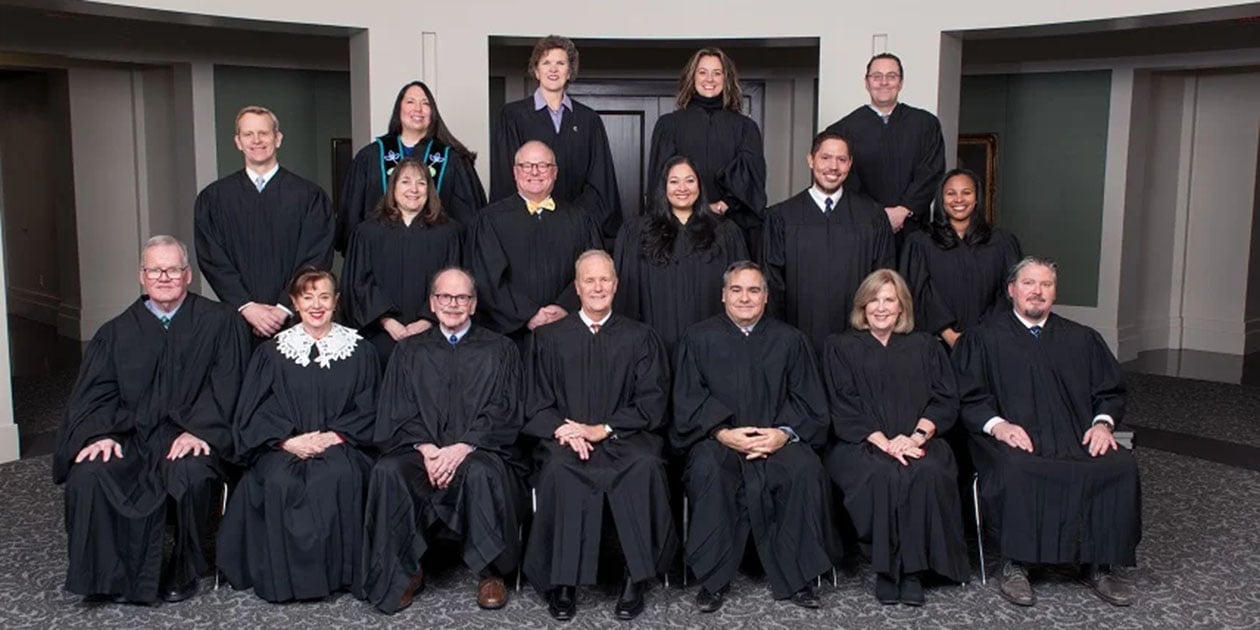
(Front row L to R): Michael J. Riordan, Jane E. Markey (retired), Mark J. Cavanagh (retired), Chief Judge Michael F. Gadola, Chief Judge Pro Tem Stephen L. Borrello, Colleen A. O’Brien, Brock A. Swartzle. (Second row L to R): Thomas C. Cameron, Anica Letica, James Robert Redford, Sima G. Patel, Noah P. Hood (appointed to Supreme Court), Kristina Robinson Garrett. (Third Row L to R): Allie Greenleaf Maldonado, Kathleen A. Feeney, Adrienne N. Young, Randy J. Wallace. (Not pictured): Christopher M. Murray, Michael J. Kelly, Mark T. Boonstra, Michelle M. Rick, Christopher P. Yates (retired), Philip P. Mariani, Matthew S. Ackerman, Daniel S. Korobkin, Christopher M. Trebilcock, Mariam Saad Bazzi, Andrew J. Lievense.
| Name | District | Year Started on Court | Current Term | Next Election Year |
|---|---|---|---|---|
| Andrew J. Lievense | 1 | 2026 | Partial term (–2027) | 2026 |
| Anica Letica | 1 | 2018 | 2021–2027 | 2026 |
| Christopher M. Murray | 1 | 2002 | 2021–2027 | 2026 |
| Kristina Robinson Garrett | 1 | 2022 | 2023–2029 | 2028 |
| Mariam Saad Bazzi | 1 | 2025 | 2021–2027 | 2026 |
| Michael J. Riordan | 1 | 2012 | 2021–2027 | Not seeking re-election |
| Thomas C. Cameron | 1 | 2017 | 2023–2029 | 2028 |
| Adrienne N. Young | 2 | 2024 | 2025–2031 | 2030 |
| Christopher M. Trebilcock | 2 | 2025 | 2021–2027 | 2026 |
| Colleen A. O'Brien | 2 | 2015 | 2023–2029 | 2028 |
| Matthew S. Ackerman | 2 | 2025 | 2025–2031 | 2030 |
| Randy J. Wallace | 2 | 2024 | 2025–2031 | 2030 |
| Sima G. Patel | 2 | 2022 | 2021–2027 | 2026 |
| Daniel S. Korobkin | 3 | 2025 | 2021–2027 | 2026 |
| James Robert Redford | 3 | 2018 | 2023–2029 | 2028 |
| Kathleen A. Feeney | 3 | 2023 | 2025–2031 | 2030 |
| Mark T. Boonstra | 3 | 2012 | 2021–2027 | 2026 |
| Philip P. Mariani | 3 | 2024 | 2025–2031 | 2030 |
| Allie Greenleaf Maldonado | 4 | 2023 | 2021–2027 | 2026 |
| Brock A. Swartzle | 4 | 2017 | 2023–2029 | 2028 |
| Michael F. Gadola | 4 | 2015 | 2023–2029 | 2028 |
| Michael J. Kelly | 4 | 2008 | 2021–2027 | 2026 |
| Michelle M. Rick | 4 | 2021 | 2021–2027 | 2026 |
| Stephen L. Borrello | 4 | 2003 | 2025–2031 | 2030 |
Term and Term Limits
Court of Appeals judges are elected by voters to serve 6-year terms. They appear on the ballot as nonpartisan candidates — and unlike Michigan Supreme Court races, they are not nominated at party conventions. Court of Appeals candidates qualify for the ballot through a nonpartisan primary or by filing nominating petitions.
- Seats Open Every 2 Years: Varies by district (based on term expiration)
- Term: 6 years
- Term limits: None, but judges must retire in the year they turn 70.
- To Get On the Ballot:
- Incumbents: may file for re-election through the nonpartisan primary or nominating petition
- Non-incumbents: must file nonpartisan nominating petitions with the required number of valid signatures. If the number of candidates exceeds twice the number of open seats, a nonpartisan primary is held in August to narrow the field before the November general election.
Vacancy: Governor appoints a replacement until the next general election.
Candidates for Michigan Court of Appeals
Ten of the following seats have terms ending January 1, 2027. One additional seat — held by Andrew J. Lievense in District 1 — is a partial term also up for election in 2026. Court of Appeals races are district-based, so only voters living in a judge's appellate district will see that race on their ballot.
| Name | District | Year Started on Court | Current Term | Next Election Year |
|---|---|---|---|---|
| Andrew J. Lievense | 1 | 2026 | Partial (–2027) | 2026 |
| Anica Letica | 1 | 2018 | 2021–2027 | 2026 |
| Christopher M. Murray | 1 | 2002 | 2021–2027 | 2026 |
| Mariam Saad Bazzi | 1 | 2025 | 2021–2027 | 2026 |
| Christopher M. Trebilcock | 2 | 2025 | 2021–2027 | 2026 |
| Sima G. Patel | 2 | 2022 | 2021–2027 | 2026 |
| Daniel S. Korobkin | 3 | 2025 | 2021–2027 | 2026 |
| Mark T. Boonstra | 3 | 2012 | 2021–2027 | 2026 |
| Allie Greenleaf Maldonado | 4 | 2023 | 2021–2027 | 2026 |
| Michael J. Kelly | 4 | 2008 | 2021–2027 | 2026 |
| Michelle M. Rick | 4 | 2021 | 2021–2027 | 2026 |
Go to Michigan Secretary of State Website
The Michigan Bureau of Elections published the official list at https://michigan.gov/sos/elections — search for "Court of Appeals" under the 2026 candidate filings.
Check Ballotpedia
You can also check Ballotpedia's Michigan Court of Appeals page, which tracks candidates as they are announced.
Trial-Level Courts
What Do Trial Courts Do?
Website: https://www.courts.michigan.gov/courts/trial-courts/
Trial courts are where a case actually begins. This is where people file lawsuits, charges are brought, witnesses testify, and a judge or jury makes the first decision. Michigan has several types of trial courts, each handling different kinds of cases, but all of their decisions can be appealed to the Michigan Court of Appeals.
4 Types of Trial-Level Courts
1. Circuit Court
The Circuit Court is Michigan’s primary trial court for major disputes and serious criminal matters. There are 57 circuit courts (one for each judicial circuit) with over 200 judges statewide serving 6-year terms.
- Civil cases involving more than $25,000
- Felony criminal cases
- Divorce, custody, and other family matters
- Appeals from District and Probate Courts
- Includes the Court of Claims (lawsuits against the state)
Circuit Court judges handle serious criminal cases, major civil disputes, and family law matters like divorce and custody — meaning their decisions can significantly impact personal freedom, financial stability, and parental rights.
Court of Claims
The Court of Claims handles lawsuits filed against the State of Michigan and operates within the Circuit Court system. Cases are heard by Court of Appeals judges assigned to this court and apply statewide.
- Claims against state departments or agencies
- Contract disputes involving the state
- Constitutional claims against the state
- Monetary claims generally over $1,000
If someone sues the State of Michigan — whether over contracts, constitutional rights, or actions by state agencies — this court decides the outcome, affecting how state government is held accountable.
2. Probate Court
Probate Courts handle legal matters involving personal decision-making and property after death. Michigan has 78 probate courts, typically one per county, with judges serving 6-year terms.
- Wills and estates
- Trust administration
- Guardianships and conservatorships
- Mental health treatment orders
Probate judges oversee wills, estates, guardianships, conservatorships, and certain mental health matters, making decisions that affect families during some of their most sensitive and vulnerable moments.
3. District Court
District Courts handle everyday legal disputes and lower-level criminal matters. Michigan has approximately 100 district courts with judges serving 6-year terms.
- Traffic violations
- Misdemeanor criminal cases
- Civil disputes up to $25,000
- Small claims cases
District Court judges handle everyday cases — traffic tickets, misdemeanors, landlord-tenant disputes, and small civil claims — making them the judges most residents are likely to encounter.
4. Municipal Courts
A small number of municipalities (primarily in the Grosse Pointe area) operate municipal courts instead of district courts.
- Handle the same types of minor criminal and civil matters as District Court
In the few cities that operate municipal courts, these judges handle local criminal and civil matters similar to district courts, directly impacting residents within those communities.
Term and Term Limits
Voters vote for the judges who serve the court area where they live. Your address determines which courts handle local cases — and therefore which judges appear on your ballot.
Judicial elections in Michigan are nonpartisan on the ballot, meaning party labels do not appear next to a judge’s name. However, the path to the ballot depends on the level of court.
Unlike the Supreme Court and Court of Appeals, trial court judges are not nominated at party conventions. Candidates qualify for the ballot by filing nominating petitions (or paying a filing fee, where permitted) with the appropriate election official.
- Seats Open Every 2 Years: Varies by local court and term expiration
- Term: 6 years
- Term limits: None, but judges must retire in the year they turn 70
- To Get On the Ballot:
- Incumbents: may file for re-election
- Non-incumbents: must file nominating petitions or pay the required filing fee
- If more candidates file than seats available, a nonpartisan primary may be held
- Vacancy: Governor appoints a replacement until the next general election.
Candidates for Trial-Level Courts (Circuit, District, Probate)
Judges do not all appear on the ballot every election year. Each judgeship has its own term, so only the seats whose terms are ending will show up for voters. In Michigan, most trial and appellate judges serve 6-year terms, and the election happens the November before the term expires.
The easiest way to check your local judges:
Option 1 – State website
- Go to the Trial Court Directory.
- Click on your county.
- Click on Locations & Judges.
Option 2 – County Website
Using Saginaw as an example:
- Go to the County website.
- In the search bar, type “judges.”
- Choose the court you want to examine in the search results (for example, the 10th Circuit Court).
- Click on the judge's name and review their bio page.
How the Federal Courts Work (And How They’re Different)
When you vote for judges in elections, you are voting only for state-level judges — not federal judges. Understanding the difference helps clarify why some judges appear on your ballot and others don't, and which court system handles which types of cases.
Not all courts in the United States are elected. The federal court system is completely separate from Michigan’s state court system.
The United States operates under a dual court system:
- State courts (like Michigan’s courts) interpret state laws and the state constitution.
- Federal courts interpret the U.S. Constitution and federal laws.
A case goes to federal court only if it involves:
- A question about the U.S. Constitution
- A federal law
- A dispute between residents of different states (in some circumstances)
- A case involving the federal government
Most everyday legal matters — traffic violations, divorce, property disputes, state criminal charges — are handled in state courts.
The Three Levels of Federal Courts
1. U.S. District Courts (Trial Courts)
These are the federal trial courts, where cases begin.
- Witnesses testify
- Evidence is presented
- Judges or juries make factual determinations
There are 94 federal judicial districts, with at least one in every state. Some states have multiple districts based on population. For example, California and Texas have 4 federal judicial districts. Michigan has two federal districts:
- Eastern District of Michigan
- Western District of Michigan
Each district has federal trial judges, magistrate judges (who assist with pretrial matters), and bankruptcy judges (who handle federal bankruptcy cases).
2. U.S. Courts of Appeals
If someone appeals a federal trial court decision, the case goes to a federal appellate court, often called "circuit courts." There are 13 federal appellate circuits:
- 11 numbered regional circuits
- 1 D.C. Circuit
- 1 Federal Circuit (nationwide court that handles specialized areas such as patent law, certain federal claims against the government, and international trade disputes)
Each circuit reviews appeals from the district courts within its geographic area.
Michigan is part of the United States Court of Appeals for the Sixth Circuit, which also includes Ohio, Kentucky, and Tennessee. These courts:
- Review written records
- Do not hold new trials
- Decide whether the law was applied correctly
3. The U.S. Supreme Court
At the top of the federal system is the Supreme Court of the United States.
- Chooses which cases to hear
- Issues decisions that set nationwide precedent
- Has the final say on interpreting the U.S. Constitution
It accepts only a small percentage of the cases it is asked to review each year.
How Federal Judges Are Selected
Unlike Michigan judges, federal judges are not elected. They are:
- Nominated by the President of the United States
- Confirmed by the U.S. Senate
- Appointed for life (during “good behavior”)
Federal Judges do not run for reelection or appear on ballots. They serve until they retire, resign, or are impeached and removed.
This system was designed to insulate federal judges from political pressure by removing them from the electoral cycle.
Why Voting for Judges Matters
Judicial elections don't always get the same attention as races for governor, Congress, or the legislature. But the judges you elect shape daily life in Michigan in three concrete ways: they decide who gets to stay on the bench, they set the limits of their own authority, and they determine how long people spend in prison. Here's what that looks like in 2026.
Who Gets on the Bench — and Who Stays There
Michigan judicial elections aren't just about who gets on the bench — they're also about who stays there. In 2026, Kahlilia Davis is running for a seat on Detroit's 36th District Court despite the Michigan Supreme Court having previously determined she should not serve as a judge. Under Michigan law, the Court can recommend removal, but voters ultimately decide who appears on the ballot. Davis's candidacy is a reminder that judicial elections require the same informed attention as any other race — and that the nonpartisan label on a judicial ballot doesn't mean all candidates are equally qualified or fit to serve.
When the Court Can Act — and When It Can't
The Slaven case illustrates a different side of judicial accountability. In June 2026, the Michigan Supreme Court ordered former Taylor District Court Judge Joseph Slaven to stay off the bench permanently due to misconduct. Unlike Kahlilia Davis — who is still running despite the Court's opposition — Slaven's case shows the Court does have teeth when it comes to removing judges who have already served. Together, these cases raise a practical question for voters: if the courts themselves can't always remove unfit judges from the ballot, who can? Voters can.
The White and Howe cases extend that principle to the Supreme Court itself. Two U.S. Taxpayers Party candidates — realtor Jody White and retired engineer Thomas Howe — are on the November 2026 ballot for Michigan Supreme Court despite acknowledging they do not hold valid law licenses. Michigan's Constitution requires justices to have been admitted to the practice of law for at least five years. The Secretary of State confirmed nothing prevents them from appearing on the ballot, but neither could legally be sworn in if elected. The system that allows this is the same one that puts Kahlilia Davis on a district court ballot: in Michigan, ballot access and office eligibility are two separate questions — and voters answer the second one.
The Judges You Elect Shape Criminal Justice for Years
Circuit court judges make the sentencing decisions that determine how long someone spends in prison. A revived Michigan Sentencing Commission — reinstated by lawmakers in 2024 after nearly three decades — began meeting in 2026 to examine whether Michigan's sentencing guidelines need reform. Average minimum sentences have increased 30% since 2014. The Commission's work is a reminder that the judges voters elect to circuit courts shape criminal justice outcomes in Michigan for years.
The Court's active role in sentencing reform was on display again in August 2026, when it ruled that a 50-to-75-year sentence imposed for a crime committed at age 16 was unconstitutionally excessive. The ruling expands resentencing eligibility to anyone convicted of a crime committed at age 21 or younger who received decades in prison. The decision affects scores of people currently serving long sentences — and illustrates why the composition of the Supreme Court matters for criminal justice outcomes.
How to Vote in Michigan
Knowing who's running is only half the equation. Here's how to make sure your vote actually counts on November 3rd (general election).
Start here: Look up your personal voter information
The Michigan Voter Information Center has everything you need in one place. Enter your information at mvic.sos.state.mi.us and you'll see:
- Whether you're registered to vote
- Your polling location on Election Day
- Your early voting location and hours
- Your absentee ballot status
- Your drop box locations
- All of your voting districts — county, state house, state senate, U.S. Congress, school board, and more
- Your local clerk's contact information
Key dates
- Primary Election: August 4, 2026 (completed)
- General Election: November 3, 2026
- Early voting is available — check the MVIC site for your specific location and hours
- Michigan allows same-day voter registration at your local clerk's office
Not registered?
You can register online at mvic.sos.state.mi.us if you have a Michigan driver's license or state ID, by mail, or in person at your local clerk's office. If you're registering within 14 days of an election, you must do so in person.
Voter information is maintained by the Michigan Secretary of State. Contact your local clerk if you have questions about your specific situation.