Why do political parties exist? Political parties help people organize around shared goals, win...
District 35 candidate forum recap: clear, nonpartisan breakdown of Tunney and Greene on key issues, policies, and priorities.
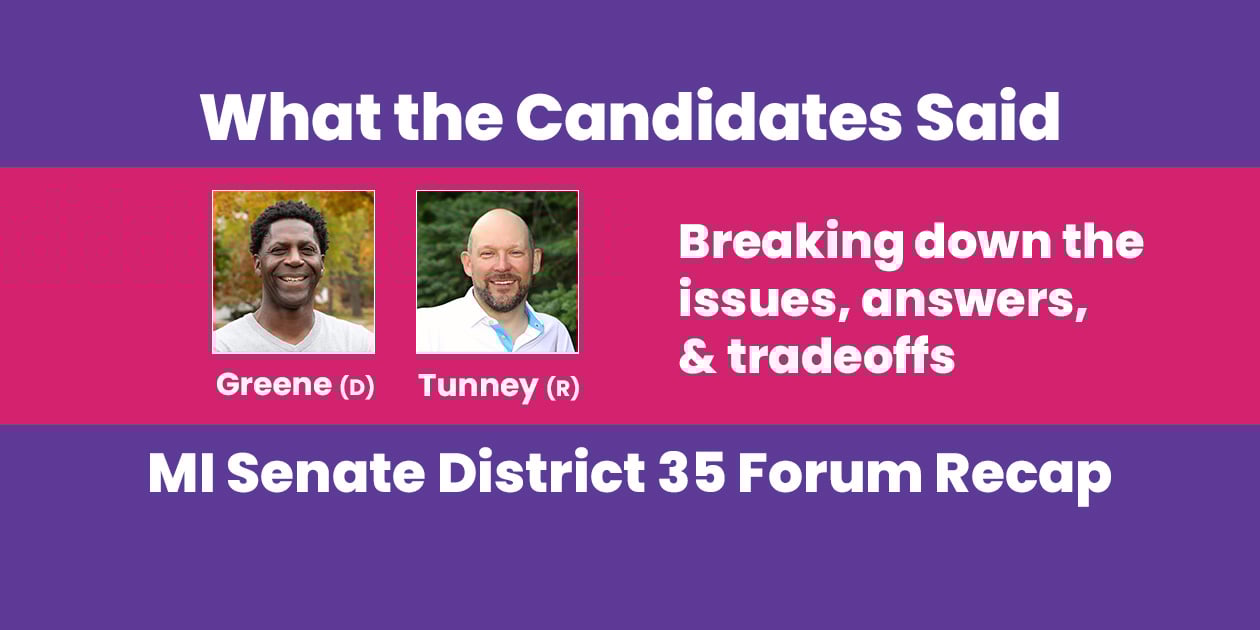
With two high-stakes elections scheduled just months apart, Michigan’s 35th State Senate District is in the spotlight in 2026, as voters choose both who will fill the current vacancy and who may hold the seat long term.
This recap covers the March 24, 2026 District 35 candidate forum moderated by Chad Livengood of The Detroit News and Zoe Clark of Michigan Public Radio. The moderators led the main questioning for most of the event, then used the final 20 minutes to bring in questions submitted by audience members.
Together, the discussion gave voters a chance to hear both prepared moderator questions and issues raised directly by people in the room.
Table of Contents
This guide is designed for easy online navigation with clickable sections. If you’d rather download or print a copy, you can get the full PDF version.
Or Continue to the Online Navigation Below 👇
- Opening Statements
- Q1: Combat Low Reading Scores
- Q2: Free School Meals
- Q3: Cost of Higher Education
- Q4: Fixing Local Roads
- Q5: Jobs and Economic Development
- Q6: Data Centers and Local Impact
- Q7: Minimum Wage
- Q8: Campaign Donations and Energy Companies
- Q9: State Budget and the Rainy Day Fund
- Q10: Serving the District and Looking Ahead
- Q11: Marijuana Policy
- Q12: Oversight of DNR and EGLE
- Q13: Public Safety
- Q14: Red Flag Laws
- Final Takeaways
Opening Statements
Candidates began by sharing their backgrounds and outlining their core reasons for running.
Jason Tunney
Emphasized a business-focused perspective, drawing on his experience as an attorney and his background in private enterprise. His remarks centered on making state government more business-friendly and limiting its scope.
Chedrick Greene
Highlighted his career in public service, including his work as a fire captain and military service. He framed his campaign around what he described as the need for an “affordable, safe, and free” community, emphasizing issues facing working families.
While both candidates spoke to leadership and public service, their opening statements reflected different professional paths and life experiences—one rooted in business and law, the other in military and emergency service—which shaped how they described the role of government and their priorities for the district.
Q1: Combat Low Reading Scores
Question: Michigan has some of the lowest reading scores among K–12 students in the country. What can you, as a state senator, do to restore literacy success in Michigan?
Why literacy was the first question
The forum opened with a focus on literacy—an issue that continues to come up in statewide discussions about education. Michigan has ranked near the bottom nationally for reading proficiency, particularly in early grades, making it a foundational concern for both economic outcomes and long-term student success.
Early literacy is often emphasized because third-grade reading is widely considered a key milestone. Students who are not reading proficiently by that point may face increasing challenges across subjects as coursework becomes more reading-dependent.
Jason Tunney
Tunney focused his response on accountability and measurement, pointing to other states as models.
Key points from his response included:
- Adopting a third-grade reading test, similar to Mississippi
- Creating an A–F grading system for schools
- Addressing chronic absenteeism, referencing Indiana’s approach
- Emphasizing parent visibility into school performance
His answer centered on the idea that clearer standards and consistent measurement can help identify problems and drive improvement.
While Mississippi is often cited for its reading gains, its approach has included multiple strategies beyond testing alone, such as:
- Literacy coaching for teachers
- Structured reading instruction
- Targeted support for struggling students
The third-grade reading requirement is one part of a broader system.
Chedrick Greene
Greene focused on the conditions that affect a student’s ability to learn, emphasizing system investment and support.
Key points from his response included:
- Addressing long-term funding challenges in education
- Increasing teacher pay
- Expanding school meal programs
- Adding mental health support for students
His response emphasized that literacy outcomes are closely tied to whether students’ basic needs are met and whether schools have the resources to support learning.
A broader question
While both candidates identified the same underlying problem—low reading proficiency—they approached it from different angles:
- Measurement and accountability
- Resources and student support
For voters, this raises a broader question worth considering:
What combination of accountability, instruction, and student support is most likely to improve literacy outcomes—and what role should each play?
What can a state senator actually do?
The question asked what each candidate could do as a state senator. Their answers point to different priorities—but also to different ways the role can be used.
Based on their responses:
If focusing on accountability and measurement (as Tunney described), a state senator could:
- Propose or support laws requiring statewide reading benchmarks or testing policies
- Advocate for school rating systems to evaluate performance
- Push for policies addressing chronic absenteeism
- Use the budget process to tie funding to performance or outcomes
If focusing on resources and student support (as Greene described), a state senator could:
- Advocate for increased education funding in the state budget
- Support policies related to teacher pay and retention
- Expand or fund programs like school meals or student services
- Allocate funding for mental health support and intervention programs
In both cases, the role centers on passing laws and directing funding, rather than directly managing schools.
Q2: Free School Meals
Question:
How would you vote on making free breakfast and lunch for all public school students in Michigan permanent?
Why this question matters
This question centers on whether Michigan should continue providing free breakfast and lunch to all public school students, regardless of household income.
The policy has been debated at the state level as part of the budget process. Supporters argue it ensures all students have consistent access to food, while critics question whether a universal approach is the most effective use of state funding.
School meals are often discussed alongside academic outcomes, as research and educator experience suggest that students who are hungry may have more difficulty focusing, learning, and participating in class.
Jason Tunney
Tunney focused his response on how funding is distributed and whether a universal program is necessary.
Key points from his response included:
- Opposing a statewide universal free meal program
- Arguing that some higher-income districts already receive sufficient funding
- Suggesting the policy could direct resources to schools that may not need additional support
- Proposing that funding be given to local districts to decide how best to use it
His response emphasized local control and targeted use of resources, rather than a one-size-fits-all statewide policy. His approach raises questions about how funding should be distributed—and whether decisions are best made at the state or local level.
Chedrick Greene
Greene focused his response on student need within the district and the role of school meals in supporting learning.
Key points from his response included:
- Supporting making free meals permanent
- Emphasizing the number of low-income students in District 35
- Connecting access to food with a student’s ability to focus and learn
- Framing school meals as part of a broader effort to support working families
His response emphasized that consistent access to food is a foundational support for students and that statewide policies can help ensure no student falls through gaps based on income or location.
A broader question
Both candidates addressed the same policy but focused on different concerns:
- Targeted vs. universal funding
- Local control vs. statewide consistency
For voters, this raises a broader question worth considering:
Should school meal programs be designed to reach all students equally, or targeted based on income and district need—and who should decide how those resources are used?
What can a state senator actually do?
This issue is decided through the state budget and legislation, meaning state senators play a direct role in whether programs like this are created, expanded, or limited.
If focusing on a targeted, local-control approach (as Tunney described), a state senator could:
- Propose or support budget changes that limit universal programs
- Redirect funding toward needs-based or district-specific allocations
- Support policies that give local districts more discretion over spending
- Set guidelines for how education funds can be flexibly used at the local level
If focusing on a universal support approach (as Greene described), a state senator could:
- Vote to fund and make permanent statewide meal programs
- Include school meals as part of broader education budget priorities
- Support legislation that ensures equal access across districts
- Advocate for programs that address basic student needs statewide
In this case, a state senator’s role is direct: they help decide whether programs like free school meals are funded, how broadly they apply, and how resources are distributed across districts.
Q3: Cost of Higher Education
Question:
What should be done to address the cost of higher education?
Why this question matters
The cost of higher education continues to be a concern for many Michigan families, particularly as tuition, fees, and student debt have increased over time.
At the same time, policymakers often connect higher education to workforce development—especially in fields like skilled trades, healthcare, and technology—raising questions about both affordability and access.
This makes it a common topic in state-level discussions, as lawmakers influence funding for public universities, community colleges, and workforce programs.
Jason Tunney
Tunney focused his response on reducing costs by restructuring how higher education systems operate.
Key points from his response included:
- Reducing administrative overhead and cutting staff
- Consolidating or eliminating low-enrollment programs
- Expanding dual enrollment opportunities
- Requiring universities to accept community college credits
His approach emphasized cost reduction through efficiency—suggesting that lowering institutional expenses could help reduce the overall cost of education.
Some elements of his response, such as dual enrollment and credit transfer, are commonly discussed across political perspectives as ways to lower costs and expand access.
Chedrick Greene
Greene focused on affordability and access, while referencing existing programs and workforce connections.
Key points from his response included:
- Emphasizing that higher education is increasingly unaffordable
- Supporting dual enrollment programs
- Referencing programs such as Michigan Reconnect
- Highlighting the importance of keeping students and workers in Michigan
His response connected education policy to broader economic goals, particularly workforce development and retention.
A broader question
Both candidates acknowledged that higher education costs are a challenge, but their responses highlighted different approaches:
- Reducing system costs and restructuring institutions
- Expanding access and connecting education to workforce programs
At the same time, both referenced ideas—like dual enrollment and credit transfer—that are often discussed across perspectives.
For voters, this raises a broader question worth considering:
What combination of cost reduction, access programs, and workforce alignment is most likely to make higher education more affordable and effective?
What can a state senator actually do?
State senators influence higher education primarily through funding decisions, policy requirements, and statewide programs.
If focusing on cost reduction and system efficiency (as Tunney described), a state senator could:
- Advocate for changes in higher education funding formulas
- Support policies encouraging program consolidation or administrative efficiency
- Require or incentivize credit transfer agreements between institutions
- Expand support for dual enrollment programs
If focusing on access and workforce connection (as Greene described), a state senator could:
- Fund or expand programs like Michigan Reconnect
- Support policies that reduce financial barriers for students
- Invest in workforce development and training programs
- Strengthen connections between education systems and local industries
While universities manage their own programs and operations, state lawmakers play a key role in shaping affordability through funding, policy requirements, and statewide initiatives.
Q4: Fixing Local Roads
Question:
What should be done to improve road funding, particularly for local roads?
Why this question matters
Road funding is a persistent issue across Michigan, especially in communities where residents regularly experience deteriorating local streets.
One reason this issue can be confusing is that not all roads are funded the same way. State highways and major roads receive funding through different mechanisms than local roads, which rely more heavily on local funding sources and allocations from the state.
This distinction often shapes the debate: even when overall transportation funding increases, local communities may still struggle to maintain neighborhood roads.
Jason Tunney
Tunney focused his response on economic growth as the primary solution to road funding challenges.
Key points from his response included:
- Emphasizing the need to grow the tax base through jobs and business development
- Arguing that more economic activity would generate additional revenue for infrastructure
- Suggesting that current funding levels are tied to population and economic limitations
- Framing road funding as part of a broader issue of regional economic growth
His approach centers on increasing available resources by expanding the local economy, rather than changing how road funding is structured.
Chedrick Greene
Greene focused on the structure of road funding and the challenges faced at the local level.
Key points from his response included:
- Highlighting that local governments are not collecting enough revenue to maintain roads
- Pointing out the difference between state and local road funding systems
- Emphasizing the need to address local funding gaps
- Connecting infrastructure needs to broader economic and community stability
His response focused more directly on how funding is distributed and the constraints local communities face in maintaining roads.
A broader question
Both candidates pointed to a similar underlying challenge: Local communities often lack sufficient funding to maintain roads.
However, they approached the issue from different angles:
- Economic growth to increase revenue
- Funding structure and local resource gaps
For voters, this raises a broader question worth considering:
Is improving road conditions primarily a question of generating more revenue, changing how funds are distributed, or a combination of both?
What can a state senator actually do?
Road funding is largely determined through the state budget and transportation policy, meaning state senators play a key role in how funds are distributed.
If focusing on economic growth (as Tunney described), a state senator could:
- Support policies aimed at business development and job creation
- Advocate for tax or regulatory changes intended to expand the tax base
- Influence how increased revenue is allocated to infrastructure
- Prioritize transportation funding within broader economic development strategies
If focusing on funding structure and local needs (as Greene described), a state senator could:
- Advocate for changes to how road funding is distributed between state and local governments
- Increase allocations for local road maintenance in the state budget
- Support policies that provide additional funding tools for local governments
- Review and adjust formulas that determine transportation funding shares
While local governments maintain many roads, state lawmakers play a central role in determining how transportation funding is generated and distributed across Michigan.
Q5: Jobs and Economic Development
Question:
What should be done to help bring jobs to the region and support economic growth?
Why this question matters
Economic development is a central issue in many parts of Michigan, particularly in regions that have experienced population decline, job loss, or shifts in major industries.
Job availability affects not only individual income, but also the local tax base, funding for public services, and long-term community stability. As a result, discussions about jobs are often closely tied to broader issues like infrastructure, education, and population trends.
This makes it a common focus in state and local policymaking, especially in areas working to attract or retain employers.
Jason Tunney
Tunney focused his response on reducing barriers for businesses and making Michigan more competitive.
Key points from his response included:
- Reducing regulation on businesses
- Lowering the corporate tax rate
- Comparing Michigan’s policies to Indiana’s lower tax structure
- Framing job growth as dependent on creating a more business-friendly environment
His approach emphasized that lowering costs and regulatory burdens could attract more businesses to the state, which in turn could increase job opportunities and economic activity.
Chedrick Greene
Greene focused his response on workforce development and strengthening existing industries.
Key points from his response included:
- Supporting skilled trades and workforce training
- Emphasizing the role of union labor
- Encouraging manufacturing growth in the region
- Connecting job creation to local workforce capacity
His approach emphasized building on existing strengths in the region’s workforce and creating pathways into stable, skilled employment.
A broader question
Both candidates emphasized the importance of job creation but approached it from different angles:
- Reducing barriers to attract businesses
- Investing in workforce and industry development
For voters, this raises a broader question worth considering:
Is job growth more effectively driven by making a state more attractive to employers, strengthening the local workforce, or a combination of both?
What can a state senator actually do?
State senators influence economic development through tax policy, regulation, and workforce investment.
If focusing on a business climate approach (as Tunney described), a state senator could:
- Propose or support changes to tax policy, including corporate tax rates
- Advocate for reducing or modifying business regulations
- Support policies aimed at improving the state’s competitive position
- Influence economic development incentives and programs
If focusing on workforce and industry development (as Greene described), a state senator could:
- Fund and expand skilled trades and workforce training programs
- Support partnerships with unions, employers, and training institutions
- Invest in manufacturing and industry-specific initiatives
- Align education and workforce programs with regional job needs
State lawmakers do not directly create jobs, but they shape the conditions—through policy, funding, and incentives—that influence where businesses locate and how workers are trained.
Q6: Data Centers and Local Impact
Question:
What is your position on bringing data centers to the region, and how should they be regulated?
Why this question matters
Data centers have become a growing topic in Michigan as communities consider new economic development opportunities tied to technology and infrastructure.
Supporters often point to the potential for job creation and investment, while concerns have been raised about energy use, water consumption, environmental impact, and local control.
Because of these tradeoffs, policymakers are often asked to balance economic benefits with safeguards for communities and natural resources.
Jason Tunney
Tunney expressed support for data centers, while emphasizing transparency and local control.
Key points from his response included:
- Supporting data center development in the region
- Raising concerns about lack of transparency or confidentiality agreements
- Emphasizing the importance of local decision-making authority
- Referencing broader concerns about how projects are approved at the state level
His response focused on ensuring that development decisions remain transparent and that local communities have a clear role in the process.
Chedrick Greene
Greene also expressed support for data centers, with a focus on safeguards and environmental protections.
Key points from his response included:
- Supporting data centers as a source of jobs
- Calling for clear guardrails and oversight
- Emphasizing protection of water and natural resources
- Referencing the need for structured systems (such as closed-loop water use)
His response focused on balancing economic development with environmental and community protections.
A broader question
In this case, both candidates expressed general support for data center development, while highlighting the need for safeguards.
Their responses suggest shared priorities around:
- Economic opportunity
- Oversight and guardrails
For voters, this raises a broader question worth considering:
What types of safeguards should be in place to ensure that new development projects benefit communities while minimizing long-term risks?
What can a state senator actually do?
State senators influence projects like data centers through policy, regulation, and oversight, rather than direct approval of individual developments.
If focusing on transparency and local control (as Tunney described), a state senator could:
- Support laws requiring greater transparency in development agreements
- Limit or regulate the use of confidentiality agreements
- Strengthen local government authority in approval processes
- Provide oversight of state agencies involved in economic development
If focusing on safeguards and environmental protections (as Greene described), a state senator could:
- Establish or strengthen environmental regulations for large-scale developments
- Set standards for water use, energy use, and infrastructure impact
- Require specific systems or practices (such as resource management safeguards)
- Fund or support monitoring and enforcement mechanisms
While local governments often approve specific projects, state lawmakers shape the rules, incentives, and protections that determine how developments like data centers are planned and managed.
Q7: Minimum Wage
Question:
Do you support changes to the minimum wage, and what should be done to help workers earn a livable income?
Why this question matters
Wages and cost of living are ongoing concerns for many Michigan residents, particularly as housing, food, and other everyday expenses have increased.
Minimum wage policy is often debated as one tool to address income levels. Supporters argue it can help workers keep up with rising costs, while critics raise concerns about its impact on businesses, hiring, and prices.
Because wage policy directly affects both workers and employers, it remains a central issue in state-level economic discussions.
Jason Tunney
Tunney focused his response on limiting government involvement in wage setting.
Key points from his response included:
- Opposing increases to the minimum wage
- Arguing that wages should not be artificially set by the government
- Emphasizing tax cuts as a way to increase take-home income
- Referencing policies like eliminating taxes on tips
His approach emphasized market-driven wages and reducing costs through tax policy, rather than increasing mandated wage levels.
Chedrick Greene
Greene focused his response on income levels and cost of living for workers in the district.
Key points from his response included:
- Supporting an increase to the minimum wage
- Highlighting that many residents earn lower incomes
- Connecting wages to the ability to afford basic needs
- Framing wage increases as a way to support working families
His approach emphasized raising wage floors as a way to address affordability and economic stability for workers.
A broader question
This issue reflects a clear difference in approach:
- Market-driven wages and tax relief
- Policy-driven wage increases
For voters, this raises a broader question worth considering:
What is the most effective way to improve financial stability for workers—raising wages directly, reducing taxes, or a combination of both?
What can a state senator actually do?
State senators play a direct role in wage policy through legislation and tax decisions.
If focusing on a market-driven approach (as Tunney described), a state senator could:
- Oppose or vote against increases to the state minimum wage
- Support legislation to reduce taxes, including income or tip-related taxes
- Advocate for policies that reduce cost burdens on businesses
- Influence broader economic policies aimed at job growth
If focusing on wage increases (as Greene described), a state senator could:
- Propose or support legislation to raise the minimum wage
- Set or adjust state wage standards
- Support policies aimed at improving income stability for workers
- Align wage policy with broader cost-of-living concerns
In this case, state lawmakers have a direct role: they determine minimum wage laws and tax policy, both of which shape how much workers earn and keep.
Q8: Campaign Donations and Energy Companies
Question:
How would you rate the performance of DTE Energy and Consumers Energy, and would you accept campaign donations from their political committees?
Why this question matters
This question brings together two areas that often intersect in state government: utility performance and campaign finance.
State-regulated utilities like DTE Energy and Consumers Energy influence everyday costs for residents, including energy rates and service reliability. These companies also participate in the political process through donations to candidates and committees.
By combining these topics, the question highlights a key consideration for voters: how policymakers oversee industries that both affect daily life and contribute to political campaigns.
Jason Tunney
Tunney focused his response on independence in decision-making and skepticism of government spending and policy.
Key points from his response included:
- Expressing concern about government spending and budget growth
- Emphasizing the need for fiscal discipline and cost-cutting
- Framing decisions around efficiency and competition
- Not clearly outlining a detailed position on accepting specific industry donations
His response focused more broadly on fiscal policy and government decision-making, rather than directly addressing utility performance or campaign finance specifics.
Chedrick Greene
Greene gave a more direct response regarding campaign donations.
Key points from his response included:
- Stating that he has not accepted donations from energy companies
- Emphasizing independence in decision-making
- Framing the issue around public trust and accountability
His response focused specifically on the source of campaign funding and maintaining separation from industry influence.
A broader question
This question highlights a broader issue beyond a single industry:
- Independence from industry influence
- Transparency in campaign funding
For voters, this raises a broader question worth considering:
How should voters evaluate the role of campaign donations in policymaking—and what level of transparency or limits should be expected?
What can a state senator actually do?
State senators play a role in both campaign finance laws and industry regulation, which can intersect.
If focusing on broader fiscal and policy independence (as Tunney described), a state senator could:
- Support general reforms related to government spending and accountability
- Influence how industries are regulated or taxed
- Participate in decisions affecting energy policy and infrastructure
- Advocate for policies that emphasize market competition
If focusing on limiting influence (as Greene described), a state senator could:
- Support policies that increase transparency in campaign finance
- Propose or vote on limits related to donations or disclosures
- Strengthen oversight of industry-related legislation
- Advocate for clearer separation between donors and policy decisions
While campaign donations are regulated by law, state lawmakers help shape both the rules around political funding and the policies that affect industries like energy.
Q9: State Budget and the Rainy Day Fund
Question:
With a potential budget shortfall, would you support using money from the state’s rainy day fund to balance the budget? If not, what alternatives would you propose?
Why this question matters
Michigan is required to pass a balanced budget each year, meaning lawmakers must find ways to match spending with available revenue.
When there is a potential shortfall, policymakers have a limited set of options:
- Use reserve funds (often called the “rainy day fund”)
- Reduce spending
- Increase revenue
The rainy day fund is designed to help stabilize the budget during economic downturns or unexpected gaps. However, there is often debate about when it should be used and how quickly it should be replenished.
Jason Tunney
Tunney focused his response on reducing spending and avoiding the use of reserve funds.
Key points from his response included:
- Opposing the use of the rainy day fund to balance the budget
- Calling for spending cuts and greater efficiency
- Highlighting growth in the state budget over time
- Suggesting the need for structural changes and cost reductions
His approach emphasized fiscal restraint and the idea that budget gaps should be addressed by reducing spending rather than drawing from reserves.
Chedrick Greene
Greene focused his response on maintaining a balanced budget while keeping services funded.
Key points from his response included:
- Supporting the need to balance the budget each year
- Indicating openness to using available tools, including reserve funds
- Emphasizing the importance of maintaining funding for key services
- Framing budget decisions around stability and continuity
His approach emphasized maintaining services while ensuring the state meets its balanced budget requirement.
A broader question
This issue reflects a common budget tradeoff:
- Cut spending to avoid using reserves
- Use reserves to maintain funding levels
For voters, this raises a broader question worth considering:
When facing a budget shortfall, should the state prioritize reducing spending, using reserve funds, or a combination of both?
What can a state senator actually do?
State senators play a central role in the budget process, including how gaps are addressed.
If focusing on spending reductions (as Tunney described), a state senator could:
- Propose or support budget cuts across departments
- Identify areas for efficiency or consolidation
- Oppose use of the rainy day fund
- Advocate for long-term changes to control spending growth
If focusing on maintaining services (as Greene described), a state senator could:
- Support using the rainy day fund when needed
- Prioritize funding for schools and public services
- Balance short-term needs with long-term financial planning
- Work to ensure budget stability during economic fluctuations
In this case, state lawmakers make the decision directly—how to close a budget gap, whether to use reserves, and what tradeoffs are made in the process.
Q10: Serving the District and Looking Ahead
Question:
What would you prioritize during the short term in office, and do you plan to run again for a full term?
Why this question matters
This race is unusual because it fills a temporary vacancy, meaning the elected candidate would serve a shortened term before another election later in the year.
That creates a different kind of expectation: voters are not just evaluating long-term ideas, but also what can realistically be accomplished in a limited timeframe.
It also raises questions about continuity—whether the candidate plans to remain in the role beyond the short-term appointment.
Jason Tunney
Tunney focused his response on representation and structural accountability.
Key points from his response included:
- Emphasizing that the district has gone extended time without representation
- Proposing a requirement that special elections be called within a set timeframe
- Framing delayed elections as a failure of government process
- Indicating interest in continuing beyond the short-term role
His response centered on restoring consistent representation and addressing gaps in how vacancies are handled.
Chedrick Greene
Greene focused his response on immediate legislative priorities and continuity of service.
Key points from his response included:
- Prioritizing participation in the state budget process
- Emphasizing funding for schools and public services
- Highlighting the importance of being present for ongoing legislative work
- Confirming plans to run for the full term
His response emphasized using the limited time in office to engage directly in active policy decisions and maintain continuity for the district.
A broader question
Both candidates acknowledged the urgency of the role but framed priorities differently:
- Fixing gaps in representation and process
- Focusing on immediate policy and budget decisions
For voters, this raises a broader question worth considering:
In a short-term role, is it more important to focus on structural fixes or immediate policy decisions—and how should voters weigh those priorities?
What can a state senator actually do?
Even in a shortened term, a state senator has full authority to participate in the legislative process.
If focusing on structural and process changes (as Tunney described), a state senator could:
- Propose legislation related to special election timelines
- Advocate for changes to state procedures and requirements
- Use oversight to examine how vacancies are handled
- Build support for longer-term governance reforms
If focusing on immediate policy engagement (as Greene described), a state senator could:
- Vote on and help shape the state budget
- Participate in active legislation and committee work
- Advocate for district priorities in ongoing policy decisions
- Prepare to continue initiatives into a full-term campaign
Even within a limited timeframe, state lawmakers can influence both immediate policy decisions and longer-term structural changes, depending on how they prioritize their role.
Q11: Marijuana Policy
Question:
What is your position on marijuana policy in Michigan?
Why this question matters
Marijuana is already legal for recreational use in Michigan, but policy discussions continue around regulation, taxation, enforcement, and local control.
State lawmakers still play a role in shaping how marijuana is managed, including decisions about business regulation, public safety, and how tax revenue is used.
This makes it an ongoing policy issue rather than a settled one.
Jason Tunney
Tunney focused his response on concerns about taxation, regulation, and unintended consequences of current marijuana policy.
Key points from his response included:
- Arguing that taxes and fees on marijuana are too high
- Suggesting the system has become a “bait and switch” from what voters expected
- Raising concerns that high costs could push consumers back to the black market
- Framing the issue as part of broader concerns about over-taxation and government expansion
His response emphasized that excessive taxation and regulation can undermine the intended outcomes of legalization, particularly if legal markets become less competitive than unregulated alternatives.
Chedrick Greene
Greene focused his response on the role of marijuana policy in generating revenue and supporting communities.
Key points from his response included:
- Emphasizing that tax revenue from marijuana supports public programs
- Framing legalization as contributing to the economy and job growth
- Connecting marijuana policy to community investment and services
- Highlighting the importance of how revenue is used to benefit residents
His response emphasized the role of marijuana as part of the state’s broader economic system, particularly how tax revenue can be used to fund public needs.
A broader question
While marijuana legalization is already in place, the candidates highlighted different perspectives on how it should be managed:
- Individual freedom and limited government involvement
- Regulation and public safety considerations
For voters, this raises a broader question worth considering:
What balance should be struck between personal freedom and government regulation when managing legalized substances?
What can a state senator actually do?
Even with legalization in place, state senators influence marijuana policy through regulation, taxation, and oversight.
If focusing on limited government involvement (as Tunney described), a state senator could:
- Support reducing or simplifying regulatory requirements
- Advocate for changes to tax structures
- Limit expansion of state oversight or enforcement mechanisms
- Emphasize policies that prioritize individual choice
If focusing on regulation and safety (as Greene described), a state senator could:
- Support maintaining or strengthening regulatory frameworks
- Influence how marijuana is taxed and where revenue is allocated
- Establish guidelines related to public health and safety
- Provide oversight of how laws are implemented and enforced
While marijuana is already legal in Michigan, state lawmakers continue to shape how it is regulated, taxed, and integrated into communities.
Q12: Oversight of DNR and EGLE
Question:
What is your position on the role of state agencies like the Department of Natural Resources (DNR) and the Department of Environment, Great Lakes, and Energy (EGLE)?
Why this question matters
State agencies like the DNR and EGLE play a major role in managing Michigan’s natural resources, environmental protections, and land use decisions.
Their work can affect issues such as water quality, hunting and fishing regulations, land development, and environmental permitting. Because of this, they are often at the center of debates about regulation, economic development, and conservation.
For many communities, the question is not whether these agencies should exist—but how much authority they should have and how they should operate.
Jason Tunney
Tunney focused his response on limiting the authority of state agencies and protecting property rights.
Key points from his response included:
- Referencing the “open fields doctrine” related to land access
- Arguing that the DNR has overextended its authority
- Describing enforcement actions as overly aggressive toward residents
- Emphasizing the need to protect private property rights
His response reflected concern about how agency authority is applied in practice, particularly when it affects landowners.
Chedrick Greene
Greene focused his response on setting clear boundaries around agency authority.
Key points from his response included:
- Supporting limits on agencies entering private property without proper authorization
- Emphasizing the need for warrants or legal justification
- Framing the issue around protecting individual rights
- Indicating support for legislation addressing these concerns
His response emphasized establishing clear legal standards for when and how agencies can access private land.
A broader question
This issue reflects a familiar policy tension:
- Private property rights
- Agency enforcement authority
For voters, this raises a broader question worth considering:
How should the state balance enforcement of environmental laws with protections for private property rights?
What can a state senator actually do?
State senators influence agencies like DNR and EGLE through laws, budgets, and oversight.
If focusing on limiting agency authority (as Tunney described), a state senator could:
- Propose or support laws that restrict regulatory authority
- Modify how agencies enforce rules and issue permits
- Reduce or adjust agency funding
- Increase legislative oversight of agency decisions
If focusing on maintaining oversight and protections (as Greene described), a state senator could:
- Support laws that strengthen environmental and resource protections
- Ensure agencies have adequate funding and staffing
- Set standards for water, land, and environmental safety
- Oversee implementation to ensure consistent enforcement
While agencies carry out day-to-day work, state lawmakers determine the rules, authority, and funding that shape how agencies like DNR and EGLE operate.
Q13: Public Safety
Question:
What should be done to promote public safety in the district?
Why this question matters
Public safety is often discussed in terms of policing and emergency response, but it can also include broader factors such as mental health, economic stability, and community conditions.
At the state level, lawmakers influence public safety through funding, policy decisions, and support for local systems.
This question often reveals how candidates define the root causes of safety issues—and what kinds of solutions they prioritize.
Jason Tunney
Tunney focused his response on enforcement and consequences.
Key points from his response included:
- Emphasizing a need for stronger enforcement
- Expressing skepticism about focusing on mental health as a primary solution
- Suggesting that some individuals require incarceration rather than intervention
- Framing public safety as a matter of accountability and consequences
His response reflected a view that public safety is best addressed through enforcement and the criminal justice system, particularly in cases involving repeat or serious offenses.
Chedrick Greene
Greene focused his response on prevention and community-based approaches.
Key points from his response included:
- Emphasizing mental health support as part of public safety
- Supporting a more holistic approach to addressing crime
- Referencing experience working alongside first responders
- Connecting safety to broader community conditions and support systems
His response reflected a view that public safety includes both emergency response and addressing underlying factors that can contribute to crime.
A broader question
This question highlighted two different ways of approaching public safety:
- Enforcement and incarceration
- Prevention and community-based support
For voters, this raises a broader question worth considering:
What role should mental health and community conditions play in public safety—and how should those approaches work alongside enforcement?
What can a state senator actually do?
Public safety is largely implemented at the local level, but state lawmakers shape the system through funding and policy.
If focusing on enforcement (as Tunney described), a state senator could:
- Increase funding for law enforcement and corrections
- Support policies related to criminal penalties and sentencing
- Prioritize resources for policing and enforcement systems
- Limit funding shifts toward alternative intervention programs
If focusing on prevention and support (as Greene described), a state senator could:
- Fund mental health services and crisis response programs
- Support policies that integrate mental health with public safety systems
- Invest in community-based prevention efforts
- Expand resources for early intervention and support services
While local agencies carry out public safety work, state lawmakers determine how resources are allocated—and which approaches are prioritized.
Q14: Red Flag Laws
Question:
What is your position on red flag laws?
Why this question matters
Red flag laws—also known as Extreme Risk Protection Orders (ERPOs)—allow a court to temporarily restrict access to firearms for individuals deemed to be a risk to themselves or others.
Supporters argue these laws can help prevent violence and provide a tool for intervention in crisis situations. Critics raise concerns about due process, individual rights, and how determinations are made.
Because these laws involve both public safety and constitutional rights, they are often a focus of debate at the state level.
Jason Tunney
Tunney focused his response on constitutional rights and concerns about due process.
Key points from his response included:
- Opposing red flag laws
- Arguing that individuals could have rights restricted based on an accusation rather than a conviction
- Emphasizing protection of Second Amendment rights
- Stating that individuals should be able to decide how firearms are handled within their own homes
His response emphasized individual control and limiting government authority, particularly in private settings.
Chedrick Greene
Greene focused his response on safety and prevention.
Key points from his response included:
- Supporting red flag laws
- Referencing “common sense” gun policies
- Stating that firearms should be secured or locked when kept in the home
- Framing the issue as part of broader public safety and community well-being
His response emphasized prevention and safe handling practices alongside policy measures.
A broader question
This exchange highlighted a more specific contrast in how each candidate views responsibility and safety:
- Individual discretion inside the home
- Expectations for safe storage and preventive measures
For voters, this raises a broader question worth considering:
What role, if any, should the state play in setting expectations for how firearms are stored or handled in private homes?
What can a state senator actually do?
State senators play a direct role in shaping laws like red flag policies.
If focusing on limiting such laws (as Tunney described), a state senator could:
- Oppose or vote against red flag legislation
- Propose changes to strengthen due process protections
- Limit how such laws are applied or enforced
- Advocate for alternative approaches to public safety and mental health
If focusing on implementing or strengthening such laws (as Greene described), a state senator could:
- Support or expand red flag legislation
- Define standards for court procedures and evidence requirements
- Fund systems for implementation and enforcement
- Integrate these laws into broader public safety strategies
In this area, state lawmakers directly determine whether such laws exist, how they are structured, and what safeguards are included.
Final Takeaways
Across the forum, both candidates addressed many of the same issues—education, jobs, infrastructure, public safety—but often approached them from different starting points.
In several areas, the contrast came down to how each candidate views the role of government:
- Whether solutions should focus on systems and accountability or investment and support
- Whether decisions are best made at the state level or locally
- Whether challenges are addressed through policy structure or economic conditions
In other areas, there was more alignment than difference. Both candidates, for example, expressed support for economic growth, workforce development, and certain education strategies like dual enrollment—though they framed those priorities differently.
Some of the clearest contrasts emerged in how each candidate defined responsibility:
- On public safety, the discussion reflected different views on enforcement versus prevention
- On marijuana and energy policy, differences centered on taxation, regulation, and economic impact
- On red flag laws, the exchange highlighted differing views on individual decision-making and expectations for safety in the home
At the same time, several responses raised practical questions about implementation—what policies would look like in practice, and how they would be carried out through the legislative process.
Throughout the forum, one theme remained consistent: State senators do not directly run schools, fix roads, or manage local services—but they make decisions about laws, funding, and priorities that shape how those systems function.
For voters, the takeaway is less about any single answer and more about understanding the patterns across them:
- What problems each candidate prioritizes
- What tools they believe are most effective
- And how they define the role of government in addressing those challenges
As the election approaches, these distinctions may help guide how voters evaluate not just what was said—but how each candidate approaches the responsibilities of the role.