

Last Update: August 7, 2026. Garlin Gilchrist vs. Anthony Forlini: Who should run Michigan's...
Last Update: August 6, 2026. The primary is over — Abdul El-Sayed and Mike Rogers are Michigan's nominees for U.S. Senate. Here's where the race stands heading into November.
This guide is designed for easy online navigation with clickable sections. If you would rather download or print a copy, use the PDF option below.
Table of Contents
Continue to the Online Navigation Below 👇
The Race Now
- About This Guide
- About the U.S. Senate Race
- The Shifting Field of Candidates
- Democratic Primary Results
- Republican Primary Results
- Who's Ahead in the General Election?
- Top Issues Shaping the Race
- In the News
Meet the Nominees
- Meet the Candidates
- Abdul El-Sayed, Democratic Nominee
- Mike Rogers, Republican Nominee
- How the Money is Flowing: Campaign Finance Overview
- What Happens After Election Day?
Understand the Office
- Who Are the Current U.S. Senators for Michigan Now?
- What Do U.S. Senators Do?
- What Can't U.S. Senators Do?
- What Has the U.S. Senate Been Doing?
- How Does the U.S. Senate Work?
- What to Look for in a U.S. Senator
Money, Voting, and More
About this Guide
This guide is designed to help you understand both the office and the election—not tell you how to vote.
We begin by explaining what the office does, how much authority it has, and why it matters. From there, we cover the current race, the major issues, what to look for in a candidate, and profiles of everyone seeking the office. The goal is to provide the context you need to evaluate candidates based on the responsibilities of the job—not just campaign headlines.
Michigan Women updates these guides throughout the election cycle as new information becomes available. We review official government records, campaign websites, debate transcripts, campaign finance filings, public statements, and reporting from a wide range of reputable news organizations. New information is verified before it is added, and significant changes are incorporated as the race develops.
As a 501(c)(3) nonprofit organization, Michigan Women does not endorse or oppose candidates or political parties. Our role is to make Michigan government and elections easier to understand so every voter can make informed decisions with confidence.
To learn more about our research process, editorial standards, and commitment to nonpartisan civic education, visit our Strategy & Impact Guide:
https://michwomen.com/blog/michigan-women-strategy-impact-guide#voice-editorial-standards
About the U.S. Senate Race
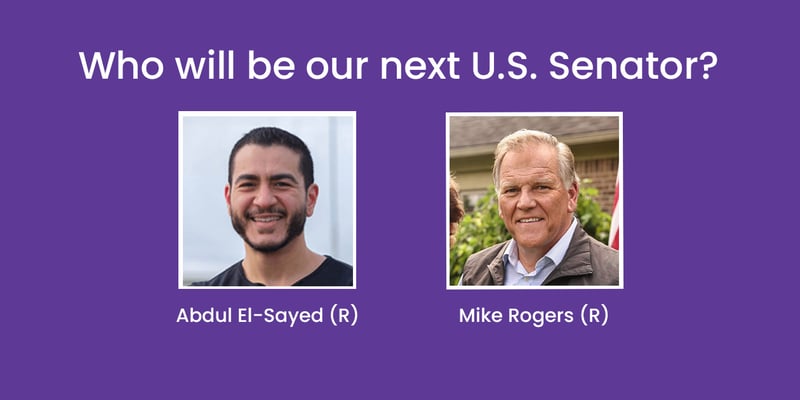
Michigan is about to choose its next U.S. Senator. Gary Peters has represented Michigan in the U.S. Senate since 2015. He's not running in 2026, and the race to replace him is shaping up to be one of the most competitive Senate contests in the country.
What started as a crowded field of 10 declared candidates across parties — including a competitive three-way Democratic primary between Haley Stevens, Mallory McMorrow, and Abdul El-Sayed — narrowed to two nominees for November. El-Sayed narrowly defeated Stevens in a tight Democratic primary (48.5% to 47.5%, with McMorrow having suspended her campaign in July), while Mike Rogers secured the Republican nomination unopposed. El-Sayed and Rogers will face off in the November 3rd general election.
Key Date
- General Election: November 3, 2026
The Shifting Field of Candidates
The 2026 U.S. Senate race started with 10 candidates across four categories — three Democrats (Haley Stevens, Abdul El-Sayed, and Mallory McMorrow), three Republicans (Mike Rogers, Genevieve Peters Scott, and Frederick Heurtebise), one independent (Valerie Lee Willis), one No Party Affiliation candidate (T.J. Stephens), plus two additional Democrats, Joseph Tate and Rachel Howard, who withdrew early and were never factors in the race.
McMorrow suspended her campaign on July 5, citing an inability to break through in a field that had consolidated around her two rivals; because Michigan's primary ballots were already printed, her name still appeared on the August 4 ballot, but votes cast for her didn't count toward the nomination. That left Stevens and El-Sayed as the two active Democratic candidates, and Mike Rogers unopposed on the Republican side.
Michigan voters selected their nominees in the August 4 primary: Abdul El-Sayed narrowly defeated Stevens (48.5% to 47.5%, per unofficial results with 99% of precincts reporting) to win the Democratic nomination. Rogers secured the Republican nomination unopposed. El-Sayed and Rogers will face off in the November 3 general election.
Democratic Primary Results
Abdul El-Sayed narrowly won the Democratic nomination over Rep. Haley Stevens, in one of the closest primaries in the country this cycle. The Associated Press called the race for El-Sayed at 9:54 a.m. Wednesday — nearly 14 hours after polls closed — with El-Sayed leading Stevens by roughly one point, 48.5% to 47.5%, once 99% of votes were counted. Mallory McMorrow, who had suspended her campaign in July, still received 4% of the vote.
The Data
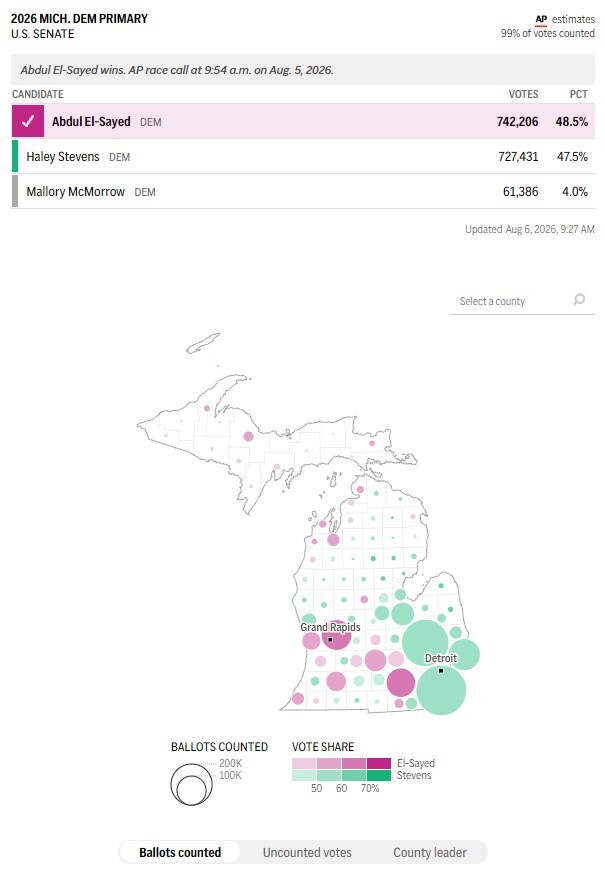
Source: MLive, Michigan U.S. Senate Primary Election Results
El-Sayed's Victory Speech
Watch El-Sayed's victory speech | Download the Transcript
Top priorities he names
- Getting money out of politics / campaign finance reform ("get money out of politics, put money back in pockets")
- Medicare for All — explicitly named as the capstone policy goal, tied to Bernie Sanders' influence
- Affordability (groceries, housing, healthcare costs)
- Collective bargaining rights / union support (heavy UAW, AFT, National Nurses United shoutouts)
- Frames the race as a fight against corporate and special-interest control of democracy generally, more than a specific policy checklist
Tone
Movement/populist-narrative heavy rather than family-anecdote heavy — leans into his own immigrant story (father emigrated from Egypt to Detroit, went to Wayne State), his medical/public health background (uses a doctor-patient "sharing pain" metaphor for campaigning), and a "brick by brick" grassroots-movement framing (12,000 volunteers, "we shook up the world"). Notably conciliatory toward his primary rivals — genuinely warm toward both McMorrow and Stevens, explicitly wishing Stevens well and calling her "one of the most committed public servants." Includes a distinct, direct appeal to Jewish American voters addressing AIPAC's role in the race.
Contrast/attack lines
- Attacks are sharply Rogers-specific — extensive personal/character attacks: calls him a "corporate sellout," accuses him of taking "corporate check after corporate check," mocks him for moving to Florida after leaving Congress, calls him "the worst of all versions of the Republican Party," and needles him for reportedly opposing Trump before later seeking his endorsement
- Cites a specific policy attack that Rogers "introduced legislation to increase the flow of opioids." This refers to real legislation — Rogers sponsored the National Pain Care Policy Act (H.R. 1863, 108th Congress, 2003), and reintroduced or co-sponsored later versions through 2005 and beyond. Confirmed independently (Bridge Michigan, Congress.gov, GovTrack): the bills did not include penalties for over-prescribing, and Rogers received at least $310,000 in related campaign contributions per an AP/Center for Public Integrity investigation. The one Rogers-linked pain bill that actually became law was the Veterans Pain Care Act of 2008 — sponsored by Democrat Tim Walz, with Rogers as a supporter rather than the lead sponsor. Rogers has said his motivation was chronic-pain relief, citing his brother's medical history.
- Publicly challenges Rogers to five debates, directly and repeatedly, within the speech itself
- Names DTE and Blue Cross Blue Shield as corporate powers he says influence Rogers
- Trump appears mostly as a secondary target ("lick every boot Donald Trump owns"), subordinate to the Rogers-specific attacks
Closing/mobilization ask
Less conventional GOTV-listing — instead frames November as a continuation of "the movement," explicitly inviting both 2024 Harris voters and 2024 Trump voters into the coalition regardless of past votes. The debate challenge to Rogers effectively serves as his closing "ask" alongside the movement-building framing.
Republican Primary Results
Mike Rogers secured the Republican nomination for U.S. Senate unopposed, having faced no primary challenge.
Mike Rogers' Post-Primary Remarks
Watch Mike Rogers's remarks | Download the Transcript
Top priorities he names
- Manufacturing jobs — blames "two Democrat senators" over "a quarter century" for the loss of 200,000 Michigan manufacturing jobs
- Education reform — cites Michigan's low fourth-grade reading rates ("almost two-thirds... cannot read at the fourth grade level"), calls for phones out of schools, shop classes restored, framed as "the civil rights issue of our lifetime"
- Cost of living — highest utility rates in the Midwest, highest auto insurance rates in the nation
- Housing — tax-free savings for down payments, deregulation to spur homeownership
- Frames the race as a generic "change election" for Michigan rather than a referendum on Trump specifically
Tone
Rally/unity-event register rather than solo victory-speech narrative — delivered alongside other GOP candidates (references to his wife Kristi Rogers and gubernatorial nominee John James) at a post-primary unity gathering, with GOTV metrics cited (1.1 million doors knocked). Personal narrative centers on his father, a shop teacher who raised five sons and built their house, framed as a working-class "American dream" story. Includes campaign-trail camaraderie humor (an Army-vs-Marines ribbing with Mike Cox).
Contrast/attack lines
- Most of Rogers' criticism here is aimed generically at "Democrats" and the status quo, not El-Sayed by name — with one major exception below
- Rogers said he never expected to run against someone who "believed that America deserved 9/11," calling El-Sayed an "anti-American 9/11 America's fault candidate." This traces to remarks made by Hasan Piker, a political commentator who campaigned alongside El-Sayed during the primary — not to any statement by El-Sayed himself. El-Sayed has said on the record that he does not believe 9/11 was justified.
- Cites Michigan's education and economic rankings as evidence against "Democrat" leadership broadly, not tied to El-Sayed's specific record
Closing/mobilization ask
Conventional GOTV framing — cites door-knocking totals (1.1 million), frames November as a "state to save," and closes with a direct call to action ("let's get out there, Michigan, and get to work").
Who's Ahead in the General Election?
Polling on the general election matchup has been close since head-to-head surveys began in May. According to RealClearPolling's average of five polls conducted between May 20 and July 31, Rogers leads El-Sayed by less than half a percentage point — 44.3% to 44.0% — well within any reasonable margin of error.
Individual polls have shown slight leads for each candidate: Rogers led by 3 points in an EPIC-MRA poll (July 24–31) and was tied with El-Sayed in a MIRS/Mitchell Research poll (July 28–29), while El-Sayed held narrow 1-point edges in both a Quantus Insights poll (June 29–30) and an earlier TIPP poll (May 20–23).
Cook Political Report rates the race a toss-up. Michigan narrowly favored Trump in the 2024 presidential race (by roughly 1.4 percentage points), making this one of the most closely watched Senate contests in the country as both parties look to flip or defend the seat in November.
Top Issues Shaping the Race
The following priorities reflect what each candidate emphasized in their post-primary remarks, not a full survey of their campaign platforms. Note: the available transcript of Rogers' remarks begins well into a longer unity event, so some topics he may have addressed earlier in the event are not captured here.
| Issue | El-Sayed | Rogers | Shared? |
|---|---|---|---|
| Cost of living / affordability | Frames broadly, tied to political corruption: "get money out of politics, put money back in your pocket." No specific cost figures cited. | Cites specific comparative stats — highest utility rates in the Midwest, highest auto insurance rates in the nation — and blames Democratic senators directly. | ✅ Shared topic, very different frame — El-Sayed: structural/corruption cause; Rogers: comparative-stats, blame-the-incumbent-party cause |
| Housing | Mentioned briefly as part of a general affordability list (groceries, housing, healthcare costs) — no specific mechanism named. | Explicit mechanism: tax-free savings accounts for down payments, paired with deregulation to spur new homeownership. | ✅ Shared but lopsided — Rogers gives it a dedicated policy mechanism; El-Sayed only references it in passing |
| Money in politics / corporate influence | Central, recurring theme — attacks Rogers by name for taking corporate donations, names DTE and Blue Cross Blue Shield specifically as corporate powers he says influence Rogers. | Not raised in this excerpt. | El-Sayed only |
| Healthcare | Central policy commitment: Medicare for All. | Not raised in this excerpt. | El-Sayed only |
| Manufacturing / jobs | Not raised as a distinct theme. | Central, repeated theme — cites 200,000 lost Michigan manufacturing jobs, invokes the state's WWII "arsenal of democracy" history, calls for restoring "defense industrial-based work." | Rogers only |
| Education | Not raised in this excerpt. | Central, repeated theme — cites Michigan's low 4th-grade reading rates, calls for removing phones from schools and restoring shop class, frames it as "the civil rights issue of our lifetime." | Rogers only |
| Collective bargaining / labor unions | Explicit — names UAW, AFT, and National Nurses United as sources of support. | Not raised in this excerpt. | El-Sayed only |
| Coalition-building / unity | Explicitly invites both 2024 Harris voters and 2024 Trump voters into his coalition — framed as ideological bridge-building. | Delivered at a formal multi-candidate "unity" event; cites door-knocking totals (1.1 million) as evidence of grassroots enthusiasm. | Both address unity, but from very different structural contexts — El-Sayed's is rhetorical; Rogers' is literal event framing |
A few notable exceptions: Neither candidate addressed data centers — one of the most contested issues raised repeatedly in debates this cycle — in these particular remarks. Despite AIPAC spending and Israel/Gaza policy dominating much of the primary, neither speech laid out a forward-looking foreign policy plank; El-Sayed's remarks touched on the topic only through a direct appeal to Jewish American voters, not a policy statement. Reproductive rights, a significant national issue, did not come up in either Senate candidate's remarks here.
Looking for our full primary debate coverage and the official-campaign-website issue comparison? That in-depth breakdown has moved to its own companion piece.
In the News
The race is moving quickly. Below is a curated collection of recent coverage from local and national outlets — endorsements, fact-checks, candidate interviews, and more. We don't pick sides; we just pull the sources together so you can read for yourself.
Meet the Candidates
Abdul El-Sayed (D) — Democratic Nominee
 |
|
Top Priorities
The priorities below are drawn from the candidate's official campaign website and reflect the issues the campaign specifically chose to emphasize.
- Campaign Finance: Supports overturning Citizens United, banning outside spending through Super PACs and 501(c)4s, and public election funding with spending caps.
- Gerrymandering: Wants congressional districts drawn by a federal nonpartisan committee modeled on the Federal Reserve Board, appointed on rolling terms.
- Supreme Court Reform: Supports ending lifetime appointments, imposing term limits, and equal appointments per presidential term.
- The Filibuster: Believes the filibuster is antidemocratic and supports abolishing it.
- Voting Access: Opposes voter ID laws like the SAVE Act; supports automatic voter registration, holiday election days, and no-reason absentee and early voting.
- Civil Rights & Liberties: Supports protecting healthcare decision privacy and freedom of speech and protest; opposes government interference in personal healthcare choices.
- Immigration: Supports abolishing ICE and replacing it with a new enforcement structure, and repurposing its funding toward legal-pathway infrastructure.
- Environment & Natural Resources: Supports codifying the EPA's Endangerment Finding, strengthening air quality and NEPA standards, and shutting down Line 5.
- Water: Supports a federal water guarantee (50 gallons per person per day, bills capped at 2% of household income), accelerated lead pipe removal by 2030, and PFAS polluter accountability.
- Foreign Policy: Opposes the war with Iran and blank-check military aid to foreign governments including Israel; supports an arms embargo on Israel and reinvestment in foreign aid including UNRWA.
- Jobs & Trade: Supports targeted, sunset-clause tariffs paired with union input, and stronger FTC anti-monopoly enforcement.
- Taxing Billionaire Wealth: Supports taxing capital gains and inheritance over $1 million as ordinary income, a billionaire wealth tax, and closing the Social Security payroll tax cap.
- Artificial Intelligence: Supports federal AI safety guardrails and an independent AI enforcement agency; opposes AI overriding doctors' healthcare decisions.
- Data Centers: Supports federal zoning guidelines and a "Terms of Engagement" framework for data centers.
- Housing & Homelessness: Supports a building boom, banning corporate ownership of single-family homes, banning algorithmic rent-fixing software, and a federal renter's bill of rights.
- Education: Supports universal pre-K, debt-free public higher education, a $60,000 teacher salary floor, and full IDEA funding.
- Farming: Supports capping farm subsidies at $250,000 per year, redirecting savings to family farmers, targeted (not blanket) tariffs on specialty crops, and H-2A guest worker reform.
- Healthcare (Medicare for All): Supports expanding Medicare to cover every American from birth, including dental, vision, and hearing, without premiums or deductibles; opposes Medicaid and ACA subsidy cuts from the reconciliation bill.
- Veterans Affairs: Supports expanding VA services, housing, jobs, and education access for veterans.
- Breaking Up Big Healthcare: Supports FTC power to review and break up hospital-merger monopolies; backs the Break Up Big Medicine Act.
- Prescription Drugs: Supports expanding Medicare drug price negotiation to all drugs and all patients, public manufacturing of essential medications, and ending pharmacy benefit managers.
- Public Health: Supports fixed-term, Senate-confirmed appointments for CDC, FDA, and NIH leadership, insulated from political turnover.
- Healthcare Freedom for Women & LGBTQ+ Americans: Supports codifying Roe v. Wade protections federally and opposes criminalizing reproductive or gender-affirming care.
Endorsements
- Endorsed by U.S. Senator Bernie Sanders and Rep. Alexandria Ocasio-Cortez, both actively campaigning alongside El-Sayed at rallies in Detroit (July 18) and Lansing (July 19), also featuring Rep. Rashida Tlaib. Also endorsed by Rep. Ilhan Omar, Rep. Pramila Jayapal, Rep. Ro Khanna, Sen. Chris Van Hollen, U.S. Sen. Tina Smith (D-MN), Rep. Adelita Grijalva (D-AZ), and State Rep. Reggie Miller (D-Van Buren Township), and other Michigan state representatives; labor endorsements include the UAW, National Nurses United, and AFT Michigan; Working Families Party, MoveOn, and Indivisible (national and Michigan branches) have also endorsed. See his full endorsements page for the complete list.
- On July 22, 314 Action — a national group that recruits and elects candidates with backgrounds in science and medicine — endorsed El-Sayed. The group has previously drawn scrutiny for accepting $1 million during the 2024 cycle from a PAC affiliated with AIPAC; it says it has not taken AIPAC-linked money this cycle and does not take foreign-policy positions for its endorsed candidates.
- Has pledged to refuse corporate PAC money and AIPAC support; running explicitly as an outsider candidate funded by individual donors
Career
- Physician and epidemiologist who served as Executive Director of the Detroit Health Department (2015–2017), one of the youngest big-city health directors in the country; ran for Michigan governor in 2018, losing in the primary to Gretchen Whitmer; served as Wayne County Health Director (2023–2025)
- Since leaving public office, built Incision Media, a political podcast and production company; remains active in progressive politics and media
Personal
- Born in Ann Arbor to Egyptian immigrant parents; earned his medical degree from Columbia and a doctorate in public health from Oxford as a Rhodes Scholar
- Muslim and has spoken openly about his faith throughout his political career; lives in Ann Arbor with his wife and daughter
Mike Rogers (R) — Republican Nominee
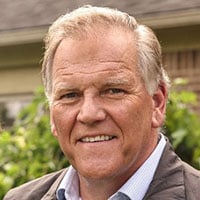 |
|
Top Priorities
The priorities below are drawn from the candidate's official campaign website and reflect the issues the campaign specifically chose to emphasize.
- Housing: Supports expanding 529 education savings plans to also cover first-time home down payments, with tax-free contributions allowed at any time for any purpose, and 529 funds counting toward a home's first year of property taxes without affecting PMI eligibility. Supports letting renters build credit through on-time rent payments to lower future mortgage rates, and letting buyers defer student loans while saving for a down payment through a matching-contribution structure. Supports rolling back federal and state housing regulations he says have driven up costs, and creating tax-free "residential housing zones" to incentivize new home construction.
Endorsements
- Endorsed by President Trump, Senate Majority Leader John Thune, NRSC Chairman Tim Scott, U.S. Senators Tom Cotton, Roger Wicker, Steve Daines, John Barrasso, Bernie Moreno, and Cynthia Lummis; Michigan Congressmen Jack Bergman and Tim Walberg and Congresswoman Lisa McClain; State Senator Rick Outman and State Representatives Phil Green, Tom Kuhn, Matt Maddock, David Martin, Luke Meerman, Jamie Thompson, and Curt VanderWall; several county sheriffs; the Michigan Farm Bureau, the Police Officers Association of Michigan, Associated Builders and Contractors, the Southeast Michigan Chamber of Commerce, and "Auto Workers for Trump."
- Sentinel Action Fund and its 501(c)4, Right Vote, announced a $15+ million investment in Rogers' campaign in March, covering advertising, voter outreach, and early-vote operations, alongside a voter resource site (MI.VOTE).
Career
- Former FBI special agent and 14-year U.S. Representative (2001–2015); chaired the House Intelligence Committee, becoming one of Congress's most prominent national security voices in the post-9/11 era
- Narrowly lost to Elissa Slotkin in the 2024 Senate race; running again in 2026 with major outside money behind him, including a $45 million commitment from the Senate Leadership Fund
Personal
- Michigan native; attended Adrian College, played football, then served in the U.S. Army before joining the FBI
- Lives in Genoa Township, Livingston County, with his wife Kristi Rogers
How the Money is Flowing: Campaign Finance Overview
How Much Have the Candidates Raised?
Fundraising is often an indicator of organizational strength and voter enthusiasm. Since the second-quarter reports came in, the money race has shifted: El-Sayed's campaign outraised Stevens more than 2-to-1 this quarter, while Stevens remained far ahead on outside spending during the primary. Rogers faced no primary opposition and held the largest campaign war chest of any candidate through the primary.
The 'Q2 Raised' column reflects the second-quarter 2026 filing period (April–June). Cash-on-hand figures are cumulative cycle-to-date totals as reported to the FEC as of July 15, 2026.
| Candidate | Party | Q2 Raised | Cash on Hand (as of 7/15/26) |
|---|---|---|---|
| Abdul El-Sayed | Democrat | $4,570,000 | $2,552,762 |
| Mike Rogers | Republican | $2,900,000 | $4,473,237 |
| Haley Stevens | Democrat | $2,100,000 | $2,793,294 |
Mallory McMorrow raised approximately $2.7 million in the second quarter before suspending her campaign on July 5; her campaign reported $1.87 million cash on hand as of mid-July, after wind-down expenses.
Source: Federal Election Commission (fec.gov), via FEC quarterly filings reported by Bridge Michigan and The Detroit News. Newly filed summary data may not appear for up to 48 hours.
Outside Spending
Outside spending refers to money spent by Super PACs, party committees, and other independent groups to support or oppose candidates — separate from the candidates' own campaigns. Unlike direct contributions, outside spending has no legal limit. For a plain-language explanation of how PACs work and why they matter, read our guide: The Impact of Political Committees (PACs) in Elections.
Based on confirmed spending figures below, outside spending during the primary totaled roughly $55 million combined across all candidates — more than double what the two Democratic campaigns raised on their own. El-Sayed's campaign separately estimated total spending backing Stevens at closer to $50 million, once ad reservations not reflected in FEC filings are included; that higher figure was not independently confirmed.
Here's what was known about outside spending in the primary as of mid-July 2026:
- AIPAC's United Democracy Project spent nearly $15 million on the race — $9.3 million supporting Stevens and $5.7 million opposing El-Sayed. The Democratic Majority for Israel (DMFI) PAC also backed her. AIPAC spent heavily in Stevens' 2022 primary victory. By mid-to-late July, AIPAC-affiliated spending overall (United Democracy Project and DMFI combined) had grown to nearly $30 million — the largest single-race investment in AIPAC's history.
- A second pro-Stevens PAC, A Stronger Michigan, formed in June, spent over $12 million; it did not disclose its donors.
- The Democratic Senatorial Campaign Committee (DSCC), which works to elect Democrats to the U.S. Senate, privately backed Stevens but did not make major public expenditures during the primary.
- On the Republican side, the Senate Leadership Fund committed $45 million to Rogers' campaign, and Sentinel Action Fund and its 501(c)4, Right Vote, announced a separate $15+ million investment in March covering advertising, voter outreach, and early-vote operations. Combined outside spending deployed on Rogers' behalf through the primary totaled about $10.9 million, with the bulk of committed funds expected to be spent closer to November.
- By contrast, only about $2.6 million in outside spending supported El-Sayed through the primary.
- Michigan is considered one of the most competitive Senate seats in the country in 2026, which is why it attracted this level of outside spending from national groups on all sides.
This section will be updated as general-election outside spending data becomes available. You can track outside spending in real time at OpenSecrets.org and FEC.gov.
What Happens After Election Day?
After the election is certified, the senator-elect begins preparing to take office — hiring staff, setting up a Washington office and Michigan field offices, and going through new-member orientation alongside every other incoming senator. Unlike the Governor's office, there's no cabinet to assemble or executive agencies to staff; the transition is mostly about building a personal office and requesting committee assignments.
Michigan's new U.S. Senator is sworn into office at noon on January 3, 2027, when the 120th Congress convenes. The senator serves a six-year term with no term limits under the U.S. Constitution, and would next be up for reelection in 2032.
A new senator can begin shaping their impact immediately by requesting seats on key committees, hiring senior staff, and setting legislative priorities — but unlike executive appointments, a senator's influence builds over time. Committee assignments, subcommittee chairs, and leadership positions are typically won through seniority and party support, not granted on day one. That's part of why experience and relationship-building matter so much in this role.
Learn more:
- U.S. Constitution, Article I (Legislative Branch): https://constitution.congress.gov/constitution/article-1/
- U.S. Senate: https://www.senate.gov
Who Are the Michigan U.S. Senators Now?
Gary Peters (D) — Not Seeking Re-Election in 2026
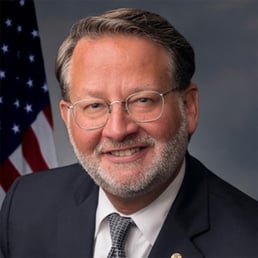 |
|
Gary's Path to the Senate
- 1995–2002: Michigan State Senate — Michigan's 14th District
- 2003–2008: Commissioner of the Michigan Lottery
- 2009–2013: U.S. House of Representatives — Michigan's 9th District
- 2013–2015: U.S. House of Representatives — Michigan's 14th District
- 2015–present: U.S. Senate, seat vacated by Carl Levin (D)
Elissa Slotkin (D) — Not Up for Re-Election in 2026
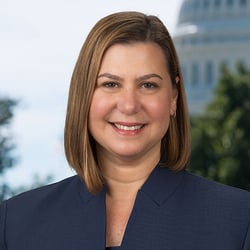 |
|
Path to the Senate
- Former CIA analyst who served three tours in Iraq alongside the U.S. military
- Worked in national security roles at the Pentagon and White House under Presidents Bush and Obama
- 2019–2023: U.S. House of Representatives — Michigan's 8th District
- 2023–2025: U.S. House of Representatives — Michigan's 7th District
- 2025–present: U.S. Senate, seat vacated by Debbie Stabenow
How Long is the Term and Term Limits
- Term: 6 Years
- Term Limits: None
- Next Election:
- November 2026 for Gary Peters
- November 2030 for Elissa Slotkin
What Do U.S. Senators Do?
Michigan's U.S. Senators represent the entire state in Washington — not a single district, not a region, but all 10 million Michigan residents. The Senate is one of two chambers of Congress, and while it shares lawmaking power with the House of Representatives, it has several unique responsibilities that make it one of the most powerful bodies in American government.
Quick Facts
- 2 senators per state, 100 total
- One-third of the body is elected every two years
- $174,000 + benefits
- Meets in the U.S. Capitol building in Washington, DC
What U.S. Senators Can Do
Make laws
Any U.S. citizen can propose a law, but only members of Congress can formally introduce legislation. In the Senate, a bill is assigned to a subcommittee, then a full committee, before being reported to the Senate floor. The majority party leadership decides when — and whether — a bill gets a vote. This process means that a Senator's relationships, party standing, and legislative priorities matter enormously in determining what actually becomes law.
Declare war
The Constitution gives Congress the power to formally declare war, with both the House and Senate participating — not the President. While modern military actions have often relied on other authorizations, this remains one of the Senate's most consequential responsibilities and a check on executive power.
Control the federal budget
The Senate raises and appropriates public money and oversees how it's spent. Every federal dollar that flows into Michigan — for roads, schools, healthcare, housing, and more — is authorized through the congressional budget process. Senators who sit on key appropriations committees have significant influence over how those funds are allocated.
Confirm presidential appointments
The Senate has the sole authority to confirm — or reject — the President's nominees for federal judges, Cabinet members, ambassadors, and other senior positions. This includes lifetime appointments to the U.S. Supreme Court, making Senate votes on nominations some of the most consequential in American political life.
Ratify treaties
Any international agreement negotiated by the executive branch requires a two-thirds Senate vote to become binding law. This gives the Senate a direct role in shaping U.S. foreign policy and international relationships.
Conduct impeachment trials
When the House votes to impeach a federal official — including the President — the Senate serves as the jury. Senators hear the case, deliberate, and vote on whether to convict and remove the official from office. It is one of the Senate's most solemn constitutional duties.
Provide oversight and conduct investigations
Senate committees have broad authority to investigate the executive branch, hold hearings, subpoena witnesses, and shine a public light on how federal agencies and programs are operating. This oversight function is a critical check on executive power — and a platform for Michigan's senators to elevate issues affecting the state.
The U.S. Senate seat is one of only two Michigan holds in the upper chamber of Congress. Whoever fills it will cast votes on issues that range from the price of prescription drugs to the future of the auto industry to the makeup of the federal courts — for a six-year term with no term limits.
What U.S. Senators Cannot Do
While the U.S. Senate is one of the most powerful bodies in American government, the office operates within limits established by the U.S. Constitution and the structure of Congress itself. Many powers that feel like they belong to a single Senator actually require the House, the President, or the courts to act as well.
Pass laws alone
A Senator can introduce and vote for a bill, but a bill only becomes law if it also passes the Senate and the House and is signed by the President — or if two-thirds of both chambers vote to override a veto.
Appoint federal judges or officials
The Senate confirms or rejects the President's nominees for federal judges, Cabinet members, and other senior positions. It does not choose who gets nominated in the first place — that power belongs to the President.
Declare war unilaterally
The Constitution gives Congress — the House and Senate together — the power to declare war, not the Senate alone. In practice, modern military engagements have often happened without a formal declaration of war at all, which limits how much this power gets used either way.
Negotiate treaties
Treaties are negotiated by the executive branch. The Senate's role is to ratify or reject what's brought to it, with a two-thirds vote required — not to negotiate the terms itself.
Remove a federal official without the House impeaching first
The Senate conducts impeachment trials and can convict and remove an official from office, but only after the House has voted to impeach. The Senate cannot initiate the process on its own.
Enforce its own subpoenas
Senate committees can subpoena witnesses and documents as part of an investigation, but if someone refuses to comply, enforcing that subpoena typically requires the courts to get involved.
Set or override Michigan state law
A U.S. Senator represents Michigan's interests in federal policy, but state law is made and changed by the Michigan Legislature and Governor. A Senator has no authority over state-level laws or policy.
Control how state or local governments operate
Cities, counties, school boards, and the state government all have their own elected officials and authority. Federal officeholders, including Senators, don't manage their day-to-day operations.
Pass most major legislation with a simple majority
Most bills need 60 votes to end debate and come to a final vote, not a simple majority of 51. This filibuster threshold means one party rarely has enough votes in the Senate to act alone, regardless of how many seats it holds.
What Has the Senate Been Doing?
How Much Legislation Actually Passes
By the numbers — 2025 (full year):
- 3,562 bills introduced in the Senate
- 24 became law
- That's less than 1%
By the numbers — 2026 (January–March):
- 698 bills introduced in the Senate
- 5 became law
- Still less than 1%
In 2025, the Senate introduced 3,562 bills. Twenty-four became law. That means for every 100 bills a senator introduces, fewer than one actually makes it through. 2026 is on the same track.
Not every bill is a major policy overhaul. Some commemorate a national awareness week. Others amend a single line of existing law or reauthorize a program that's been around for decades. They all come in the same way — numbered in sequence, referred to a committee, and then most of them wait — sometimes forever.
Why do so few pass? A bill has to clear a lot of hurdles — committee approval, a floor vote, the House, and the President's signature. And in the Senate, any senator can hold up a vote indefinitely through a procedural move called a filibuster. To override it, you need 60 votes — not just a simple majority of 51.
This is why experience matters when you're choosing a senator. Anyone can introduce a bill. Moving one all the way to becoming law takes relationships, strategy, and political muscle. When candidates tell you what they'll fight for, it's fair to ask: do they know how to actually get it done?
What Stands Out
Beyond the numbers, a few things stand out from the 119th Congress so far — a mix of major legislation that's already law, and fights that are still playing out:
- The budget reconciliation bill (the "One Big Beautiful Bill") is the single biggest piece of legislation this Congress has passed — permanent tax cuts paired with Medicaid and SNAP cuts that directly affect millions of Michigan households.
- Tariffs have been decided by the courts more than by Congress — the Supreme Court struck down the administration's sweeping IEEPA tariffs in February, a major reversal for an auto-dependent state like Michigan.
- The SAVE Act, which would require proof of citizenship to register to vote, remains one of the most contested pieces of election legislation pending in the Senate — read our full SAVE Act explainer.
- The new farm bill passed the House in April and is now before the Senate, where Michigan's Sen. Slotkin sits on the relevant subcommittee — a direct opportunity to shape legislation covering everything from crop insurance to SNAP.
- War powers votes on Iran have failed narrowly, repeatedly, in both chambers — an unresolved constitutional fight over who has the authority to authorize military action.
Every issue above — and dozens more, sorted by category with bill numbers, vote counts, and Michigan-specific impact — is tracked in a companion piece to this guide: 119th Congress Legislation Tracker: What's Passed, What's Pending, and What It Means for Michigan. It's a bill-by-bill breakdown of what the current Senate has actually done, updated as new Congressional Record Daily Digest data becomes available, so you can see the full record before deciding who you want representing Michigan in the next one.
How the U.S. Senate Works
The U.S. Senate is one of two chambers of Congress. It has 100 members — two per state — and operates under a set of rules and leadership structures that shape what gets done, what gets blocked, and how Michigan's senators can make an impact.
Leadership
The Senate is led by the Majority Leader, who controls the floor schedule and decides what legislation gets a vote. The Minority Leader heads the opposing party. Leadership also includes party whips, who help count votes and keep members aligned. The Vice President of the United States serves as President of the Senate and can cast a tie-breaking vote, but otherwise has a limited role in day-to-day operations.
| Majority Leader | Minority Leader |
|---|---|
|
|
|
View the full U.S. Senate Leadership Roster >> www.senate.gov/senators/leadership.htm
Committees
Most of the Senate's real work happens in committees — smaller groups of senators who draft, debate, and advance legislation in specific policy areas before it ever reaches a full Senate vote. There are 16 standing committees in the current Senate, covering everything from agriculture to armed services to the judiciary.
Each committee has a chair (currently held by the majority party, Republicans) who sets the agenda and decides which bills get hearings. Getting a seat on a powerful committee — especially Appropriations, which controls federal funding — is one of the most effective ways a senator can deliver for their state.
View all the U.S. Senate Committees >> https://www.senate.gov/committees
Michigan's current senators sit on committees that directly affect the state:
Gary Peters (D)
Not seeking re-election in 2026
- Appropriations
- Armed Services
- Commerce, Science, and Transportation
- Homeland Security and Governmental Affairs
Elissa Slotkin (D)
Up for re-election in 2030
- Agriculture, Nutrition, and Forestry
- Armed Services
- Homeland Security and Governmental Affairs
- Veterans' Affairs
Subcommittees
Most committees are further divided into subcommittees focused on specific topics. For example, the Armed Services Committee has subcommittees on Cybersecurity, Personnel, Strategic Forces, and more. Slotkin sits on the Airland, Cybersecurity, and Emerging Threats subcommittees — areas directly relevant to Michigan's defense manufacturing sector.
Caucuses and Commissions
Beyond formal committees, senators participate in informal caucuses — voluntary groups organized around shared interests, like the Senate Auto Caucus (important for Michigan), the Rural Caucus, or the Bipartisan Senate Ukraine Caucus. These groups don't have legislative power, but they shape priorities, coordinate messaging, and build coalitions across party lines.
The 60-Vote Rule
One of the most important things to understand about the Senate is that most major legislation requires 60 votes to move forward — not a simple majority of 51. This threshold, known as cloture, is what's needed to end debate and force a vote. With 53 Republicans and 47 Democrats/Independents in the current Senate, significant legislation almost always requires some bipartisan support. It's why the ability to negotiate and build coalitions matters so much in a Senate race.
How a Bill Becomes a Law
- A senator introduces a bill, which is assigned to the relevant committee
- The committee holds hearings, debates, and votes on whether to advance it
- If it passes committee, Senate leadership decides whether to bring it to the floor
- The full Senate debates and votes — 60 votes to end debate, 51 to pass
- If it passes, it goes to the House, where the process repeats
- If both chambers pass identical versions, it goes to the President to sign or veto
- A presidential veto can be overridden by a two-thirds vote in both chambers
What to Look for in a U.S. Senator
Once you understand what a U.S. Senator does, the next question is: what kind of experience and leadership help someone do the job well? The Senate handles some of the most consequential decisions in American government — from confirming Supreme Court justices to ratifying international treaties to controlling the federal budget. The role requires a combination of policy depth, strategic thinking, and the ability to represent an entire state, not just a single district or constituency.
For a deeper look at what makes an effective legislator, read our guide: What It Takes to Be an Effective Legislator.
Legislative experience and process knowledge
The Senate is a complex institution with its own rules, procedures, and political dynamics. A candidate who understands how legislation actually moves — through committee, onto the floor, and into law — is better positioned to be effective from day one. Experience working within legislative bodies, whether at the state or federal level, is worth examining closely.
Policy depth across a wide range of issues
U.S. Senators vote on everything — defense, healthcare, trade, immigration, environmental policy, technology regulation, and more. A strong candidate can speak specifically and substantively about policy, not just in general terms. Voters should look for candidates who demonstrate real understanding of the issues, including tradeoffs, not just talking points.
Budget and fiscal understanding
Every federal dollar that flows into Michigan passes through the congressional appropriations process. A Senator who understands federal budgeting — how revenue, spending, and federal-state funding relationships work — is better equipped to fight for Michigan's priorities when resources are tight and competing interests are loud.
National security and foreign policy awareness
The Senate has unique authority over treaties, military authorizations, and presidential appointments that shape U.S. foreign policy. Michigan's economy is deeply tied to international trade, particularly with Canada and global auto markets. A candidate's fluency in these areas — and their understanding of how federal decisions affect Michigan specifically — matters.
Collaboration and negotiation
The Senate requires 60 votes to advance most major legislation, which means effective senators must be able to work across party lines. The ability to build coalitions, find common ground, and move things forward without abandoning core commitments is a practical skill — not just a campaign message.
Constituent connection
Michigan is a large, economically and geographically diverse state — from the UP to Detroit, from rural farming communities to major research universities. A strong candidate understands that diversity and can represent the full range of Michigan residents, not just the ones who voted for them.
Communication and transparency
Senators cast votes that affect millions of people, often on issues that are highly technical or politically charged. The ability to explain those votes clearly, honestly, and in plain language — and to stay accountable to constituents between elections — is part of the job. How a candidate communicates during the campaign often reflects how they'll communicate from Washington.
Integrity and public trust
A U.S. Senator holds significant power over federal appointments, legislation, and public resources. A candidate's personal and professional track record — how they've handled mistakes, how they've treated the public trust, and whether their record matches their rhetoric — deserves serious scrutiny. Voters are essentially hiring someone to represent Michigan's interests in one of the most powerful legislative bodies in the world.
Lost or Dropped Out Candidates
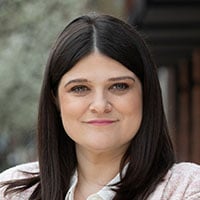
Haley Stevens (D)
Lost the August 4, 2026 primary.
 |
|
Top Priorities
The priorities below are drawn from the candidate's official campaign website and reflect the issues the campaign specifically chose to emphasize.
- Equitable Federal Investment: Ensure federal resources and infrastructure investments are delivered equitably to underserved Michigan communities to strengthen public services, transit, and economic opportunity.
- Economic Empowerment and Access: Expand access to capital and training for underserved communities and advance an industrial policy that creates jobs, lowers costs, and strengthens Michigan's economic future.
- Safer Communities: Advance fair and accountable policing, invest in community-based violence prevention, and strengthen commonsense gun safety laws.
- Health and Family Stability: Lower health care costs, advance health equity, protect science-based care, and defend Social Security, Medicare, and Medicaid.
- Education, Innovation, and STEM Workforce Future: Ensure Michigan leads 21st-century manufacturing and innovation by investing in education, STEM and job-training pipelines, and policies that strengthen the supply chain.
- Water and Infrastructure: Prioritize safe, clean drinking water, invest in lead pipe replacement, and fight contamination like PFAS, especially in communities most affected by environmental injustice.
- Lowering Housing Costs: Increase housing supply, support low-income families, seniors, and people with disabilities, and strengthen pathways to the middle class.
- Has described herself as a "proud pro-Israel Democrat;" backed by AIPAC and the Democratic Majority for Israel (DMFI) PAC; was booed at the 2026 Michigan Democratic Party Convention over her stance on Israel
Endorsements
- Endorsed by Gov. Gretchen Whitmer (July 24), retiring U.S. Senator Gary Peters — the senator whose seat she's seeking to fill — along with former House Speaker Nancy Pelosi, former U.S. Senator Debbie Stabenow, former Michigan Governor and U.S. Energy Secretary Jennifer Granholm, U.S. Senator Chris Coons (DE), and the Michigan Democratic Party Black Caucus; receives reported support from Senate Democratic leadership including Chuck Schumer and the DSCC. EMILYs List endorsed on July 6. State-level endorsers include Michigan Attorney General Dana Nessel, State Sens. Paul Wojno and Dayna Polehanki, and State Rep. Jennifer Conlin. Labor endorsements include Boilermakers Local 169, UNITE Here Local 24, IronWorkers Local 25, Michigan Laborers District Council, and Teamsters Joint Council 43 and Local 299; also endorsed by the Rev. Charles Williams II.
Career
- Served as Chief of Staff for the U.S. Auto Rescue Task Force under Obama, helping save GM, Chrysler, and over 200,000 Michigan jobs; afterward, joined a manufacturing research lab focused on the future of work
- First elected to represent Michigan's 11th District in 2018; currently serving her fourth term in Congress with a focus on manufacturing, STEM education, and workforce development
Personal
- Born in Rochester Hills, raised in Birmingham; graduated from Seaholm High School; earned a B.A. and M.A. from American University
- Grew up in an entrepreneurial household where her parents ran a landscaping business; still lives in Birmingham
Race Note
On July 23, Stevens' campaign terminated its contract with consultant Cailin Legacki after learning of her paid consulting work for Palantir, a data and surveillance technology company that contracts with ICE. El-Sayed's campaign pointed to the connection in criticizing Stevens' record on ICE funding votes; Stevens' campaign said it was unaware of the outside work and reiterated her position that ICE needs reform — including ending what she calls its "slush fund" — rather than abolition.
Mallory McMorrow (D)
Suspended her campaign July 5, 2026.
 |
|
McMorrow suspended her campaign on July 5, 2026, citing an inability to break through in a race that had consolidated around Abdul El-Sayed and Haley Stevens. She had been polling in single digits in recent weeks after leading or near the top of the field earlier in the cycle. Because Michigan's primary ballots were already printed, her name still appeared on the August 4 ballot; she received 4% of the vote, which did not count toward the nomination.
Top Priorities
The priorities below are drawn from the candidate's official campaign website and reflect the issues the campaign specifically chose to emphasize.
- Economy and Cost of Living: Supports raising the federal minimum wage to $15/hour indexed to inflation, expanding the Earned Income Tax Credit and Child Tax Credit, ending the carried-interest loophole, opposes broad Trump tariffs, and supports eliminating the Social Security payroll tax cap.
- Healthcare: Supports a Medicare buy-in public option open to any age, Medicare drug price negotiation with capped out-of-pocket costs, codifying abortion and contraception access into federal law, and treating mental health on par with physical health.
- Government Reform: Supports banning members of Congress from trading individual stocks, increased government transparency requirements, streamlining regulatory burdens on housing and infrastructure, and defending the rule of law against executive overreach.
- Kids and Families: Supports national paid family and medical leave, restoring the expanded Child Tax Credit, universal childcare and early childhood education, and stronger federal regulation of social media companies over youth mental health.
- Labor and Workers: Supports the PRO Act to protect union organizing, banning non-compete agreements federally, and cracking down on worker misclassification and wage theft.
- Public Safety and Guns: Supports universal background checks, a federal assault weapons ban, a national red flag law modeled on Michigan's, a ban on ghost guns, and repealing the law shielding gun manufacturers from liability.
- Immigration: Supports increased Border Patrol staffing and technology, hiring more immigration judges to clear the asylum backlog, expanding legal immigration pathways, and a full overhaul of ICE with enforcement refocused on violent crime rather than law-abiding immigrants.
- Foreign Policy: Supports strengthening NATO and U.S. alliances, opposes the Trump administration's military action in Iran as a "war of choice," and supports a two-state solution between Israel and Palestine, including restoring humanitarian aid flow to Gaza and an end to Israeli bombing campaigns there and in the West Bank.
- Civil Rights and Democracy: Supports the John Lewis Voting Rights Act, nationwide automatic and same-day voter registration, a federal ban on partisan gerrymandering, reversing Citizens United, and Supreme Court age limits with a binding ethics code.
- Technology and Innovation: Supports independent third-party testing of AI models before deployment, restricting adversary access to advanced chips, a tax on corporate AI use to fund job training, and comprehensive federal data privacy legislation.
- Environment and Energy: Supports climate-resilient infrastructure investment, holding polluters financially accountable, expanded Great Lakes Restoration Initiative funding, a federal PFAS ban, and requiring data center companies to pay for their own energy and grid upgrades.
- Housing: Supports expanding the Low-Income Housing Tax Credit, streamlining zoning and permitting to increase housing supply, and cracking down on corporate hedge funds buying up housing stock.
- Education: Supports increased federal public school funding, opposes school voucher programs, supports tuition-free community college, and reforming federal student loans to eliminate compounding-interest traps.
Endorsements
- Endorsed by U.S. Senators Peter Welch (VT), Martin Heinrich (NM), Elizabeth Warren (MA), and Chris Murphy (CT); Michigan State Senator Jeff Irwin (D-Ann Arbor); the 12th Congressional District Democrats of Michigan; and autoworker unions; has pledged to refuse AIPAC money and has asked the organization not to intervene in the Democratic primary on behalf of any candidate
Career
- Industrial designer and creative director before entering politics; first elected to the Michigan Senate in 2018, now serves as Senate Majority Whip — the first woman in Michigan history to hold that position
- Became a national figure after a 2022 viral floor speech pushing back against a Republican fundraising email accusing her of grooming children; published her first book, Hate Won't Win, in March 2025
Personal
- Originally from New Jersey; earned a B.A. in Industrial Design from the University of Notre Dame in 2008
- Lives in Royal Oak with her husband and their daughter
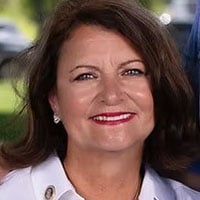
Genevieve Peters Scott (R)
 |
|
Positions
- Revitalize Michigan's economy through a national skilled trades training program for middle and high schools
- Establish uniform nationwide standards for federal elections
- Require teaching of U.S. founding documents in K-12 schools
- Eliminate federal waste, fraud, and abuse; end what she calls unconstitutional spending
- Protect religious freedom and oppose government mandates
- Oppose sanctuary cities; support border security
- Aligned with the Trump America First agenda
Career
- Former educator who went on to join the leadership team in Michigan's third-largest county clerk's office, where she led election integrity efforts and bipartisan reforms; attended Western Michigan University
- A vocal Trump supporter and grassroots activist; she was present at events surrounding January 6th and has been documented protesting outside Michigan Secretary of State Jocelyn Benson's home; nearly beat Rogers in a GOP straw poll before she officially entered the race
Personal
- Raised on Detroit's Eastside in a working-class family — her father built Chevys after serving in the military, her mother worked at the local diner
- Lives in Royal Oak with her husband John and their two rescue cats
Frederick Heurtebise (R)
 |
|
Heurtebise is a welding engineer from Grand Rapids with no campaign website and minimal public profile. He raised roughly $10,000. Limited public information is available at time of publication.
Valerie Lee Willis (I)
 |
|
Willis has run for Michigan's U.S. Senate seat multiple times — as a write-in candidate in 2018, on the U.S. Taxpayers Party ticket in 2020, and as a write-in again in 2024. She attended Central Michigan University and runs "As the Sun Rises," a Facebook-based advocacy group focused on child support reform. Limited public information is available at time of publication.
T.J. Stephens (No Party Affiliation)
 |
|
Positions
- Break the grip of the two-party system; running as an independent voice
- Transparency and honest communication as governing principles
- Reform the healthcare system — motivated by personal experience with insurance industry failures
- Fiscal responsibility and constituent-first governance
- Return decision-making power to Michigan voters, not party leadership
Career
- Senior executive in the medical software industry with a background that includes working as a volunteer firefighter, on an oil rig, and in real estate; his interest in healthcare policy stems from a personal battle with an insurance company at age 18
Personal
- Lives in Grand Blanc, Genesee County; no additional personal background publicly available at time of publication
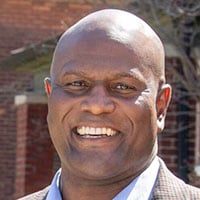
Joseph Tate (D)
Ran for about three months starting in May 2025, then withdrew early in the race and was never a factor.
 |
|
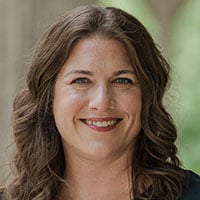
Rachel Howard (D)
Rachel Howard withdrew from the U.S. Senate race in May 2026.
 |
|
Positions
- Gradual transition to a single-payer healthcare system covering physical and mental health
- Cut prescription drug prices and reform Pharmacy Benefit Manager conflicts of interest
- Overhaul VA healthcare and expand veterans' services and telehealth
- Reform child support system to reduce poverty among families
- Improve grade school education with a focus on both academic and vocational pathways
- Preserve Michigan farmland through tax incentives for agricultural use
- Reform campaign finance — ban corporate donations to individual candidates
- Evidence-based policymaking grounded in research, not party politics
Career
- Served 14 years as a combat medic in the Michigan Army National Guard, deploying to Iraq and Afghanistan; one of fewer than 500 women ever to receive the Purple Heart; medically retired in 2019
- After service, worked as an EMT in metro Detroit, a clinical researcher at Henry Ford Health, and a Research Health Science Specialist at the VA in Ann Arbor, where she helped create one of the only Post-Deployment Respiratory Health specialty clinics in the country; resigned from the VA in 2026 to run for Senate
Personal
- Born and raised in Michigan, grew up in Macomb County; holds a bachelor's degree from Grand Valley State University and two master's degrees — one in Social Work from Wayne State and one in Public Health from George Washington University
- Mother and stepmother of four sons in a blended family; lives in Dexter
How to Vote in Michigan
Knowing who's running is only half the equation. Here's how to make sure your vote actually counts on November 3rd.
Start here: Look up your personal voter information
The Michigan Voter Information Center has everything you need in one place. Enter your information at mvic.sos.state.mi.us and you'll see:
- Whether you're registered to vote
- Your polling location on Election Day
- Your early voting location and hours
- Your absentee ballot status
- Your drop box locations
- All of your voting districts — county, state house, state senate, U.S. Congress, school board, and more
- Your local clerk's contact information
Key date
- General Election: November 3, 2026
- Early voting is available — check the MVIC site for your specific location and hours
- Michigan allows same-day voter registration at your local clerk's office
Not registered?
You can register online at mvic.sos.state.mi.us if you have a Michigan driver's license or state ID, by mail, or in person at your local clerk's office. If you're registering within 14 days of an election, you must do so in person.
Voter information is maintained by the Michigan Secretary of State. Contact your local clerk if you have questions about your specific situation.
Help Build a More Informed Michigan
Democracy works best when every voter has access to clear, factual, and nonpartisan information.
If you found this guide helpful, you can help make sure the next voter finds it too.
Your support helps Michigan Women research statewide races, publish free voter guides, explain complex ballot issues, interview candidates, and expand civic education into more Michigan communities — all without subscriptions or paywalls.
Ways to Support
Donate
Help keep these guides free and available to every Michigan voter. https://michwomen.com/donate
Subscribe
Join our email list to receive new voter guides, election updates, and civic education resources. https://michwomen.com/join
Follow Michigan Women
Stay connected for new guides, interviews, videos, and election coverage.
- Facebook: https://www.facebook.com/michwomencoalition/
- LinkedIn: https://www.linkedin.com/company/michigan-women
- YouTube: https://www.youtube.com/@MichiganWomen
- TikTok: https://www.tiktok.com/@michwomen
- Instagram: https://www.instagram.com/michigan_women/
- Nextdoor: https://nextdoor.com/pages/michigan-women-saginaw-mi/
Share This Guide
Help friends, family, and neighbors make informed decisions by sharing this guide.
Michigan Women Education Fund
Michigan Women Education Fund is a registered 501(c)(3) nonprofit organization. Contributions are tax-deductible to the extent allowed by law.
Together, we can help every Michigan voter make a more informed decision at the ballot box.
Content Disclaimer: Our team researches information from official websites, news outlets, and other public resources to make it easier for Michigan residents to stay informed. We strive to provide accurate, balanced, and up-to-date information, but we may occasionally miss updates or changes. Michigan Women is a 501(c)(3) non-profit organization and does not support or oppose any political candidate or party. This content is intended solely for civic education and public awareness.