
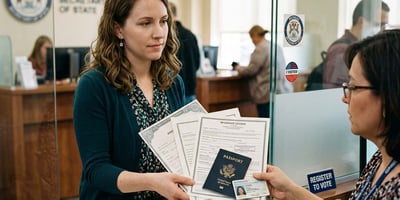
Last update: June 30, 2026. Three proposals could end automatic voter registration in Michigan....
Last Update: August 7, 2026. The SAVE Act would change how Americans register to vote. Here's what it actually does — and why it keeps failing in the Senate
Table of Contents
This guide is designed for easy online navigation with clickable sections. If you’d rather download or print a copy, you can get the full PDF version.
What's the Latest on the SAVE Act?
FAs of August 7, 2026, the SAVE America Act has not passed the Senate despite being President Trump's stated top legislative priority. Republicans have tried four separate approaches to force it through — two reconciliation amendments, an NDAA attachment, and a new grant-based reconciliation framework — and every attempt has either failed outright or stalled in the Senate. The bill lacks both the 60 votes needed to overcome a filibuster and, as of the most recent votes, even a simple majority.
The Senate headed into August recess without a vote. Senate Majority Leader John Thune has said preventing a government shutdown before the September 30 funding deadline is the more pressing priority. Whether the SAVE Act gets another attempt before the November midterms — and in what form — remains an open question.
What Is the SAVE Act?
The SAVE Act — short for the Safeguard American Voter Eligibility Act — is federal legislation that would require people to provide documentary proof of U.S. citizenship in order to register to vote in federal elections. Some versions of the bill would also require voters to show photo identification when casting a ballot.
"Documentary proof of citizenship" means something more specific than the identification most people already carry. A standard driver's license — even a REAL ID — typically would not count on its own. Acceptable documents would generally include a U.S. passport, a birth certificate, naturalization papers, or a REAL ID specifically marked to indicate citizenship (only a handful of states, including Michigan, currently offer that marked version).
This is a meaningfully different requirement than what most people think of as "voter ID." Voter ID laws ask someone to prove who they are at the polls. The SAVE Act asks someone to prove that they are a citizen — a higher bar, and one most people have never had to clear to register to vote, because U.S. law has historically relied on a signed declaration under penalty of perjury rather than a document.
Why Does the SAVE Act Exist?
Supporters say it closes a gap: current law already makes it illegal for noncitizens to vote in federal elections, but enforcement mostly relies on people telling the truth on a form, backed up by database checks rather than physical documents. They argue that a documentary standard would create a uniform, harder-to-game system and increase public confidence in election results.
Opponents argue the gap doesn't meaningfully exist in practice — that noncitizen voting in federal elections is already rare and already illegal, and that the bill's practical effect would fall on the millions of eligible citizens who don't have ready access to a passport or other qualifying document, rather than on the small number of ineligible voters it's aimed at.
Both of these claims get examined in detail later in this guide — see The SAVE Act Rationale for what the data on voter fraud actually shows, and Policy Arguments For and Against the SAVE Act for the fuller case on each side.
It's Not One Bill — It's Three (2 House Bills & 1 Senate Bill)
"The SAVE Act" isn't a single piece of legislation. Over the past year and a half, it has existed as three separate bills in Congress, each version slightly different:
| Bill | Chamber | What It Would Do |
|---|---|---|
| H.R. 22 | House | The original version. Requires documentary proof of citizenship to register to vote in federal elections. |
| H.R. 7296 | House | A follow-up version with the same citizenship requirement, plus a new requirement to show photo ID when voting. |
| S. 1383 | Senate | The vehicle currently being used in the Senate. Carries citizenship-proof and photo-ID requirements similar to H.R. 7296. |
The reason there are three is mostly procedural, not a reflection of three competing ideas: each new version was introduced after the previous one stalled, and the House eventually used S. 1383 — an unrelated, already-passed Senate bill — as a legislative shortcut by replacing its text with SAVE Act language rather than starting over with a brand-new Senate bill. (The SAVE Act Legislation in Congress section of this guide breaks down exactly how each bill differs and where each one currently stands.)
Why Did the House Pass Two Different Bills With the Same Idea?
This is a fair question, and the answer is a quirk of how Congress moves legislation rather than a sign of three competing proposals.
H.R. 22 passed the House in April 2025 and then sat in the Senate for ten months without a vote — the same dead end that awaits most House bills the Senate majority doesn't want to take up. By January 2026, House Republicans tried again with a new bill, H.R. 7296, which added a photo-ID-to-vote requirement on top of H.R. 22's citizenship-proof rule.
The House passed H.R. 7296 on February 11, 2026 — but rather than send that bill to the Senate and risk the same fate as H.R. 22, House leadership used it for a different purpose: as the source text for a separate maneuver. On the same day, the House took S. 1383 — an unrelated bill that had already passed the Senate by unanimous consent two months earlier, in December 2025 — and replaced its entire contents with H.R. 7296's language. The House then passed this amended version of S. 1383 and sent it back to the Senate.
In effect, H.R. 7296 served as the draft: it gave House Republicans a finished, House-approved version of the policy. S. 1383 became the delivery vehicle: because it had already cleared the Senate once (on an unrelated topic), sending it back as a Senate bill the House had amended put it in a different procedural lane than introducing a brand-new bill — one Republican leaders judged more likely to get Senate floor time. This kind of substitution, sometimes called using a bill as a "shell," is a long-standing congressional tactic, not unique to the SAVE Act.
The result is that H.R. 7296 and S. 1383 carry essentially identical language, but only S. 1383 is the version still alive in the Senate. H.R. 7296 remains on the books as a separate bill, useful mainly as the public record of what the House passed, but it isn't going anywhere on its own.
Is the SAVE Act the Same as a Voter ID Law?
No — though the two get conflated often, including in some of the bill's own informal nicknames.
A typical state voter ID law asks someone to show identification, like a driver's license, when they show up to vote. The SAVE Act's central requirement is about registering to vote, and it's about proving citizenship specifically, not just identity.
Several versions of the bill also add a separate photo-ID requirement for casting a ballot, which is closer to what people usually mean by "voter ID" — but that's a second, distinct provision layered on top of the citizenship requirement, not the bill's main feature.
Does This Affect Michigan Voters Specifically?
The SAVE Act is federal legislation, so if passed, it would apply to voter registration for federal elections in every state, including Michigan.
Separately, Michigan has its own proof-of-citizenship efforts moving on a parallel track: a state bill (House Bill 4765, passed by the state House but stalled in the Senate) and two competing ballot initiatives collecting signatures for the November election. These would apply only to Michigan's state and local elections, not federal ones, and are moving through entirely separate processes from the federal bill.
For the full picture — what HB 4765 and the ballot initiatives would actually require, their status, and how they differ from this federal bill — see our companion guide, Guide to Michigan's Proof-of-Citizenship Voting Proposals.
Timeline: How the SAVE Act Got to Where It Is Today
Phase 1: Introduction and First House Passage
January 2025 – April 2025
- January 3, 2025 — H.R. 22, the Safeguard American Voter Eligibility (SAVE) Act, is introduced in the U.S. House of Representatives by Rep. Chip Roy (R-TX).
- April 10, 2025 — H.R. 22 passes the House of Representatives, 220–208.
- April 10, 2025 — H.R. 22 is received by the U.S. Senate but is not scheduled for committee review or a floor vote. It will remain here, untouched, for the next ten months.
Phase 2: A Second Bill, and the S.1383 Maneuver
January 2026 – March 2026
- January 30, 2026 — With H.R. 22 stalled, Rep. Chip Roy introduces a follow-up bill, H.R. 7296, in the House. It carries the same citizenship-proof requirement as H.R. 22 and adds new voting and election-administration provisions, including a photo-ID requirement to cast a ballot.
- February 11, 2026 — H.R. 7296 passes the House, 218–213.
- March 2026 — Rather than send H.R. 7296 to the Senate floor directly, House leadership takes a procedural shortcut: it inserts the SAVE Act language into S.1383, an unrelated bill the Senate had already passed earlier in the session. The House passes this amended version of S.1383 and sends it back to the Senate — making S.1383, not H.R. 22 or H.R. 7296, the active vehicle going forward.
- March 17, 2026 — The Senate votes 51–48 to approve a motion to proceed, allowing debate to begin on the House-passed version of S.1383. This is a procedural vote to start debate, not a vote on the bill itself.
- March 21, 2026 — During a rare weekend session, the Senate rejects a Trump-backed amendment to S.1383 related to transgender athletes. The vote confirms the Senate is actively debating and amending the bill — but the underlying legislation still hasn't advanced to a passage vote.
- March 23, 2026 — President Trump publicly ties the SAVE America Act to an ongoing Department of Homeland Security funding standoff, urging Republicans not to agree to a DHS funding deal unless the SAVE Act advances. This raises the bill's political profile but doesn't change its legislative status — it's still pending.
Phase 3: Two Failed Attempts to Pass It Through Reconciliation
April 2026 – June 2026
With a traditional 60-vote path to cloture looking unreachable, Senate Republicans try a different route twice: attaching the SAVE Act's core provisions to unrelated budget reconciliation bills, which only need a simple majority to pass.
- April 23, 2026 — Sen. John Kennedy (R-LA) offers an amendment attaching SAVE Act provisions to a budget reconciliation bill. It fails, 48–50. Republican Sens. Susan Collins (ME), Lisa Murkowski (AK), Mitch McConnell (KY), and Thom Tillis (NC) join every Democrat in voting no.
- June 4, 2026 — Sen. Lindsey Graham (R-SC) tries again, attaching similar provisions to a second reconciliation bill funding ICE and Customs and Border Protection. The amendment fails again, 48–50, with the same four Republicans voting no.
Phase 4: Trump's Pressure Campaign and the NDAA Maneuver
June 2026 – August 2026
With both Senate reconciliation attempts having failed, Trump shifts tactics — rather than working through the Senate, he begins blocking unrelated legislation and escalating public pressure while the House tries new routes to force a Senate vote.
- June 12, 2026 — Section 702 of the Foreign Intelligence Surveillance Act (FISA), the government's warrantless surveillance authority, lapses. It had already been extended once, through this date, by an earlier bill Congress passed in April; it is not renewed again.
- June 14, 2026 — Sen. Mitch McConnell is hospitalized following a medical emergency and is absent from the Senate. He chairs the Senate Rules Committee, which would be responsible for drafting any version of the SAVE Act structured to survive the reconciliation process. His absence leaves Senate Republicans at 52 effective votes instead of 53. No firm return date is announced.
- June 17, 2026 — Hours before a scheduled Senate confirmation hearing for his own pick for Director of National Intelligence, Jay Clayton — whose confirmation was expected to unlock the Democratic votes needed to pass a new FISA extension — Trump pulls Clayton from the hearing over an unrelated dispute, and adds in the same Truth Social post that he won't approve any FISA extension unless the SAVE America Act is attached to it.
- June 24, 2026 — Trump cancels the signing ceremony for the 21st Century ROAD to Housing Act, a bipartisan housing bill that passed both chambers by veto-proof margins (89–10 in the Senate), writing on Truth Social that the signing "is hereby cancelled until such time as we pass the desperately needed SAVE AMERICA ACT, which I consider to be a National Emergency."
- June 28, 2026 — Sens. Thom Tillis (R-NC) and Bill Cassidy (R-LA) say publicly, on separate Sunday shows, that the bill isn't passing this year. Tillis calls it an "impossible task" to implement before the midterms; Cassidy says plainly that "there are not the votes." Both echo what Senate Majority Leader John Thune has said for weeks.
- June 30, 2026 — Speaker Mike Johnson tries to merge the House-passed SAVE America Act with the National Defense Authorization Act (NDAA) via a procedural rule, so voting for the rule would send both to the Senate as one package. Rep. Anna Paulina Luna (R-FL) and other hardliners reject this as too weak, insisting SAVE language be written directly into the NDAA's text instead. The rule fails, 198–224, with 14 Republicans — including Luna, Chip Roy (R-TX), and Thomas Massie (R-KY) — voting no. Unlike the earlier reconciliation votes, these Republicans aren't opposing the SAVE Act; they want a stronger version of it. The failure stalls the NDAA and sends the House into recess early.
- July 12, 2026 — Sen. Lindsey Graham dies at age 71. His South Carolina seat is filled by appointed Sen. Darline Graham Nordone. Graham had been one of the SAVE Act's most active Senate advocates and sponsored the June 4 reconciliation amendment. Trump publicly cites Graham's death as renewed reason to pass the SAVE Act.
- July 16, 2026 — Trump delivers a primetime address from the White House on election security, announcing the declassification of documents he says show "shocking vulnerabilities" in U.S. election infrastructure, including claims of Chinese access to 220 million voter files. He uses the address to call on Congress to pass the SAVE Act. Fact-checkers at FactCheck.org, NPR, and ABC News find the declassified documents contain no new evidence that votes were changed or that election outcomes were altered.
- July 17, 2026 — DHS Secretary Markwayne Mullin sends letters to California, Nevada, New Jersey, and Pennsylvania claiming preliminary reviews found more than 250,000 potential noncitizens on their voter rolls, and threatens states with loss of federal funding and prison time for election officials who don't cooperate. Officials in at least three of the four states dispute the figures and ask DHS to explain its methodology. DHS's own letters describe the numbers as "preliminary" and "potential."
- July 21, 2026 — New Jersey Gov. Mikie Sherrill announces that approximately 6,600 people who identified themselves as noncitizens when obtaining driver's licenses were mistakenly registered to vote between June 2023 and June 2024, due to a state Motor Vehicle Commission software error. About 400 later cast ballots. The vendor (IDEMIA) says its system correctly recorded both the applicants' noncitizen declarations and their voter registration requests; the state's system failed to block them. Trump cites New Jersey as the primary argument for passing the SAVE Act. Democratic senators, including Sen. Cory Booker, argue the SAVE Act's proof-of-citizenship requirement would not have prevented a software failure of this kind.
- July 22, 2026 — After three weeks of House floor paralysis, Speaker Johnson reaches an agreement with conservative holdouts. The House passes the 2027 National Defense Authorization Act, 216–212, with SAVE Act language attached by a procedural move called "MIRVing." Six Democrats cross over in favor; seven Republicans (including Chip Roy and Thomas Massie) vote no — not because they oppose the SAVE Act, but because they wanted its language written directly into the bill text rather than attached as a rider. The NDAA now sits in the Senate, where it faces the same 60-vote filibuster threshold. Senate Democrats block a procedural vote to advance it the following week.
- July 22, 2026 — On the same day, the House passes a third budget reconciliation framework, 216–214, directing the House Administration Committee to allocate up to $10 billion over 10 years in grants to incentivize states to adopt proof-of-citizenship and voter ID requirements. This approach — turning mandates into grant conditions — is designed to survive the Senate parliamentarian's ruling that the SAVE Act's direct requirements are not budgetary in nature. Budget experts and some conservatives express skepticism; even if it passes the Byrd bath procedural test, implementation would take years — well past the 2026 midterms. Trump called for the Senate parliamentarian to be fired after her ruling.
- Late July – August 7, 2026 — Senate Republicans debate whether to delay the August recess to force a SAVE Act vote. No vote is taken. Thune prioritizes averting a government shutdown before the September 30 funding deadline. By late July, Tillis is openly mocking the escalation: "We've got SAVE Act, Son of SAVE Act, SAVE Act goes to Hollywood — a lot of sequels." Some conservatives float attaching the SAVE Act to a continuing resolution as a final pre-midterm attempt — a path that would still require 60 votes. The Senate heads into recess without passing anything on the bill.
Current Status (August 2026)
- H.R. 22 remains formally pending in the Senate but has not been the active vehicle for debate since March 2026.
- H.R. 7296 passed the House but, like H.R. 22, is not the bill currently being acted on — its language lives on through S. 1383.
- S. 1383, carrying the SAVE America Act language, has not passed the Senate. Republicans have made four separate attempts to advance it since March — two reconciliation amendments (April and June, both failing 48–50), the June 30 NDAA rule vote (failed 198–224), and the July 22 NDAA passage — and none has cleared the Senate.
- Senate Majority Leader John Thune has said he has no current plan to bring the bill back to the floor as a standalone vote, citing the September 30 government shutdown deadline as the more pressing priority.
- Sen. Mitch McConnell remains absent following a June 14 medical emergency, leaving Republicans at 52 effective votes and the Senate Rules Committee without its chair at a critical moment for the bill's reconciliation path.
- The bill has not been formally withdrawn, and President Trump has continued pushing for it — including holding unrelated legislation hostage, calling for the Senate parliamentarian to be fired, and urging senators to cancel the August recess.
- The next live pressure point is the September 30 government funding deadline. Some Senate conservatives have floated attaching the SAVE Act to a continuing resolution, though that approach also requires 60 votes.
What Happens Next
For S. 1383 to become law through the ordinary legislative process, the Senate would need 60 votes to invoke cloture and end debate. Republicans have repeatedly tried to bypass this through budget reconciliation, which requires only a simple majority — but the Senate parliamentarian ruled the SAVE Act's provisions are not budgetary in nature, meaning they can be stripped from any reconciliation bill before a vote. The current $10 billion grant framework is an attempt to work around that ruling, though budget experts say it faces similar challenges.
In practice, the bill appears unlikely to pass the Senate before the November 2026 midterms. Whether it returns in 2027 will depend on midterm results and whether a new Congress changes the math.
A Note on the SAVE System vs. the SAVE Act
The SAVE system — the Systematic Alien Verification for Entitlements database — is a separate, existing federal tool originally built to verify immigration status for benefits eligibility. It is not a voter database. S. 1383 would require states to use it to cross-check voter rolls, but a federal judge in Boston ruled in June 2026 that the government may not repurpose it for voter-roll screening, citing violations of the Privacy Act of 1974. The system was also found to produce a false-positive rate of at least 14%, flagging eligible, naturalized citizens as noncitizens.
The SAVE Act Rationale
Concerns about voter fraud have become a major political issue in the United States over the past decade, particularly after the 2016 and 2020 presidential elections. During those elections and afterward, President Donald Trump and some allies repeatedly claimed that widespread voter fraud had occurred, including allegations of illegal votes.
These claims led to numerous investigations, lawsuits, and election audits. Courts, state election officials from both parties, and federal agencies reviewed the allegations but did not find evidence of widespread fraud that would have changed election outcomes.
Despite those findings, concerns about election integrity remain influential in American politics. Some lawmakers argue that stronger voter verification requirements are needed to increase public confidence in elections, while others argue that additional restrictions could make voting more difficult for eligible citizens.
Key Facts About Voter Fraud
Voter fraud is illegal under federal and state law. Non-citizens are prohibited from voting in federal elections, and violations can carry criminal penalties.
- Documented voter impersonation is extremely rare. A widely cited study reviewing elections from 2000–2014 found 31 credible cases of voter impersonation out of more than 1 billion ballots cast. (Source: Brennan Center for Justice analysis of election records.)
- Confirmed cases of election fraud do occur, but they represent a very small share of total ballots cast. The Heritage Foundation's Election Fraud Database lists more than 1,500 proven cases across several decades. These cases include absentee ballot violations, vote buying, registration fraud, and ballot tampering. (Source: Heritage Foundation Election Fraud Database.)
- Investigations following the 2020 election — including court cases, state audits, and reviews by the U.S. Department of Justice — did not find evidence of widespread fraud that would have changed the outcome of the election. (Source: Associated Press reporting and court records.)
- When election fraud does occur, it most often involves absentee ballots or administrative violations rather than impersonation at polling places.
- Recent case — New Jersey (2026): Approximately 6,600 people who identified themselves as noncitizens when obtaining driver's licenses were mistakenly registered to vote in New Jersey between 2023 and 2024, due to a software error in the state Motor Vehicle Commission's system. About 400 cast ballots before the error was discovered. The vendor involved said its system had correctly recorded both the applicants' noncitizen declarations and their voter registration requests — the state's own system failed to block them. Supporters of the SAVE Act cited this as evidence of a systemic vulnerability; opponents argued the SAVE Act's proof-of-citizenship requirement would not have prevented a software failure of this kind.
Evidence From Investigations and Audits
After the 2020 presidential election, dozens of lawsuits were filed challenging election results in several states. Courts — including judges appointed by both Republican and Democratic presidents — dismissed many of these cases due to lack of evidence or legal standing.
Federal and state officials also conducted reviews of election processes. The U.S. Department of Justice, state election administrators, and independent audits did not find evidence of widespread fraud that would have changed the outcome of the election.
The Cybersecurity and Infrastructure Security Agency (CISA), the federal agency responsible for election security, described the 2020 election as "the most secure in American history."
Policy Arguments For and Against the SAVE Act
The stated purpose of the SAVE Act is to prevent non-citizens from registering to vote and to strengthen verification of voter eligibility in federal elections. The debate reflects different views about how voter eligibility should be verified in federal elections and what level of documentation should be required.
The table below summarizes the main policy arguments raised by supporters and opponents of the legislation.
| Topic | Supporters of the SAVE Act (mostly Republican lawmakers) | Opponents of the SAVE Act (mostly Democratic lawmakers) |
|---|---|---|
| Purpose of the Bill | Argue the bill strengthens election integrity by ensuring only U.S. citizens can register and vote in federal elections. | Argue non-citizen voting is already illegal and extremely rare, so the bill addresses a problem that is not widespread. |
| Proof of Citizenship Requirement | Argue requiring documents like a passport or birth certificate provides stronger verification than sworn statements or database checks. | Argue documentation requirements could make registration harder for some eligible voters who may not have easy access to documents. |
| Verification at Registration and Voting | Argue verifying eligibility during registration and voting creates an additional safeguard against improper voting. | Argue multiple verification steps could create administrative burdens and increase the risk of eligible voters being turned away. |
| Impact on Election Security | Argue stronger identity and citizenship verification would increase public confidence in election results. | Argue the changes could create confusion, longer lines, or inconsistent enforcement across states. |
| Federal vs. State Role | Argue Congress can set national standards for federal elections and voter eligibility verification. | Argue elections are primarily administered by states and new federal requirements could complicate existing systems. |
| Administrative Impact | Argue national standards could simplify verification rules across states. | Argue election offices would face increased workload and costs verifying additional documentation. |
While this table summarizes the main policy arguments raised by each side, public debate around election laws often includes stronger political claims about the motives of the opposing party.
Political Rhetoric That Often Appears in the Debate
In addition to policy arguments, debate about election laws often includes strong political rhetoric about the motives of the opposing party. The table below summarizes common claims made during political debate around voting laws like the SAVE Act.
| Topic | Rhetoric Used by Supporters of the SAVE Act | Rhetoric Used by Opponents of the SAVE Act |
|---|---|---|
| Motivation of the Other Party | Supporters sometimes claim Democrats oppose voter verification because illegal voting benefits them politically. | Opponents sometimes claim Republicans support stricter voting rules because limiting access benefits them politically. |
| Characterization of the Policy | Supporters describe the bill as a simple "commonsense voter ID requirement" and portray opposition as politically motivated. | Opponents describe the bill as an attempt to suppress votes or discourage participation among certain voters. |
| Framing the Stakes | Supporters argue failing to pass stricter verification laws allows illegal voting or undermines election integrity. | Opponents argue stricter documentation requirements could prevent eligible citizens from voting. |
| Characterization of the Debate | Supporters frame the issue as choosing between protecting election integrity or allowing weak safeguards. | Opponents frame the issue as choosing between protecting voting rights or restricting ballot access. |
| Scale of Election Fraud | Supporters argue significant voter fraud may be occurring and stronger verification laws are needed, though large-scale fraud has not been demonstrated. | Opponents argue research and investigations show voter fraud is extremely rare and existing safeguards detect violations. |
Understanding the policy debate around the SAVE Act requires understanding how voter eligibility is currently verified in the United States. Today, most states rely on a combination of voter attestation, identity verification through government databases, and voter roll maintenance procedures. The SAVE Act would change this process by requiring documentary proof of citizenship as part of voter registration for federal elections.
How Voter Eligibility Is Verified Today
In the United States, voter eligibility is primarily verified by the states. Each state administers its own elections and maintains its own voter registration system, although federal law establishes certain baseline rules.
Under current federal law, most states rely on voter self-attestation of citizenship combined with identity verification through government databases.
1) Voter Documentation
When registering to vote in most states, individuals must:
- Declare under penalty of perjury that they are U.S. citizens and eligible to vote
- Provide identifying information such as a driver's license number or the last four digits of their Social Security number
If a voter registers by mail or online and the identity cannot be confirmed through these databases, the voter must provide identification the first time they vote.
Acceptable identification varies by state but may include:
- Michigan driver's license
- Michigan state ID
- U.S. passport
- military ID
- tribal ID
- student ID (from certain institutions)
- utility bill
- bank statement
- government check
- paycheck
- government document showing name and address
These documents confirm identity and residency, not citizenship.
2) Voter Identity Verification
States then verify identity by checking the information against government databases, such as:
- State driver's license records
- Social Security Administration databases
3) Voter Roll Maintenance
In addition, election officials maintain voter rolls using other government records, including:
- death records
- change-of-address data
- voter participation records
- interstate data systems used to identify people who may have moved
- the SAVE system (Systematic Alien Verification for Entitlements) — a federal database tool originally built to verify immigration status for benefits eligibility, which some states have used voluntarily to cross-check voter rolls. Update, June 2026: A federal judge in Boston barred the government from using the SAVE system to cross-check state voter rolls, ruling the practice violated the Privacy Act of 1974 — which restricts the federal government from repurposing data collected for one purpose (immigration benefits verification) for an unrelated use (election administration) without authorization. The ruling followed reporting that when states ran their voter rolls through the system, it produced a false-positive rate of at least 14%, incorrectly flagging eligible, naturalized citizens as noncitizens.
Under this system, citizenship is generally affirmed by the voter rather than proven with documentation, and identity verification occurs through database matching.
This self-attestation and database-matching system is the baseline the SAVE Act would change. Documentary proof of citizenship — rather than a signed declaration — would become the standard for registering to vote in federal elections.
SAVE Act Impact on Voters
How the SAVE Act Would Change Voter Documentation
| Stage | Current System (Most States) | H.R. 22 (SAVE Act 2025) | S.1383 (House-Passed Update) |
|---|---|---|---|
| Register to Vote | Voters attest to citizenship under penalty of perjury and provide identifying information such as a driver's license number or last four digits of a Social Security number. | Requires documentary proof of U.S. citizenship when registering for federal elections. | Same citizenship documentation requirement as H.R. 22. |
| Citizenship Proof | Citizenship usually affirmed by the voter; documents typically verify identity and residency rather than citizenship. | Requires documents such as a passport, birth certificate with photo ID, or naturalization certificate. | Same documentation requirement. |
| Voting in Person | Identification rules vary by state. Some states require ID; others allow signing an affidavit if ID is unavailable. | Does not change voting ID rules. | Requires a qualifying photo ID when casting a ballot. |
| Absentee Voting | Rules vary by state; some require ID verification, others use signature matching. | No major change to absentee voting requirements. | Requires a copy of qualifying photo ID when requesting and returning an absentee ballot. |
Voters May Need Additional Documentation When Registering
States would be required to verify citizenship before registering voters for federal elections. In practice, this could occur through government database checks or by requiring applicants to provide documentation.
How this process would work in practice could vary by state because election administration is handled at the state level, and states differ in their laws, data-sharing authority, and technical systems.
1: The state verifies citizenship ahead of time (easier for voters)
- When you register, the state may verify citizenship using government records or databases
- Election systems may mark voter records as "citizenship verified" once documentation has been confirmed
- On Election Day, you show a normal photo ID (like a driver's license) and vote
- You do not need to bring a birth certificate to the polling place
2: The voter may need to prove citizenship at the polls
- The state has not verified citizenship ahead of time, so your record is not marked "citizenship verified."
- On Election Day, you must show a photo ID
- If your photo ID does not indicate U.S. citizenship, you must also show proof of citizenship (such as a birth certificate)
Obtaining these documents can involve fees and additional steps
For example:
- Michigan birth certificate fees typically range from about $10 to $35 depending on the county
- A U.S. passport currently costs about $165–$183 for first-time adult applicants
- A Michigan Enhanced Driver's License would meet the Proof of U.S. citizenship requirements, but there is also a $30–$45 fee to obtain one.
Voters can confirm their registration is active through their state's voter lookup, and if new federal requirements were adopted, states would be required to notify voters if additional documentation is needed.
Why a Driver's License Alone Isn't Valid Proof
In most states, a standard REAL ID driver's license would not meet the proof of U.S. citizenship requirement because:
- REAL ID status alone generally does not prove citizenship
- Many non-citizens can legally receive REAL ID–compliant licenses
- Most REAL ID driver's licenses do not indicate citizenship on the card
- For a REAL ID to qualify on its own, it must:
- Be REAL ID–compliant and
- Explicitly indicate that the holder is a U.S. citizen
Name Changes & Documentation Matching
The Issue
Some voters have identification documents issued under different legal names. For example, a birth certificate may list a person's maiden name, while a driver's license and voter registration reflect a married name.
Why This Can Matter
If proof of citizenship is required during voter registration or voting, election officials may need to confirm that documents showing different names refer to the same person. In those cases, voters may need to provide additional documentation linking the names.
Examples of documents that may help establish this connection include:
- certified marriage certificate
- divorce decree reflecting a name change
- court order documenting a legal name change
Estimated Impact
Some researchers estimate that millions of Americans have identification documents under different names due to marriage or other legal changes.
Preparing Documentation
Voters who have changed their legal name may wish to keep documentation available that connects their current name to the name appearing on their birth certificate or other citizenship document.
The Most Complete Document: A U.S. Passport.
Why: A valid unexpired U.S. Passport already proves both your citizenship and your current legal name (if updated). It is the single best document to bypass the name-mismatch mess.
The "Bridge" Document: Certified Marriage License.
Why: If you rely on your birth certificate for citizenship proof, you will likely need your original or certified copy of your marriage license (not the fancy commemorative one) to legally "bridge" the gap between your birth name and your voter registration name.
What Makes Voter ID Requirements More Complex Than They May Appear
Voter identification requirements are often viewed as straightforward. Identification is commonly used for everyday activities such as driving, banking, boarding flights, or purchasing age-restricted products. From that perspective, it can seem reasonable to assume that nearly everyone already has the identification needed to vote.
In reality, access to government-issued identification and the underlying documents required to obtain it can vary widely depending on a person's circumstances.
Not everyone has a government-issued photo ID.
Research by the Brennan Center for Justice estimates that roughly 11% of U.S. citizens of voting age — about 21 million people — do not have a current government-issued photo ID.
The rates are higher among certain populations, including older adults, lower-income individuals, and some minority communities.
Obtaining ID often requires other official documents.
To obtain a driver's license or state ID card, individuals usually must present documents such as:
- a certified birth certificate
- a passport
- proof of Social Security number
- proof of current address
For people who do not have these documents readily available, obtaining them can require additional steps, fees, and travel.
Some documents can be difficult to replace.
Birth certificates are typically issued by the state or county where a person was born. If someone was born in another state — or if records were lost, damaged, or never formally recorded — replacing those documents can take time and may require multiple forms of identification.
Name changes can also create complications. For example, some married voters may have a birth certificate in one name and other documents in another, requiring additional paperwork to reconcile the records.
Transportation and office access can be barriers.
In many areas, particularly rural communities, driver's license offices or state ID offices may be located far from where people live. Limited office hours, transportation challenges, or work schedules can make it difficult for some individuals to obtain or renew identification.
Cost can also play a role.
While some states offer free voter identification cards, the supporting documents needed to obtain them — such as certified birth certificates — often involve fees. Travel costs and time off work can also add to the burden.
Certain populations are more likely to face these challenges.
Research has found higher rates of missing identification among:
- older Americans who may have been born before standardized birth records were common in some regions
- lower-income individuals who may lack transportation or documentation
- people who move frequently and may struggle to maintain consistent address documentation
- individuals who have changed their name due to marriage or other life events
New "Safety Net" Provisions
While the requirements are strict, the legislation (H.R. 22 and H.R. 7296) includes specific protections for voters with documentation challenges:
- Alternative verification procedures: The legislation allows states to establish procedures for individuals who cannot readily obtain documentary proof of citizenship. These may include providing additional evidence or sworn statements under penalty of perjury, depending on how the law is implemented.
- Name Change Attestation: To protect voters whose current legal name differs from their birth certificate (common for married women), the law allows for a signed attestation swearing to the accuracy of the name change to "bridge the gap" between documents.
SAVE Act Legislation in Congress
Current Legislative Vehicle: Although the SAVE Act was introduced as H.R. 22 and later expanded in H.R. 7296, the version in the Senate is S.1383. The House amended that Senate bill by replacing its original text with SAVE Act language, making S.1383 the legislative vehicle since March 2026. The House also attached SAVE Act language to the 2027 National Defense Authorization Act (NDAA), which passed the House on July 22, 2026 and is now pending in the Senate.
1) H.R. 22 (Federal House Bill)
Bill Summary
H.R. 22, known as the SAVE Act (Safeguard American Voter Eligibility Act), was introduced to require documentary proof of U.S. citizenship when registering to vote in federal elections. It passed the House in 2025 and served as the legislative foundation for the more expansive requirements later carried by H.R. 7296 and S. 1383.
The registration requirement applies to all methods:
- Motor vehicle offices (DMV)
- Mail-in registration
- Voter registration agencies
- In-person registration
Required Documentation to Register to Vote
People already registered to vote would not be automatically removed from the voter rolls; however, states would be required to actively verify citizenship and may require proof if eligibility is questioned.
In Michigan, a driver's license — even a REAL ID — would generally not be sufficient on its own to meet the bill's citizenship documentation requirement. Voters would typically also need a document proving U.S. citizenship, such as a birth certificate or U.S. passport.
1) Valid: Stand-alone documents that may satisfy the citizenship requirement
- A REAL ID–compliant identification that indicates U.S. citizenship. Michigan is one of five states that offers an Enhanced Driver's License, which costs $30–$45.
- A valid U.S. passport, which costs approximately $183.
- A U.S. military ID plus a military service record showing the person was born in the United States
- A government-issued photo ID (federal, state, or tribal) that shows the person's place of birth in the United States
2) Valid: Government photo ID plus supporting citizenship document
If the photo ID does not show U.S. citizenship, it must be accompanied by one of the following:
- A certified U.S. birth certificate
- A U.S. hospital record of birth created at the time of birth
- A final adoption decree showing the person was born in the United States
- A Consular Report of Birth Abroad or certification of such a report
- A U.S. Naturalization Certificate or Certificate of Citizenship
- Any other federal document issued under immigration law that proves U.S. citizenship
- An American Indian Card issued by the Department of Homeland Security with classification "KIC"
Bill Status
- Introduced: January 3, 2025, by Rep. Chip Roy (R-TX).
- Passed by the House: April 10, 2025 (Vote: 220–208).
- Current Senate Status: Received in the Senate. No further action taken.
H.R. 22 remains formally pending in the Senate, though it has not been the active legislative vehicle since debate shifted to S. 1383 in March 2026. With S. 1383 having since failed twice as a reconciliation amendment, H.R. 22 continues to exist on paper as a separate bill, but there is no indication the Senate plans to take it up directly.
2) H.R. 7296 (Federal House Bill)
Bill Summary
After H.R. 22 stalled in the Senate, a new bill, H.R. 7296, was introduced in the House in January 2026 with similar provisions and additional requirements.
H.R. 7296 includes similar documentation requirements for voter registration as H.R. 22, requiring photo identification together with proof of U.S. citizenship.
Introducing a new bill does not cancel or replace the earlier one. H.R. 22 remains pending in the Senate unless it is withdrawn or acted on, while H.R. 7296 began a separate legislative process in the House — one that, as it turned out, became the source text for S. 1383 rather than a bill sent independently to the Senate. (See It's Not One Bill — It's Three for why.)
Added Requirements
Under H.R. 7296, voters would be required to present photo identification when casting a ballot. Unless a state has already verified a voter's citizenship in its records, a standard driver's license that does not indicate citizenship would not be sufficient on its own.
In-person voting
- Voters must present an eligible photo identification document
- The document must be physical (not digital)
- The document must be presented at the polling place
Absentee voting
- Voters must include a copy of an eligible photo identification document:
- With the request for an absentee ballot
- With the returned absentee ballot
Eligible photo identification document
- The photo ID must be issued by one of the following authorities:
- A state agency that issues driver's licenses
- A state or local election office
- A Native tribal government
- The U.S. Department of State
- The U.S. Department of Defense
- A branch of the U.S. Armed Forces
- School and college IDs do not qualify
- The required photo ID to cast a ballot must contain:
- A photograph of the voter
- An indication that the voter is a U.S. citizen (unless citizenship has already been verified by the state)
- One of the following: an identification number issued by the licensing authority, or the last four digits of the voter's Social Security number
Use of additional documentation with photo ID: A photo ID that does not indicate U.S. citizenship may only be used if it is presented together with another document that confirms U.S. citizenship.
Bill Status
- Introduced: January 30, 2026, by Rep. Chip Roy (R-TX).
- Passed by the House: February 11, 2026 (Vote: 218–213).
- Current Senate Status: Not under direct consideration. Its language was used as the substitute text inserted into S. 1383 the same day it passed the House, and S. 1383 — not H.R. 7296 itself — became the bill carried forward in the Senate.
3) S.1383 (Federal Senate Bill)
Bill Summary
S.1383 originally began as a bill establishing the Veterans Advisory Committee on Equal Access and passed the Senate by unanimous consent on December 18, 2025. The House later amended the bill by striking that original text entirely and replacing it with the Safeguard American Voter Eligibility Act language from H.R. 7296 — making S. 1383 the legislative vehicle for the SAVE America Act rather than a brand-new bill. (See It's Not One Bill — It's Three for why Congress used this approach.)
The amended legislation would require documentary proof of U.S. citizenship when registering to vote in federal elections and would establish nationwide photo identification requirements for casting ballots in those elections.
Like the House SAVE Act proposals, the amended bill modifies portions of the National Voter Registration Act of 1993 and the Help America Vote Act (HAVA) to establish new federal standards for voter registration verification and voter identification.
Citizenship Verification for Voter Registration
Under the amended bill, states could not accept or process a voter registration application for federal elections unless the applicant provides documentary proof of U.S. citizenship at the time of registration.
The bill lists examples of acceptable documentation, including:
- Identification issued consistent with the REAL ID Act that indicates the applicant is a U.S. citizen
- A valid U.S. passport
- A U.S. military identification card together with military service records showing a U.S. place of birth
If the identification does not independently demonstrate citizenship, it may be used together with additional documentation such as:
- A certified birth certificate
- A hospital record of birth created at the time of birth
- A final adoption decree showing U.S. birth
- A Consular Report of Birth Abroad
- A Certificate of Naturalization or Certificate of Citizenship
- Other federal documentation proving citizenship under immigration law
Additional State Responsibilities
The amended bill would also require states to take ongoing steps to ensure that only U.S. citizens are registered to vote in federal elections. These provisions include:
- Requiring voter registration agencies and motor vehicle agencies to verify citizenship documentation during registration
- Establishing procedures to address discrepancies in names or documentation when verifying citizenship
- Allowing states to compare voter registration lists with federal immigration databases such as the SAVE system
- Requiring states to remove individuals from voter rolls when verified information shows they are not U.S. citizens
- Expanding coordination between state election systems and federal databases for citizenship verification, which may involve sharing voter registration information with federal agencies as part of that process
Federal Photo Identification Requirement for Voting
The amended bill would also create a new federal requirement for voters to present valid photo identification when casting a ballot in federal elections.
In-person voting
Voters would be required to present a valid physical photo identification before receiving a ballot.
Voting by mail or absentee
Voters submitting a ballot other than in person would need to include either:
- A copy of valid photo identification, or
- The last four digits of their Social Security number together with an affidavit stating that they were unable to obtain a copy of their photo identification after making reasonable efforts.
Acceptable photo identification could include:
- A state-issued driver's license with a photo
- A state-issued identification card with a photo
- A U.S. passport
- A military identification card
- A tribal identification card with a photo
If a voter does not present the required identification at the polling place, the bill allows the individual to cast a provisional ballot and later provide identification for the ballot to be counted.
Bill Status
- Introduced in the Senate: April 9, 2025 (originally the Veterans Accessibility Advisory Committee Act).
- Passed Senate (original bill text).
- Passed House with amendment replacing the bill text with the SAVE America Act: February 11, 2026.
- February 12, 2026: House amendment to the Senate bill received in the Senate and placed at the desk.
- March 17, 2026: The Senate voted 51–48 to approve a motion to proceed to the House-amended version of S.1383. The motion allows the Senate to begin debate and consider amendments but does not pass the bill.
As of August 7, 2026, the bill has not passed the Senate. The March 17 vote to proceed allowed debate and amendments but did not lead to a final passage vote. Since then, Republicans have made four separate attempts to advance the bill — two reconciliation amendments (April and June, both failing 48–50), the June 30 NDAA rule vote (failed 198–224), and the July 22 NDAA passage — and none has cleared the Senate. Both reconciliation amendment votes failed with Republican Sens. Susan Collins (ME), Lisa Murkowski (AK), Mitch McConnell (KY), and Thom Tillis (NC) joining every Democrat in opposition.
As of August 2026, Senate Majority Leader John Thune has said he has no immediate plan to bring the SAVE America Act back to the floor as a standalone vote. The bill has not been withdrawn, and supporters — including President Trump — have continued to press for another attempt. See What's the Latest on the SAVE Act? for the full current picture.
For the bill to become law, the Senate must still:
- Approve the amended bill text (or a revised version) by clearing the 60-vote filibuster threshold, or advance it through reconciliation in a form the Senate parliamentarian rules is budgetary in nature.
- Ensure the House and Senate pass identical language.
- Send the final bill to the President for signature or veto.
Explore More: Key Sources and Links
The following sources were used to research and verify the information in this guide, or provide additional depth on specific topics. Michigan Women does not endorse the editorial positions of any of these organizations.
Read the Primary Sources
- S.1383 — Full bill text and legislative history (Congress.gov)
- H.R. 22 — Original SAVE Act (Congress.gov)
- H.R. 7296 — SAVE America Act (Congress.gov)
- Michigan HB 4765 — Official bill page (Michigan Legislature)
Understand the Policy Debate
- FactCheck.org: Fact-checking Trump's July 16 election security speech — a nonpartisan line-by-line review of the claims made in the White House address.
- Bipartisan Policy Center: Five Things to Know About the SAVE America Act — covers the bill's requirements, implementation challenges, and state-level precedents like Kansas and Arizona.
- National Association of Counties: SAVE America Act County Resource Hub — explains how the bill would affect local election administration, including costs and timing concerns.
- FactCheck.org: Q&A on the SAVE America Act — answers common reader questions about the bill's requirements, including name-change situations and absentee voting.
- Democracy Docket — tracks voting-rights litigation and legislation, including the SAVE Act court cases and related legal fights.
Michigan-Specific
- Michigan Women: Guide to Michigan's Proof-of-Citizenship Voting Proposals — our companion guide covering HB 4765, the two competing ballot initiatives, and how they differ from the federal SAVE Act.
- Michigan Department of State: Noncitizen voting is extremely rare in Michigan — official state review finding 15 potential noncitizen cases in the 2024 general election out of more than 5.7 million votes cast.
- Michigan Secretary of State Election Fact Center — official state resource for election rules, deadlines, and voter information.
How to Make Sure You Are Ready to Vote in Michigan
If you plan to vote in Michigan, the most important step is to make sure your voter registration and identification are up to date before Election Day. Michigan provides several tools that allow residents to check their registration status, update information, and understand what to bring to the polls.
1. Learn the Facts About Michigan Elections
The State of Michigan Secretary of State provides an Election Fact Center, where voters can get official information on Michigan elections and voting.
https://www.michigan.gov/sos/elections/election-fact-center
2. Check Your Voter Registration
Before every election, confirm that you are registered and that your address is correct. You can check your voter registration through the Michigan Voter Information Center:
Michigan Voter Information Center
https://mvic.sos.state.mi.us
This official state website allows you to:
- Verify your voter registration status
- Confirm your polling location
- View your ballot for upcoming elections
- Track absentee ballot requests and returns
If you are not registered, Michigan allows same-day voter registration, including on Election Day, at your local city or township clerk's office.
3. Register to Vote
You can register to vote in Michigan in several ways:
Online (if you have a Michigan driver's license or state ID)
https://mvic.sos.state.mi.us/RegisterVoter
In person at your local clerk's office.
By mail using a voter registration form.
If registering within 14 days of an election, you must register in person at your local clerk's office and provide proof of residency.
4. Understand Michigan Voter ID Rules
Michigan law allows voters to cast a ballot even if they do not have photo identification available at the polling place.
When voting in person:
- If you have a photo ID, you will be asked to show it.
- If you do not have an ID, you can still vote by signing a voter identification affidavit affirming your identity.
Accepted photo IDs include:
- Michigan driver's license
- Michigan state ID card
- U.S. passport
- Military ID
- Tribal ID
- Student ID (from certain institutions)
5. Request an Absentee Ballot
Michigan voters have the option to vote absentee without providing a reason.
You can request an absentee ballot through the Michigan Voter Information Center: https://mvic.sos.state.mi.us/AVApplication
You can:
- Request an absentee ballot
- Track your absentee ballot
- Verify it was received and counted
6. Nonpartisan Voting Information
Several nonpartisan organizations provide voter education tools to help people prepare for elections.
Vote411 (League of Women Voters)
https://www.vote411.org
Vote411 provides:
- Candidate information
- Ballot previews
- Voting deadlines
- Election information by address
Final Tip
Election rules and deadlines can change, and local procedures may vary slightly by community. The best way to stay informed is to verify your information through the Michigan Secretary of State's voter information website and contact your local clerk's office if you have questions.
Checking your registration and understanding the process ahead of time can help ensure your vote is counted.
Copyright ©2026 | michwomen.com