
Quick answer: Michigan's November 3, 2026 ballot has three sections: partisan, nonpartisan, and proposals. You can vote a straight party ticket, but it only fills in the partisan section. Judges, the Supreme Court, college and school boards, and every proposal must be marked separately, or they're left blank.
Most people see their full ballot for the first time in the voting booth. This post covers your options for voting it, then walks through the ballot section by section. In each section, we separate what's on every Michigan ballot from what depends on where you live, with links to our full voter guides along the way. Local examples come from a Saginaw Township ballot. You can see your exact ballot at the Michigan Voter Information Center.
Table of Contents
How Do You Vote Your Ballot?
- Straight Ticket
- Split Ticket
- Mixed Ticket
- What Does a Straight-Ticket Vote Skip?
- Tips for Marking Your Ballot
How Is the Michigan Ballot Organized?
When and How Can You Vote?
How Do You Vote Your Ballot?
In a November general election, Michigan gives you three ways to vote the partisan section of your ballot: a straight ticket, a split ticket, or a mixed ticket. All three are valid. The choice only affects the partisan section; the nonpartisan and proposal sections are always voted race by race.
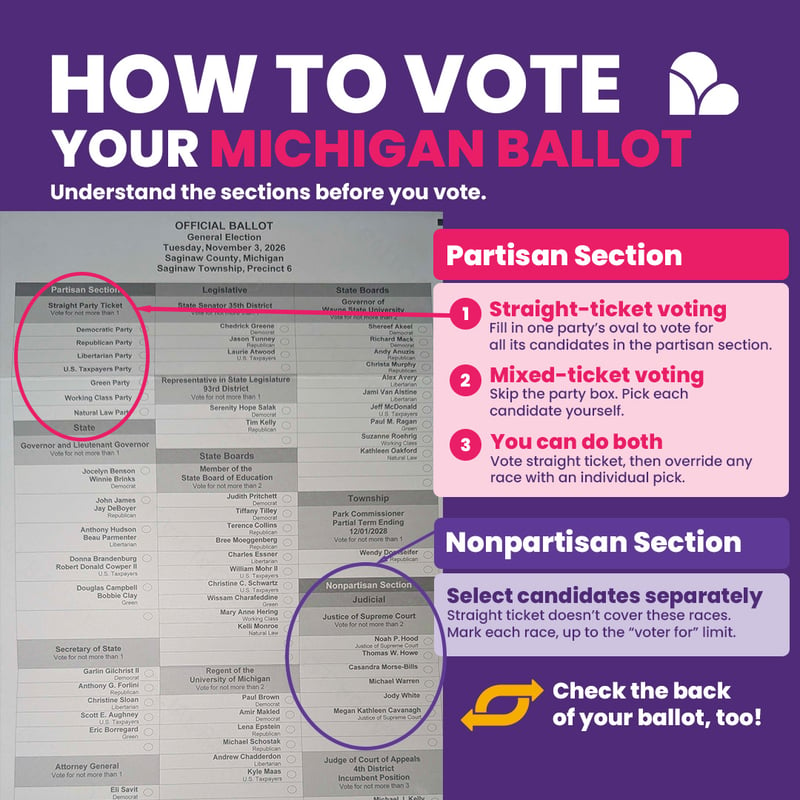
Straight Ticket
At the top of the partisan section is a box labeled "Straight Party Ticket." Fill in one oval next to a party, and that single mark counts as a vote for every candidate of that party in the partisan section, up to the number of seats in each race.
- It only covers races where the party has a candidate. Seven parties appear on this year's ballot, and not every party runs someone in every race. If your party has no candidate in a race, that race is left blank unless you mark it yourself.
- It's a general-election option only. In the August primary, you vote in one party's column and can't cross over.
Straight-ticket voting has a back-and-forth history here. The Legislature eliminated it in 2001, and voters restored it by referendum. Lawmakers eliminated it again in 2015, and voters restored it in the state constitution through Proposal 3 in 2018.
Split Ticket
Mark your straight-party oval, then mark a candidate from a different party (or a write-in) in any individual race. Your direct vote in that race replaces the straight-ticket vote for that office. Every other partisan race still goes to your party's candidates.
If you mark the straight-party oval and also mark a candidate from that same party, nothing goes wrong. The vote counts once.
A practical tip for "vote for 2" races: The state education boards each elect two people. If you want to split one of those races, fill in both of your choices yourself rather than relying on the straight-ticket mark to fill the second slot. That way there's no question about how your ballot is read.
Mixed Ticket
Skip the straight-party box entirely and pick a candidate in each race, from any party. This takes a few more marks, but every choice is one you made directly.
What Does a Straight-Ticket Vote Skip?
Everything outside the partisan section:
- Michigan Supreme Court (candidates are nominated at party conventions, but they appear in the nonpartisan section)
- Court of Appeals, Circuit, Probate, and District judges
- Community college and local school board seats
- All statewide and local proposals
These are the races where people most often stop voting. If you use the straight-ticket option, keep going past the partisan section.
Tips for Marking Your Ballot
- Read the "vote for" line in every race. It changes from race to race: 1, 2, or 3.
- Voting for too many cancels that race. If you mark more candidates than allowed, your vote in that race won't count. The rest of your ballot still counts.
- Voting for fewer is fine. You can leave any race blank or vote for one person in a "vote for 2" race.
- Fill the oval completely. Don't use checkmarks or X's.
- Write-ins need the oval too. Write the name and fill in the oval next to it, or the write-in won't count.
- Turn it over. Proposals are at the end and may be on the back.
- Made a mistake? Ask an election worker for a new ballot. Don't try to erase or cross out.
How Is the Michigan Ballot Organized?
Every Michigan general election ballot is split into three parts, always in this order:
- Partisan section: Candidates run with a party label next to their name. The Straight Party Ticket box is at the top, followed by Governor, Congress, the Legislature, and the state education boards.
- Nonpartisan section: No party labels. Judges, community college trustees, and school board members are here.
- Proposal section: Yes-or-no questions, statewide and local. These are at the end of the ballot and may be on the back.
Some races are the same for every voter in the state. Others depend on your districts. Not sure which districts you're in? Take our Do You Know Your Voting District? quiz.
The Partisan Section
On Every Michigan Ballot
- Governor and Lieutenant Governor (vote for 1 pair). Five tickets. Open seat; Gov. Whitmer is term-limited. Governor voter guide
- Secretary of State (vote for 1). Five candidates. Runs Michigan's elections and Secretary of State offices. Secretary of State voter guide
- Attorney General (vote for 1). Six candidates. The state's chief lawyer. Attorney General voter guide
- U.S. Senator (vote for 1). Six candidates for an open seat. U.S. Senate voter guide
- State Board of Education (vote for not more than 2). Ten candidates. Sets statewide K-12 policy. State Board of Education voter guide
- University of Michigan Regents (vote for not more than 2). Six candidates.
- Michigan State University Trustees (vote for not more than 2). Eleven candidates.
- Wayne State University Governors (vote for not more than 2). Ten candidates.
Many voters are surprised the education boards are partisan races. They are, and a straight-ticket vote includes them. Every Michigan voter votes on all three university boards, no matter where you live. U-M Regents, MSU Trustees & WSU Governors voter guide
Depends on Where You Live
- U.S. Representative (vote for 1). Michigan has 13 congressional districts. U.S. House page
- State Senator (vote for 1). All 38 seats are up this year. Michigan Senate page
- State Representative (vote for 1). All 110 seats are up. Michigan House page
- Local partisan offices. Some ballots include township or county offices with party labels.
Example, Saginaw Township Precinct 6: 8th Congressional District, 35th State Senate District (District 35 voter guide), 93rd State House District, and a partial-term race for Saginaw Township Park Commissioner.
The Nonpartisan Section
No party labels appear here, and a straight-ticket vote doesn't reach it. Sitting judges running for reelection are labeled with their current title on the ballot (for example, "Justice of Supreme Court").
On Every Michigan Ballot
- Michigan Supreme Court (vote for not more than 2). Six candidates, including two sitting justices. The two with the most votes win eight-year terms. Judicial voter guide
Depends on Where You Live
- Court of Appeals. Michigan has four appeals districts; your ballot shows the judges for yours.
- Circuit, Probate, and District Court judges. Set by your county and local court district.
- Community college trustees. If you live in a community college district.
- Local school board. Your school district's board seats. Terms and vote limits vary by district.
Uncontested judicial races still appear on the ballot, and you can vote in them or leave them blank.
Example, Saginaw Township Precinct 6: sitting judges for the 4th District Court of Appeals (three for three seats), 10th Circuit Court, Saginaw County Probate Court, and 70th District Court; Delta College trustee seats for Bay, Midland, and Saginaw counties; and two Saginaw Township Community Schools races side by side, one "vote for 3" and one "vote for 1." That's an easy place to mix up the limits.
The Proposal Section
On Every Michigan Ballot
Proposal 2026-1: Should Michigan hold a Constitutional Convention?
Michigan's constitution automatically puts this question on the ballot every 16 years. Voters said no in 1978, 1994, and 2010. The current constitution came out of the last convention and was adopted in 1963.
- A yes vote starts the process of electing delegates to rewrite the state constitution.
- A no vote keeps the current constitution. The question returns in 2042.
If voters say yes:
- February 2027: Special primary for convention delegates.
- May 2027: Voters elect 148 delegates, one from each State House and State Senate district.
- October 5, 2027: The convention begins in Lansing. There's no set time limit and no fixed budget.
- Afterward: Any proposed changes go to voters for approval, at least 90 days after the convention adjourns.
Supporters say:
- It's a chance for broad reform of government structure, taxes, and operations.
- It gives citizens a way around legislative gridlock.
- Nothing changes unless voters approve it.
Opponents say:
- It could cost millions and create years of uncertainty.
- Well-funded or partisan interests could try to influence delegates.
- The scope is open-ended, so existing protections, including voter-approved amendments, could be reopened.
Who's involved: Opposition is organized under Protect MI Constitution from Special Interests, a bipartisan coalition that includes the Michigan Chamber of Commerce, the Michigan Education Association, the Michigan Catholic Conference, and the League of Women Voters of Michigan. Supporters include Republican consultant Dennis Lennox, who led the 2010 yes campaign. There is no organized yes campaign on the scale of the opposition. More in our Election Issues guide
Proposal 2026-2: Should political contributions from regulated utilities and large government contractors be banned?
- A yes vote bars regulated electric and gas utilities, contractors with more than $250,000 a year in government contracts, and people and groups substantially connected to them from contributing to candidates and officeholders who affect them. It also expands donor disclosure to ads that clearly identify a candidate or ballot question, and applies "paid for by" rules to online political ads.
- A no vote leaves current campaign finance law as it is.
Supporters say:
- It reduces "pay-to-play" risk between companies and the officials who regulate them or award their contracts.
- It makes "dark money" in political ads easier to trace.
- It closes the loophole that lets issue ads skip donor disclosure.
Opponents say:
- It limits the free speech of companies and their employees.
- It singles out some groups while leaving others, like labor unions, unaffected.
- It could face court challenges, and money may shift to other kinds of political spending rather than leave politics.
Who's involved: The ballot committee behind the proposal is Michiganders for Money Out of Politics. The opposition committee is Protect MI Free Speech, a coalition that includes the Michigan Chamber of Commerce. Consumers Energy and Blue Cross Blue Shield of Michigan also oppose it.
Proposal timelines and arguments adapted from a presentation by the League of Women Voters of Saginaw County.
Depends on Where You Live
Local proposals usually ask about millages (a property tax for a specific purpose), bonds (borrowing for buildings or projects), or city charter changes. Your sample ballot shows the full wording.
Example, Saginaw Township Precinct 6:
- Saginaw County 9-1-1 Authority Millage Renewal. Renews 0.28 mill (28 cents per $1,000 of taxable value) for 2028–2037 to replace outdated emergency radio equipment and keep 24-hour 9-1-1 dispatch running. Estimated to raise about $2.03 million in the first year.
- Saginaw ISD Career and Technical Education Millage. Renews the existing 0.9962 mill for 2028–2037 and adds 0.0038 mill, bringing it back to a full 1 mill. The small increase restores what was lost to a state-required rollback (often called a "Headlee rollback"). Estimated to raise about $7.08 million in 2028.
When and How Can You Vote?
- Election Day: Tuesday, November 3, 2026. Polls are open 7 a.m. to 8 p.m.
- Early voting: Saturday, October 24 through Sunday, November 1 statewide. Some communities offer more days. Sites and hours vary.
- Absentee ballots: Must be received by your clerk by 8 p.m. on Election Day. Return it in person or at a drop box if it's close to the deadline.
- Not registered? You can still register and vote in person at your city or township clerk's office through Election Day. Bring proof of residency.
Find your polling place, early voting site, drop box, and your exact ballot at the Michigan Voter Information Center. For more on the basics, see How to Vote in Michigan.
About Michigan Women
Michigan Women is a nonpartisan nonprofit. We don't support or oppose any candidate, party, or proposal. Our job is to help you understand what's on your ballot so you can decide for yourself.
Want updates as the guides change between now and Election Day? Subscribe to our newsletter. If this guide was useful, a small recurring donation helps keep it free for every Michigan voter.