
Last Update: August 7, 2026. Eli Savit vs. Doug Lloyd: who should be Michigan's top cop? A...
What do political labels actually mean? Learn the differences between Democrat, Republican, liberal, conservative, socialist, communist, MAGA and more.
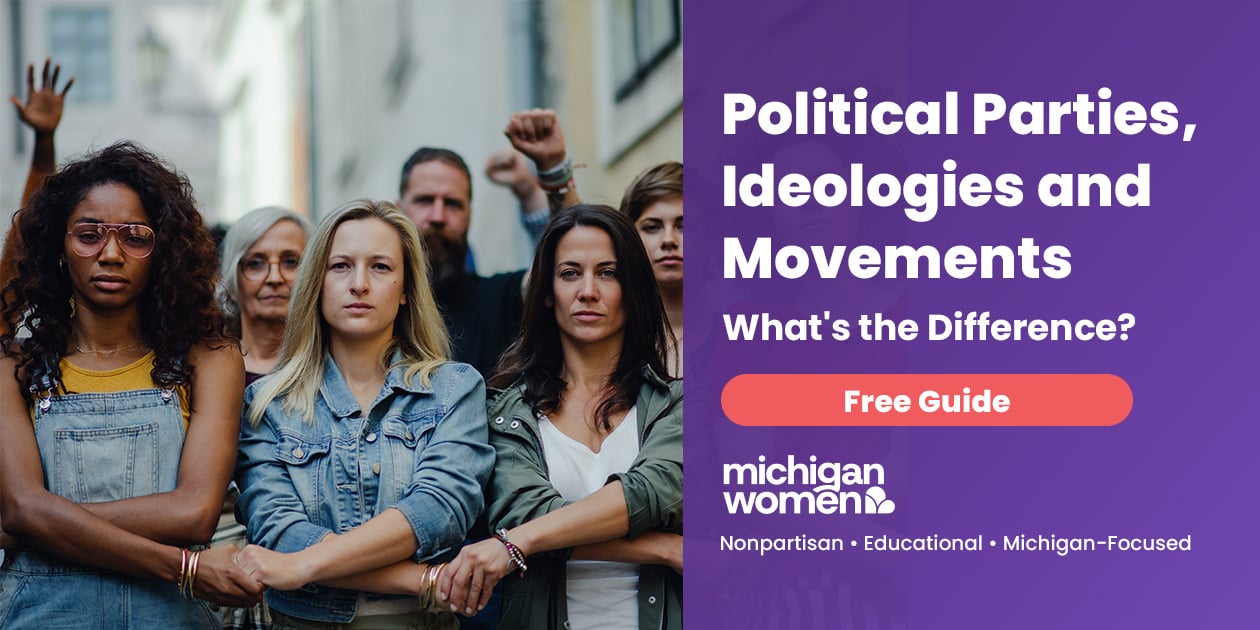
Table of Contents
This guide is designed for easy online navigation with clickable sections. If you would rather download or print a copy, use the PDF option below.
Continue to the Online Navigation 👇
- Introduction
- The Major U.S. Political Parties
- Political Ideologies: What Do You Believe?
- What Is a Liberal?
- What Is a Conservative?
- What Is a Moderate or Centrist?
- What Is a Progressive?
- What Is a Libertarian?
- What Is a Social Democrat?
- What Is a Democratic Socialist?
- What’s the Difference Between a Social Democrat and a Democratic Socialist?
- What Is a Socialist?
- What Is a Communist?
- What Is a Nationalist?
- What Is a Populist?
- What Is a Fascist?
- Political Movements and Factions
- Why These Distinctions Matter
- Keep Exploring
Introduction
Before we talk about Democrats, Republicans, socialists, conservatives, MAGA, communists, or fascists, there's an important distinction to make:
These words don't all describe the same thing.
A political party is an organization that recruits candidates, contests elections and tries to turn its priorities into public policy.
A political ideology is a set of ideas about how government, the economy and society should work.
A political movement organizes people around particular goals or beliefs and may operate inside a political party, outside of one, or both.
One person can belong to all three categories at the same time.
- Someone might be a Republican by party, conservative by ideology and part of the MAGA movement.
- Someone else might be a Democrat by party, progressive by ideology and active in the labor movement.
And plenty of Americans don't fit neatly into any of those boxes.
That's why these labels can tell us something about a person without telling us everything.
The Major U.S. Political Parties
The United States has more than two political parties, although the Democratic and Republican parties overwhelmingly dominate American elections.
Democratic Party
The Democratic Party is one of America's two major political parties.
Its current national platform supports a significant role for government in areas including healthcare, education, infrastructure, environmental protection, worker and consumer protections, civil rights and economic opportunity. It generally supports a market economy combined with public investment, regulation and social programs.
But Democrats don't all believe the same things. The party includes centrists and moderates, liberals, progressives and some democratic socialists.
Read the 2024 Democratic Party Platform
Parties generally adopt their formal platforms during presidential-election years, at their national conventions. The most recent presidential election was 2024, so those are still the latest formal national party platforms in 2026.
Republican Party
The Republican Party is America's other major political party.
Its current national platform emphasizes individual freedom, economic growth, lower taxes and regulation, border enforcement, public safety, gun rights, energy production, religious liberty, national defense and limiting federal power in a number of areas.
Republicans don't all believe the same things either. The coalition includes traditional conservatives, social conservatives, economic conservatives, libertarian-leaning Republicans, populists and the MAGA movement.
Read the 2024 Republican Party Platform
Parties generally adopt their formal platforms during presidential-election years, at their national conventions. The most recent presidential election was 2024, so those are still the latest formal national party platforms in 2026.
Libertarian Party
The Libertarian Party places individual liberty at the center of its philosophy.
It argues that people should generally be free to make their own economic and personal decisions as long as they don't violate the rights of others. The party supports free markets, strong civil liberties and substantially less government involvement in both economic and personal life.
That produces a combination that doesn't always fit the familiar Democratic-Republican divide. Libertarians may agree with Republicans on reducing taxes or regulation while agreeing with Democrats on some civil-liberties or personal-freedom issues.
Read the Libertarian Party Platform
Green Party
The Green Party is a left-wing political party organized around four broad pillars: ecological wisdom, social justice, grassroots democracy and nonviolence.
Its platform includes environmental and climate action, economic and social justice, stronger democratic institutions and significant changes to the economic and political status quo.
Constitution Party
The Constitution Party is a political party on the right that advocates a much more strictly limited federal government.
Its platform emphasizes an originalist interpretation of the Constitution, states' rights, religious and socially conservative principles, private property, gun rights and eliminating federal activities it believes aren't authorized by the Constitution.
Read the Constitution Party Platform
Reform Party
The Reform Party describes itself as a centrist, citizen-driven alternative to the Democratic and Republican parties.
Its platform emphasizes government ethics, fiscal responsibility, election reform and reducing the influence of entrenched partisan interests.
Read the Reform Party Platform
There are additional minor and state-specific political parties in the United States. The parties listed are some of the principal national parties you're most likely to encounter in discussions about alternatives to the Democratic-Republican system.
Political Ideologies: What Do You Believe?
This is where things get more complicated.
Being a Democrat or Republican tells us which political organization someone identifies with. Words like liberal, conservative, progressive and socialist describe ideas.
Those ideas can exist inside more than one party.
What Is a Liberal?
In modern American politics, liberals generally believe individual rights and a market economy can coexist with an active government that regulates markets, provides public services and intervenes when necessary to address inequality, discrimination or other social and economic problems.
Most American liberals currently align with the Democratic Party.
But liberal does not mean Democrat, and liberalism does not mean socialism.
What Is a Conservative?
Conservatives generally emphasize limited government, individual responsibility, private property, free enterprise, public order and the preservation of institutions and traditions they believe have demonstrated value.
Conservative thought also tends to be more cautious about rapid government-led change and more concerned about unintended consequences and concentrations of government power.
Most American conservatives currently align with the Republican Party.
But conservative does not mean Republican.
What Is a Moderate or Centrist?
Moderates or centrists generally hold views that fall between—or combine elements of—the country's major ideological camps.
A moderate Democrat might support a strong social safety net while being more cautious about government spending.
A moderate Republican might favor lower taxes and less regulation while taking more liberal positions on social issues.
"Moderate" doesn't necessarily mean splitting every issue down the middle. Someone can hold strong positions that simply don't line up consistently with one ideological camp.
What Is a Progressive?
Progressives are generally on the political left and share many goals with liberals but tend to advocate more substantial structural change.
Modern American progressives often emphasize economic inequality, concentrated corporate power, labor rights, universal public programs, climate action and reforms to political and economic institutions.
Most progressives operate within or vote with the Democratic coalition, but not every Democrat is progressive.
What Is a Libertarian?
Libertarianism is both an ideology and the philosophy behind the Libertarian Party.
Libertarians put individual liberty at the center of political decision-making and generally favor less government involvement in both the economy and people's personal lives.
Someone can have libertarian beliefs without belonging to the Libertarian Party. There are libertarian-leaning Republicans, independents and others.
What Is a Social Democrat?
Social democrats generally support a predominantly capitalist, market-based economy combined with a strong social safety net, worker protections, regulation and broadly available public services.
Rather than eliminating capitalism, social democracy generally seeks to make a capitalist economy produce greater economic security and more broadly shared prosperity.
This distinction becomes important when the word "socialist" gets used in American political arguments.
What Is a Democratic Socialist?
Democratic socialism goes further.
Democratic socialists seek to expand democratic control beyond government and into economic institutions themselves.
The Democratic Socialists of America, the largest U.S. democratic socialist organization, says its vision goes beyond traditional social democracy and advocates collective ownership of key parts of the economy, such as energy and transportation.
What’s the Difference Between a Social Democrat and a Democratic Socialist?
There is a meaningful distinction:
- Social democracy generally seeks to reform and regulate capitalism.
- Democratic socialism ultimately seeks to change who owns or controls significant parts of the economy.
Democratic socialism also isn't synonymous with the Democratic Party. The Democratic Socialists of America is a political organization, not the Democratic Party, although many candidates it supports run as Democrats.
Read DSA's explanation of democratic socialism
What Is a Socialist?
Socialism is a much broader family of political and economic ideas.
At its core is the belief that economic resources and the means of producing goods and services should be subject to substantially greater social, worker, collective or public ownership or control rather than being predominantly controlled by private owners of capital.
There are many forms of socialism, and socialists disagree about ownership, markets, government and how economic decisions should be made.
That's one reason simply calling someone a "socialist" doesn't tell you exactly what that person believes.
What Is a Communist?
Communism is a political and economic tradition that seeks to replace capitalism and private ownership of the major means of production with common ownership, with the theoretical ultimate goal of a classless society.
In practice, 20th-century governments identifying as communist—including the Soviet Union and Maoist China—developed centralized economies and authoritarian one-party political systems.
A communist is not simply someone who supports government programs, higher taxes, universal healthcare or greater regulation of capitalism.
Democrat, liberal, progressive, social democrat, democratic socialist, socialist and communist are not interchangeable terms.
What Is a Nationalist?
Nationalism places strong emphasis on the interests, identity, sovereignty and cohesion of the nation.
Nationalism can take different forms and isn't automatically left-wing or right-wing. It can emphasize national independence and self-government, or it can become associated with exclusionary ideas about who truly belongs to the nation.
In contemporary American politics, nationalist ideas are most visible within parts of the political right.
What Is a Populist?
Populism generally frames politics as a struggle between "ordinary people" and a powerful or corrupt elite.
Importantly, populism isn't inherently left or right.
A left-wing populist might attack wealthy corporations, billionaires and economic elites.
A right-wing populist might attack political establishments, government bureaucracies, universities, media organizations or global institutions.
Both are using a similar political frame: the people versus the establishment.
What Is a Fascist?
Fascism has a specific historical and political meaning. It isn't simply another word for "authoritarian" or for a politician someone strongly dislikes.
Historically, fascist movements have been characterized by extreme nationalism, authoritarian leadership, rejection of liberal democratic constraints, suppression of political opposition and the elevation of the nation or collective above individual rights. Fascist movements have also historically embraced or legitimized political violence.
That doesn't mean the word can never accurately describe a contemporary political movement or behavior.
It means that, like "communist," it should describe identifiable characteristics—not simply communicate that the speaker thinks someone is dangerous or extreme.
Political Movements and Factions
Finally, some of the labels we hear constantly aren't parties or complete political ideologies. They're movements or factions operating within the larger political system.
What Is the MAGA Movement?
MAGA—"Make America Great Again"—is a political movement built around Donald Trump that has become a dominant force within today's Republican Party.
It generally combines populism, nationalism, stricter immigration enforcement, skepticism toward established political and governmental institutions, an "America First" approach to foreign and economic policy, and strong identification with Trump.
MAGA and Republican aren't synonymous. Someone can be a Republican without identifying with MAGA, although the movement currently exercises substantial influence within the Republican Party.
What Are the Democratic Socialists of America?
The Democratic Socialists of America is a political organization promoting democratic socialism.
It isn't the Democratic Party, and "Democratic" in its name doesn't mean that democratic socialism is the ideology of the Democratic Party.
DSA-backed candidates frequently participate in Democratic primaries and caucus with Democrats after being elected, which is one reason the distinction can become confusing.
Learn about Democratic Socialists of America
What Is the Progressive Movement?
The modern progressive movement isn't a separate national political party.
It is a broad political movement advocating policies and structural changes associated with the American political left. Most nationally prominent progressive elected officials currently operate within the Democratic Party.
Again:
Progressive and Democrat aren't synonyms.
Why These Distinctions Matter
Now look at what happens in political rhetoric.
Democrat → liberal → progressive → socialist → communist
or:
Republican → conservative → MAGA → nationalist → fascist
Those aren't definitions.
They're a series of labels being collapsed into one another.
Someone can certainly hold beliefs that fit more than one of those descriptions. And sometimes a serious examination of someone's positions may justify a particular ideological label.
But the label should follow the evidence—not replace it.
If you want to understand what a candidate actually believes, don't stop when someone tells you they're a Democrat, Republican, socialist, conservative, progressive or MAGA.
Look at what they're actually proposing to do.
Keep Exploring
Political labels tell us something about how people organize and think about government — but they're only part of the picture.
👉 Next Article >> What Do Democrats and Republicans Believe—and Why?
👈Previous Article>> Why Do We Have Political Parties?
👇Full Guide >> Get all the articles in the series in one document for the full discussion of political parties, political beliefs, psychology, rhetoric and how we work together when we disagree.
Beyond Political Labels: How We Think, Govern, and Build Thriving Communities
Get the Guide: https://e9ffr.share.hsforms.com/2ndWeQlemTUyjXri_IwFYZA
Content Disclaimer: Our team researches information from official websites, news outlets, and other public resources to make it easier for Michigan residents to stay informed. We strive to provide accurate, balanced, and up-to-date information, but we may occasionally miss updates or changes. Michigan Women is a 501(c)(3) non-profit organization and does not support or oppose any political candidate or party. This content is intended solely for civic education and public awareness.