

Last Update: June 26, 2026. Eli Savit vs. Doug Lloyd: who should be Michigan's top cop? A...
Last Update: June 26, 2026. Garlin Gilchrist vs. Anthony Forlini: who should run Michigan's elections? A plain-language guide to the 2026 Secretary of State race.
Table of Contents
This guide is designed for easy online navigation with clickable sections. If you’d rather download or print a copy, you can get the full PDF version.
Or Continue to the Online Navigation Below 👇
About the Secretary of State
- Introduction
- Current Secretary of State, Jocelyn Benson
- How Long is the Term and Term Limits
- What Does the Michigan Secretary of State Do?
- What to Look for in a Secretary of State
- How Michigan Picks Party Nominees for Secretary of State
- What the Candidates are Talking About
Democratic Candidate
Garlin Gilchrist, Michigan Lieutenant Governor ✅
Republican Candidate
Anthony Forlini, Macomb County Clerk ✅
Dropped Out / Unendorsed Candidates
Unendorsed Candidates
- Barb Byrum, Ingham County Clerk
- Suzanna Shkreli, Former Michigan Lottery Commissioner
- Monica Yatooma, GEIA, Director of Development & Strategic Partnerships
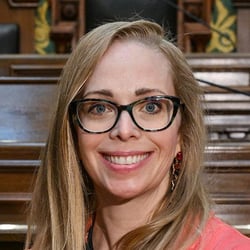
- Amanda Love
- Timothy Smith, Gentex
Dropped Out
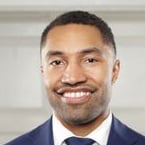
- Adam Hollier (D), Army Reserves, Former MI State Senator
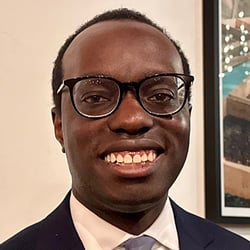
- Aghogho Edevbie (D), MI Deputy Secretary of State
More Insights
About the Secretary of State
Introduction
Michigan's next Secretary of State will run our elections. Who should it be?
This is one of the most consequential — and most overlooked — races on the 2026 ballot.
The basics
Jocelyn Benson has held the position for eight years, but term limits mean she's out — and she's running for governor instead. That means Michigan will have a brand-new Secretary of State in 2027, at a time when election administration, voter access, and government transparency are hotter topics than ever.
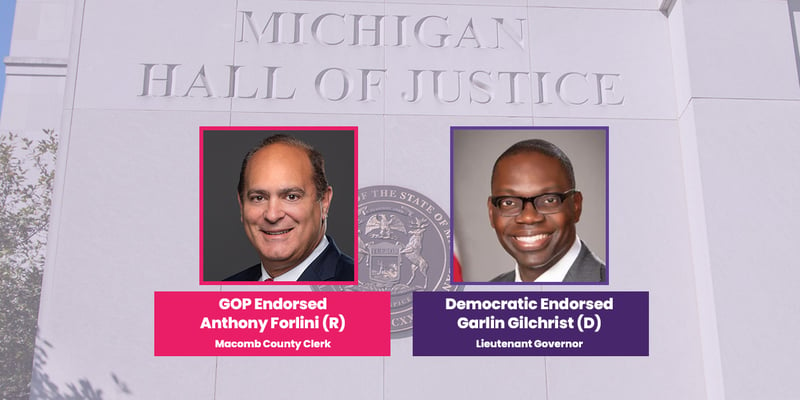
Unlike the governor's race, this one skips the August primary. Michigan's two major parties pick their Secretary of State nominee at conventions, not at the ballot box. Both parties have already chosen: Democrats nominated Lt. Gov. Garlin Gilchrist on April 19, 2026, and Republicans nominated Macomb County Clerk Anthony Forlini on March 28, 2026. With no other candidates qualifying for the ballot, this is a clean two-person race heading into November.
Where things stand
The field narrowed early and stayed narrow. On the Democratic side, Gilchrist defeated Ingham County Clerk Barb Byrum and former Lottery Commissioner Suzanna Shkreli on the first ballot at the April convention. On the Republican side, Forlini defeated Oakland County activist Monica Yatooma and Clarkston school board member Amanda Love, winning outright on the first ballot in March.
That leaves two active candidates heading into November: Democrat Garlin Gilchrist and Republican Anthony Forlini.
The polling
No independent poll has tested a Gilchrist vs. Forlini general-election matchup yet. Gilchrist's campaign released an internal poll in June showing him leading 44% to 40%, but as a campaign-sponsored poll it should be read with that caveat in mind — campaigns typically release internal numbers that favor them, and the methodology hasn't been independently reviewed.
The money
Fundraising plays a smaller role in this race than in the governor's race, since neither candidate had to win a primary — only convince convention delegates. Michigan Bureau of Elections filings show Forlini's committee, "CTE Anthony G Forlini," with a closing balance of $135,330.04 as of December 31, 2025, up from $42,827.73 three months earlier.
Gilchrist's financial picture is split across two committees because of his January switch from the governor's race. His original committee, "Garlin Gilchrist for Governor," held $262,764.24 in cash on hand as of December 31, 2025 — down from $378,457.17 three months earlier, reflecting wind-down spending before the switch. His new Secretary of State committee, "Garlin Gilchrist for Michigan," was organized January 12, 2026, but had not yet filed a campaign statement as of the most recent filing period reviewed for this guide, so it isn't possible to confirm how much of that money has been transferred into the SOS race or what's been raised since. Michigan campaign finance rules generally allow candidates to transfer funds between their own committees when switching races.
The national environment
This race is playing out against an unusually charged national backdrop on voting rules. At the federal level, the SAVE Act would require documentary proof of citizenship to register to vote (i.e., birth certificate) — Congress has been fighting over a version of it for over a year, and it keeps resurfacing tied to other legislation.
Michigan has its own parallel fight in HB 4765, a state bill that would have the Secretary of State verify voter citizenship using state and federal databases rather than requiring upfront documentation. For the details on what each version would actually require and where they stand, see our guide: The SAVE Act: What It Is, Why It Was Proposed, and What It Could Change.
Layer on top of that the federal subpoena to Macomb County over noncitizen voting claims, and the Americans for Citizen Voting ballot initiative that would add a citizenship-verification requirement to Michigan's constitution — and it's clear the next Secretary of State won't just be running elections day-to-day. They'll be the one implementing whatever comes out of this fight, whether that's a new federal mandate, a new state law, or a voter-approved constitutional amendment.
Current Secretary of State: Jocelyn Benson (D)
 |
|
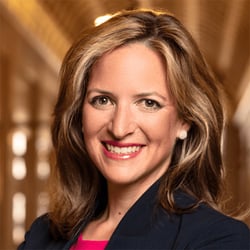
Jocelyn Benson, Michigan's current Secretary of State, is term-limited and cannot seek reelection in 2026 after serving the maximum two four-year terms. As a result, the office will be open in the next election cycle.
Benson has announced that she is running for governor, shifting her focus from election administration to a statewide executive campaign. Her decision to pursue the governorship is one reason the 2026 Secretary of State race is drawing early attention, as it marks a leadership transition in an office that plays a central role in Michigan elections and public records.
How Long is the Term and Term Limits
- Term length: 4 years
- Term limits: 2 terms (8 years total)
- Next Election: November 2026
What Does the Michigan Secretary of State Do?
The Michigan Secretary of State is one of the state's most important administrative and election-related offices. The role combines election oversight, business services, and record-keeping, all of which affect nearly every resident.
At a high level, the Secretary of State is responsible for:
- Overseeing elections
- Administers statewide elections
- Certifies election results
- Provides guidance and oversight to local election officials
- Helps ensure election laws and procedures are followed
- Managing voter access and registration
- Oversees voter registration systems
- Maintains statewide voter rolls
- Implements election-related policies approved by law or ballot initiative
- Running Michigan's driver and vehicle services
- Oversees driver's licenses and state ID cards
- Manages vehicle titles, registrations, and license plates
- Operates branch offices and online services
- Maintaining public and business records
- Registers businesses and nonprofits
- Oversees campaign finance and lobbying disclosures
- Maintains official state records and filings
- Enforcing transparency and compliance
- Administers campaign finance reporting systems
- Ensures political committees and candidates file required disclosures
- Makes election and finance data publicly accessible
While the office does not make laws, it plays a central role in how elections function in practice and how accessible and transparent key government services are for Michigan residents.
What to Look for in a Michigan Secretary of State
Once you understand what the office does, the next question is: what kind of experience and leadership help someone do the job well? Because the Secretary of State primarily has an administrative and oversight role, a candidate's management ability and operational judgment matter a lot.
- Operational leadership: Experience running complex systems, large teams, or public-facing services at scale.
- Election administration knowledge: Familiarity with how elections are conducted, the role of local clerks, and how statewide guidance is implemented.
- Transparency and compliance mindset: A track record of following rules, disclosing information properly, and protecting the integrity of public reporting systems.
- Clear communication under pressure: Ability to explain processes and decisions calmly, accurately, and consistently during high-attention moments.
- Role clarity: Understanding what the office can and cannot do under Michigan law, court decisions, and voter-approved policies.
- Service delivery focus: Commitment to improving everyday services like IDs, titles, registrations, and online/branch office experiences.
- Collaboration skills: Ability to work effectively with clerks, the legislature, the governor's office, courts, and the public.
How Michigan Picks Party Nominees for Secretary of State
Michigan doesn't hold public primaries for most statewide offices—including Secretary of State, Attorney General, Michigan Supreme Court, and state university boards. Instead, each political party selects its nominees at conventions, where credentialed delegates decide who appears on the November general election ballot.
Read, How Michigan Chooses Nominees for Statewide Offices, to learn how the process works, how early endorsements have shifted the political calendar, and how you can participate in shaping who makes it to the general election.
What Are the Candidates Talking About?
The 2026 Secretary of State race is shaping up around a few core themes. Here's a plain-language look at where the two parties generally stand.
Election Integrity & Voter Rolls
Both parties say they want secure, accurate elections — but they mean different things. Democrats argue Michigan's elections are already secure, have withstood multiple audits, and that claims of widespread fraud are overstated. Republicans argue more needs to be done to verify voter eligibility, particularly around citizenship verification, and want a Secretary of State who will actively investigate and clean up the voter rolls.
Proof of Citizenship to Vote
This is one of the sharpest dividing lines in the race. Republican candidates generally support requiring voters to prove citizenship when registering, pointing to federal efforts like the SAVE Act. Democratic candidates say noncitizen voting is already illegal with multiple safeguards in place, and that adding documentation requirements would make it harder for eligible voters to participate.
Modernizing State Services
This one crosses party lines. Candidates on both sides say the Secretary of State's office — including branch offices, vehicle registration, and the state's campaign finance reporting system — needs to be updated and made more user-friendly. Democrats tend to frame this as expanding access and improving the experience for all residents. Republicans tend to frame it as reducing bureaucracy and streamlining operations.
Federal Overreach & State Authority
Democratic candidates have been vocal about protecting Michigan's authority to run its own elections and pushing back against federal attempts to nationalize election administration. Republican candidates are generally more aligned with the current federal administration's direction on elections.
Issues, positions, and candidates can change as the race develops. Michigan Women will continue tracking the race and sharing updates.
Benson's Conflict of Interest and Election Oversight
One of the most debated questions heading into 2026 is whether Michigan's current Secretary of State can fairly administer an election in which she is a candidate.
Jocelyn Benson is running for governor while simultaneously serving as Michigan's chief election official. In November 2025, a group of 22 Republican state lawmakers wrote to U.S. Attorney General Pam Bondi requesting that the DOJ deploy monitors to Michigan vote-counting facilities, citing what they called "an inherent and unavoidable conflict of interest." Several Republican gubernatorial candidates, including Aric Nesbitt and Perry Johnson, publicly called on Benson to recuse herself from election oversight entirely.
In May 2026, Benson responded by announcing a formal "firewall" policy — developed with help from the nonpartisan Election Reformers Network — under which she recuses herself from all decisions and administrative tasks that have a direct impact on the gubernatorial race. Under the policy, the nonpartisan Bureau of Elections handles those functions independently and does not share its work with Benson until decisions are finalized.
Context worth knowing: Michigan's elections are administered at the local level by county and municipal clerks. State-level functions are carried out by nonpartisan civil servants in the Bureau of Elections. The Secretary of State does not handle ballots or signatures directly. The Republican chair of the Board of State Canvassers has noted that Benson has never attended a board meeting during his tenure. Past secretaries of state — including Republican Ruth Johnson — have also overseen elections in which they personally appeared on the ballot.
Democratic candidates in the SOS race generally support Benson's firewall approach and argue the system's existing safeguards are sufficient. Republican candidates have been more skeptical, arguing that external oversight is warranted regardless of the firewall policy.
Vote Counting and Election Equipment
How Michigan counts votes has become an increasingly contested topic — and the next Secretary of State will have real authority over the systems and standards involved.
Michigan uses a decentralized vote-counting system. Ballots are counted at the local level by municipal and county clerks using optical scan tabulators — machines that read paper ballots and produce a count that can be audited against the physical paper. Results are then submitted to county canvassers for certification before routing to the Bureau of Elections at the state level. The Secretary of State does not directly handle ballots, signatures, or tabulation equipment.
Despite that structure, the integrity of vote counting has become a live issue in this race. Republican candidates have generally emphasized the need for greater transparency in tabulation and stronger oversight of local clerks. Some have raised questions about electronic voting equipment, though Michigan's system uses paper ballots that provide an auditable record. Democratic candidates have pushed back on what they describe as unfounded claims about counting accuracy, pointing to Michigan's post-election audit processes and the multiple layers of bipartisan oversight already built into the system.
What to watch: Whether any candidates formally call for hand counting of ballots — a practice election administrators across both parties have warned is slower, more error-prone, and more expensive than machine tabulation — and how the next SOS responds to continued pressure around tabulation transparency.
Poll Watchers and Voter Intimidation Concerns
Republican U.S. Senate candidate Mike Rogers drew attention in May 2026 when an audio recording obtained by the Detroit News revealed he had called for recruiting off-duty or retired police officers as poll watchers in Detroit. Critics — including civil rights organizations — said the proposal echoed historical tactics used to intimidate voters of color at polling places. Rogers's campaign did not dispute the recording.
While Rogers is a Senate candidate rather than an SOS candidate, the episode is relevant to the SOS race because poll watcher rules, conduct standards, and enforcement fall within the Secretary of State's jurisdiction. How each SOS candidate responds to questions about poll watcher guidelines and voter intimidation prevention is a legitimate issue for voters to evaluate.
Democratic Candidate
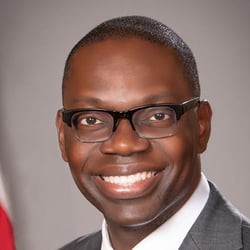
The Michigan Democratic Party held its endorsement convention on April 19, 2026, in Detroit, where party members voted to back Garlin Gilchrist for Secretary of State ahead of the November General Election.
DEMOCRATIC ENDORSED: Garlin Gilchrest (D)
 |
|
Positions
- Protect voter data and privacy from federal data-sharing requests and “Big Tech” overreach — a centerpiece of his campaign
- Continue modernizing licensing, registration, and branch-office services statewide
- Hold companies accountable for auto repair scams
- Push back on federal efforts to “nationalize” election administration and preserve state control over Michigan's elections
- Says “vanishingly few” noncitizens actually vote, but supports holding anyone who does accountable “to the fullest extent of the law”
- Advocate for campaign finance reform legislation
Endorsements
Won the Democratic nomination outright on the first ballot at the April 19, 2026 convention, defeating Ingham County Clerk Barb Byrum and former Lottery Commissioner Suzanna Shkreli.
Career
- Lieutenant Governor of Michigan since 2019, serving under Gov. Gretchen Whitmer
- Ran for Detroit City Clerk in 2017, losing to longtime Clerk Janice Winfrey by fewer than 1,500 votes
- Worked as a software engineer at Microsoft, where he helped build SharePoint; later served as the City of Detroit's Director of Innovation, where he created the Improve Detroit app
- Briefly ran for governor in 2026 before switching to the Secretary of State race in January
Personal
- Born September 25, 1982; grew up in metro Detroit
- Graduate of the University of Michigan
- f elected, would be only the second Black Secretary of State in Michigan's history, after Richard H. Austin (1971–1995)
Race Note
Gilchrist has criticized Forlini in sharp terms, at one point calling him a “MAGA extremist” who would “weaponize voters' private data.” Forlini responded by pointing to Detroit News reporting that Gilchrist has attended only about 6% of his presiding duties over the Michigan Senate as lieutenant governor, contrasting it with his own attendance record as a state representative. Both lines of attack are about character and performance rather than substantive policy disputes, and voters can weigh them as they see fit.
Republican Candidate
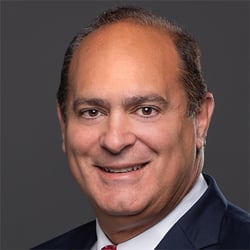
The Michigan Republican Party held its early endorsement convention on March 28, 2026, where party delegates voted to back Anthony Forlini as their preferred candidate for Secretary of State ahead of the November general election.
GOP ENDORSED: Anthony Forlini (R)
 |
|
Positions
- Require government verification of voter citizenship, rather than relying on self-attestation alone
- Clean up Michigan's voter rolls and expand local clerks' access to federal citizenship-verification tools like the SAVE database
- Provide additional training and resources for local election workers
- Modernize branch-office and vehicle-registration services, framed around reducing bureaucracy and cutting wait times
- Increase transparency and oversight of vote tabulation
- Has teamed up with Americans for Citizen Voting, the group behind the proof-of-citizenship ballot initiative described above
Endorsements
Won the Republican nomination on the first ballot at the March 28, 2026 convention with 55% of the vote, defeating Oakland County activist Monica Yatooma (25%) and Clarkston school board member Amanda Love (19%).
Career
- Macomb County Clerk since 2020, reelected in 2024
- Served in the Michigan House of Representatives, 2011–2016
- Supervisor of Harrison Township earlier in his career
- Ran unsuccessfully for Michigan's 10th Congressional District in 2016
- As clerk, conducted a forensic audit of the 2020 election in Macomb County that found no outside interference, and introduced watermarked ballot paper and tabulator hash validation to verify election software hasn't been tampered with
Personal
- Born February 4, 1962; lifelong resident of Macomb County
- Graduate of Western Michigan University
- Married to Diane Forlini for 40 years; they have three adult children and four grandchildren
Race Note
Forlini has drawn national attention for his noncitizen-voter claims in Macomb County. In January, he compared the county's voter rolls to a list of people who had claimed noncitizen status to get out of jury duty, initially flagging 15 names.
A state review later found that of those 15, several were eligible citizens, several were confirmed noncitizens (some already removed from the rolls), and a few remained under review. In May, Forlini told Votebeat he had identified additional names by informally collaborating with federal officials who have access to the SAVE citizenship database, though he said he did not have direct access himself and could not specify which federal agency he was working with.
In June, Votebeat reported that Homeland Security Investigations had subpoenaed Macomb County in January for “all available information” on noncitizen voters as part of an active federal investigation — a Michigan Department of State spokesperson said she was not aware of any other Michigan county receiving a similar subpoena.
Forlini's supporters see this as diligent oversight; critics, including Secretary of State Benson, have called some of his claims overstated and warned that comparing jury-duty exemptions to voter rolls is a known source of false positives, since people can share similar or identical names and addresses.
Unendorsed Candidates
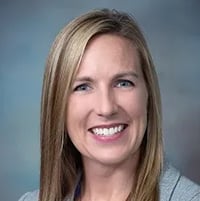
Barb Byrum (D)
 |
|
Update (April–May 2026): Byrum did not receive the Democratic endorsement at the April 19 convention, where Garlin Gilchrist was endorsed. She has not conceded the race and can still collect petition signatures to appear on the November ballot. Following the convention, Byrum raised concerns about the process itself — specifically the use of electronic voting and a reported instance of a delegate voting from home rather than in person. She called for the convention to use paper ballots and renewed her support for moving SOS nominations to a primary election. Byrum said she supports a primary only if it happens earlier in the year, similar to the spring endorsement conventions both parties have already adopted, arguing that an August primary would disadvantage candidates on fundraising and messaging.
Articles
- 2026-02-02 Ep. 48: Good Trouble, No Gatekeeping: A Conversation with Barb Byrum (Beyond Resistance)
- 2025-03-07 Democrat Barb Byrum launches campaign to become Michigan Secretary of State (Detroit Free Press)
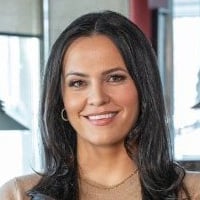
Suzanna Shkreli (D)
 |
|
Articles
- 2025-12-08 Michigan lottery commissioner resigns to run for secretary of state (Detroit Free Press)
Monica Yatooma (R)
 |
|
Articles
- 2026-02-02 Straw Poll Winner: Amanda Love Takes 54% in Sold-Out GOP SOS Debate; Monica Yatooma 46%; Anthony Forlini Absent (0%) (Michigan Fair Elections Institute)
- 2026-01-25 Monica Yatooma on "tabulators" and more... (Efrain Mgr)
- 2026-01-24 Meet SOS Candidate Monica Yatooma (Efrain Mgr)
- 2026-01-09 Monica Yatooma for MI SOS 2026 (MI True Red)
- 2025-11-15 Michigan Moms, Sex Ed & Election Integrity — LIVE with Monica Yatooma (Rising Above Podcast)
- Monica Yatooma announces her candidacy for Michigan Secretary of State (CBS News Detroit)
Amanda Love (R)
 |
|
Articles
- 2026-02-02 Straw Poll Winner: Amanda Love Takes 54% in Sold-Out GOP SOS Debate; Monica Yatooma 46%; Anthony Forlini Absent (0%) (Michigan Fair Elections Institute)
- 2026-01-24 Meet SOS Candidate Amanda Love (Efrain Mgr)
- 2026-01-11 Inside the Michigan Secretary of State Race: Amanda Love Discusses Election Integrity (Jose Aliaga)
Timothy Smith (R)
 |
|
Dropped Out Candidates
Adam Hollier (D)
 |
|
Articles
- 2026-02-03 Detroit Democrat drops out of Secretary of State race (MLive)
- 2026-02-02 Adam Hollier drops secretary of state bid, enters State Senate District 3 race (The Arab American News)
- 2025-09-10 Ex-state senator Adam Hollier ends bid for Congress, joins race for Michigan secretary of state (Michigan Advance)
Aghogho Edevbie (D)
 |
|
Articles
- 2026-01-16 Aghogho Edevbie exits Michigan Secretary of State race (Detroit Free Press)
- 2025-02-06 Edevbie racks up endorsements in Michigan secretary of state bid, adding two sitting legislators (Michigan Advance)
Political Committees
Understanding political committees and campaign finance laws is crucial for informed voting. The following committees and organizations are political action committees (PACs) that have registered campaign activity related to the Secretary of State race. They are not candidates.
You can search the full list of active committees through the state's campaign finance portal at https://mi-boe.entellitrak.com/.
-
- Jaffe Snider Raitt Heuer and Weiss Political Committee — Michigan law firm PAC. https://www.jaffelaw.com/
- Kevin Coleman Future Leaders Fund — Political leadership PAC. No public website identified.
- UNITE HERE TIP Campaign Committee – Michigan — Labor union PAC representing hospitality workers. https://unitehere.org/
- End Citizens United Non-Federal — National campaign finance reform PAC. https://endcitizensunited.org/
- Conservative Voices — Ideological advocacy PAC. No public website identified.
- Joe Aragona for Majority — Leadership PAC affiliated with Michigan State Rep. Joe Aragona (R, District 60, Macomb County). No dedicated PAC website; Rep. Aragona's campaign site is https://josepharagonaforhouse.com/
- Michigan Legacy PAC — Michigan-based PAC. No public website identified.
- CandicePAC — Candidate-named PAC. No public website identified.
- Advancing for Detroit and MI PAC — Founded by former State Sen. Adam Hollier (D-Detroit). No public website identified.
- Michigan Aggregates Association — Industry trade association PAC representing the aggregates (sand, gravel, crushed stone) industry. https://www.michiganaggregates.org/
- Chaldean Chamber Political Action Committee — Political arm of the Chaldean American Chamber of Commerce. https://www.chaldeanchamber.com/
- Michigan Boating Industries Association PAC — Marine industry trade association PAC. https://www.mibia.org/
- Plumbers and Pipefitters Local 333 PAC — Labor union PAC. https://ua333.org/
- Michigan Motorcycle Riders PAC — No public website identified. (Likely affiliated with ABATE of Michigan or a similar motorcyclist rights organization — https://abateofmichigan.org/ — but no confirmed direct link to this specific PAC.)
- Michigan Manufactured Housing RV and Campground Assn PAC — Trade association PAC for the manufactured housing, RV, and campground industries. https://www.michhome.org/ (MMHA) / https://www.michiganrvandcampgrounds.org/ (MARVAC division)
- Miller Canfield PAC — Law firm PAC. https://www.millercanfield.com/
- United Food and Commercial Workers Active Ballot Club — Labor union PAC (UFCW). https://www.ufcw.org/
- Plumbers and Steamfitters Local 85 PAC — Labor union PAC. https://www.local85.org/
Learn about their roles, regulations, and how to stay informed: What Are Political Committees (PACs) in Elections.
How to Vote in Michigan
Knowing who's running is only half the equation. Here's how to make sure your vote actually counts on November 3rd.
Look up your personal voter information
The Michigan Voter Information Center has everything you need in one place. Enter your information at mvic.sos.state.mi.us and you'll see:
- Whether you're registered to vote
- Your polling location on Election Day
- Your early voting location and hours
- Your absentee ballot status
- Your drop box locations
- All of your voting districts — county, state house, state senate, U.S. Congress, school board, and more
- Your local clerk's contact information
Key dates
- General Election: November 3, 2026
- Early voting is available — check the MVIC site for your specific location and hours
- Michigan allows same-day voter registration at your local clerk's office
Not registered? You can register online at mvic.sos.state.mi.us if you have a Michigan driver's license or state ID, by mail, or in person at your local clerk's office. If you're registering within 14 days of an election, you must do so in person.
Voter information is maintained by the Michigan Secretary of State. Contact your local clerk if you have questions about your specific situation.
More Articles
Other Voter Guides
- 2026-02-03 Who's running for Secretary of State in Michigan? The major candidates (Detroit Free Press)
- Candidate Overview (Democratic Association of Secretaries of State) — note: this is a Democratic organization, so its candidate descriptions are partisan in nature
- Michigan Secretary of State election, 2026 (Ballotpedia) — nonpartisan candidate profiles and election information
- Michigan secretary of state candidates share election policies (Votebeat, March 2, 2026) — in-depth Q&A with all major candidates on key issues
- 2026 Voter Guide (WDET 101.9 FM) — Detroit public radio's broader 2026 election guide covering SOS and all major races
- 2026 Michigan Secretary of State election (Wikipedia)
More Articles
- 2026-04-08 Gov. Gretchen Whitmer says she won't endorse in 2 key Democratic races (The Detroit News)
- 2026-03-19 Controversies embroil Democratic race for secretary of state (The Detroit News)
- 2026-02-06 Trump's calls to 'nationalize' elections have state, local election officials bracing for tumult (Michigan Advance)
- 2026-02-04 Michigan officials split on President Trump's calls for federal election takeover (WILX 10)
- 2026-02-04 Secretary of state race takes shape ahead of party conventions (The Center Square)
- 2026-01-13 (Opinion) Gilchrist departure from Mich. gov race changed down-ballot math (Detroit Free Press)
- 2025-12-12 Michigan's 2026 Secretary of State race takes shape ahead of state conventions (Arab American News)
Content Disclaimer: Our team researches information from official websites, news outlets, and other public resources to make it easier for Michigan residents to stay informed. We strive to provide accurate, balanced, and up-to-date information, but we may occasionally miss updates or changes. Michigan Women is a 501(c)(3) non-profit organization and does not support or oppose any political candidate or party. This content is intended solely for civic education and public awareness.