
What do political labels actually mean? Learn the differences between Democrat, Republican,...
If our differences can make our decisions better, what happens when political rhetoric teaches us that the people who see things differently aren't useful — they're dangerous?
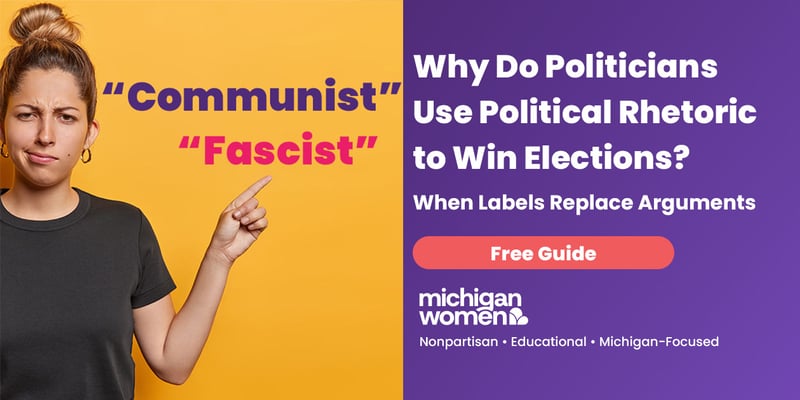
Table of Contents
- What You'll Hear This Election Cycle
- How Does Political Rhetoric Affect Us?
- Why Do Politicians Use Political Rhetoric?
- Keep Exploring
Introduction
As we head into the 2026 general election, the political rhetoric is impossible to ignore.
Communist. Fascist. Socialist. Nazi. Radical. Anti-American. Marxist. Racist. Tyrant. Lunatic.
Some of these words describe real political ideologies and behaviors. They have actual meanings. Sometimes they may accurately describe what someone believes or does.
But they're also increasingly used as political weapons — encouraging us to see the other side as extreme, immoral, dishonest or dangerous.
So it's worth asking:
- What happens when we stop arguing about what a person is proposing and start arguing about what kind of person they are?
- And what does that do to our ability to solve the friction points that prevent, slow or stall thriving communities — or to choose leaders capable of solving them?
What You'll Hear This Election Cycle
From the Republican Side
President Donald Trump has made “communist” one of his central attacks against Democrats. TIME found that he used some version of the term more than 94 times in public statements and social media posts between June 25 and July 13 alone.
“You can be a communist, or you can be a patriot,” Trump said in his Independence Day speech. “You cannot be both.”
He's described communism as a “cancer” that needs to be “cut out.” House Speaker Mike Johnson has described the election as a choice between our constitutional republic and a “dark road of death to communism.” Michigan Rep. Lisa McClain said some Democratic candidates “hate our country and everything that our country stands for.”
Trump has also taken to using Democratic U.S. Senate candidate El-Sayed's full name — Abdulrahman Mohamed El-Sayed — the same way he used "Barack Hussein Obama."
Mike Rogers, Republican candidate for U.S. Senate, says El-Sayed "hates Jewish people."
From the Democratic Side
The rhetoric goes the other direction, too.
Sen. Elizabeth Warren has said Trump is turning the country into a "fascist state." Rep. Ayanna Pressley calls him "a fascist," full stop. Rep. John Larson has compared federal immigration enforcement to "the SS" and "the Gestapo."
It's not just elected officials, either. Progressive commentator Kyle Kulinski recently described the United States as having "descended into fascism," compared American political leaders to Hitler and Mussolini, and called the MAGA movement an "imperialist fascist death cult."
How Does Political Rhetoric Affect Us?
This isn't really a new phenomenon.
For decades, politicians have discovered that attaching an opponent to something people already fear can be more effective than explaining a complicated policy disagreement.
And it works because these words carry much more than their dictionary definitions.
“Communist” doesn't make you think about the appropriate balance between private markets and government programs.
It makes you think about Stalin, bread lines and the Soviet Union.
“Fascist” doesn't make you think about the appropriate limits of executive authority.
It makes you think about Hitler, dictatorship and World War II.
The policy debate has disappeared.
Now we're fighting evil.
Consider the difference:
- “This healthcare proposal would give government too much control.”
- “You're a communist.”
- “This administration is exceeding the proper limits of executive power.”
- “You're a fascist.”
- “This immigration policy could increase illegal immigration.”
- “You want open borders.”
- “This voting requirement could make voting harder for some citizens.”
- “You don't want people to vote.”
- “This spending reduction could cause people to lose healthcare coverage.”
- “You want poor people to die.”
The first statement in each pair gives us something to examine. We can look at evidence. Ask questions. Compare alternatives. Debate tradeoffs. Maybe even find a better solution.
The second tells us something about the other person's identity or motives.
And once I believe you're a communist trying to destroy America, why would I compromise with you?
If I believe you're a fascist trying to destroy democracy, why would I look for a win-win solution with you?
If I believe you actually want people to suffer, why would I care what problem you're trying to solve?
Once the other person becomes the problem, defeating the person starts to feel like solving the problem.
But the original problem is still sitting there.
- Healthcare is still expensive.
- The immigration system still has problems.
- Schools still need funding.
- Housing is still unaffordable.
- Roads still need to be fixed.
- Businesses still need workers.
- Communities still have to figure out how to pay for the things they need.
Calling each other names hasn't solved any of it. Swap the argument for the label and the target becomes someone to defeat, not someone to persuade.
Why Do Politicians Use Political Rhetoric?
This isn't accidental. Political labels work for a few specific reasons.
They Replace a Complicated Argument With a Simple Identity
Healthcare policy is complicated. Immigration policy is complicated. Tax policy is complicated.
"Communist" isn't complicated.
Neither is "fascist."
Instead of asking you to understand a proposal, weigh evidence and consider tradeoffs, the label tells you what kind of person you're dealing with — and how you should feel about them.
Trump has described the strategy himself. Explaining his campaign strategy against Kamala Harris in August 2024, he said, "All we have to do is define our opponent as being a communist or a socialist or somebody who is going to destroy our country." (Associated Press — Trump brands his opponents as ‘communists,’ a label loaded with the baggage of American history)
They Activate Something We Already Fear
The strategy isn't new.
The specific enemy changes, but the mechanism is familiar: connect your opponent to something people already understand as dangerous.
- Communist.
- Fascist.
- Nazi.
- Tyrant.
- Threat to democracy.
- Threat to America.
You don't have to explain why a 200-page healthcare proposal is bad if voters already believe the person proposing it represents something dangerous.
They Can Motivate Your Side
A Republican operative involved in the current "communist" messaging told CNBC that part of its purpose is to "help turn out the base and say exactly what we're running against." (CNBC - Why Michigan voters are hearing ‘communist’ as they vote Tuesday)
A former Trump administration official described the political calculation surrounding Democratic U.S. Senate nominee Abdul El-Sayed even more directly to Politico: "Can you scare the base to be scared of a Muslim, socialist, communist?" (Politico - Trump and the GOP have a new bogeyman)
That's an important distinction.
Political communication isn't always designed to persuade someone who disagrees with you.
Sometimes the goal is to make people who already agree with you afraid, angry or motivated enough to show up.
And our political system rewards it.
None of this requires every politician to sit in a room plotting how to manipulate voters.
The incentives are simpler than that.
If an inflammatory label gets more attention than a detailed policy argument, politicians have an incentive to use the label.
If it generates more television coverage, social media engagement, donations or voter turnout, the incentive gets stronger.
And if the other side is doing it too, stopping can feel like unilateral disarmament.
So the rhetoric escalates.
Meanwhile, the original problem is still waiting to be solved.
Keep Exploring
Political rhetoric can turn legitimate disagreements into judgments about people's motives or character — making it harder to understand what the other side actually sees and harder to work together on the problems our communities need to solve.
👉 Next Article >> How Can We Work Together to Build Thriving Communities?
👈Previous Article >> What Do Democrats and Republicans Believe—and Why?
👇Full Guide >> Get all the articles in the series in one document for the full discussion of political parties, political beliefs, psychology, rhetoric and how we work together when we disagree.
Beyond Political Labels: How We Think, Govern, and Build Thriving Communities