Last update: June 30, 2026. Three proposals could end automatic voter registration in Michigan....
I analyzed a week of Glenn Beck and Heather Cox Richardson, fact-checked both, and compared their framing. Here's why varying your sources matters.
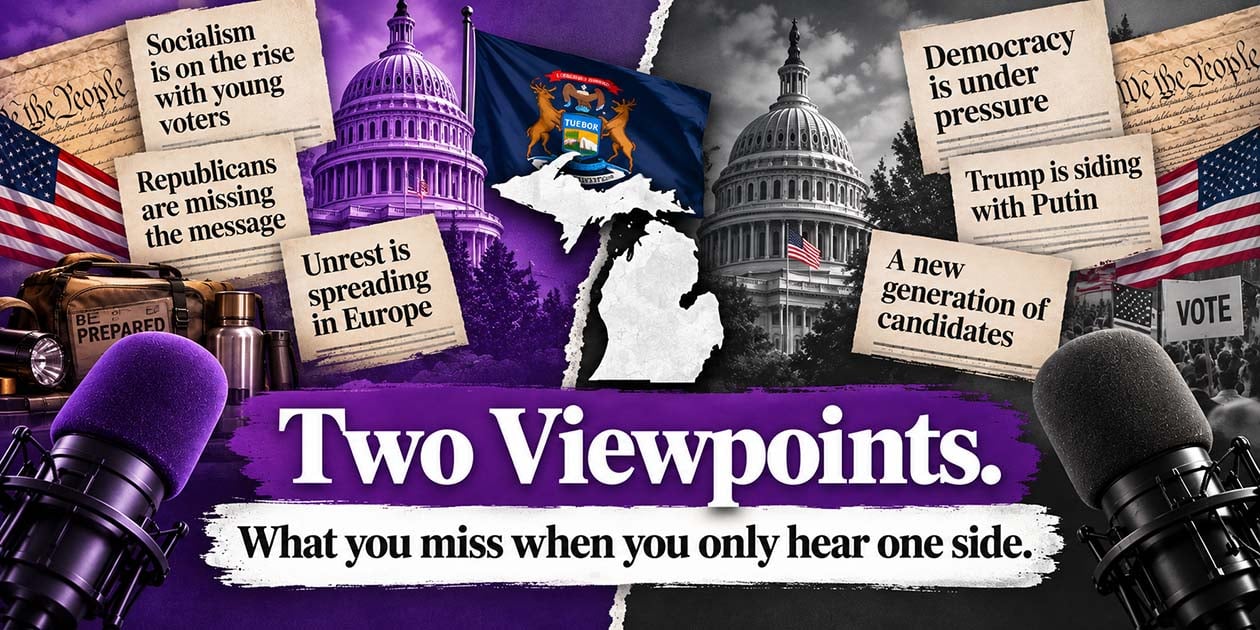
The biggest lesson from spending a week with Glenn Beck and Heather Cox Richardson wasn't about either of them. It's that no single source gives you the whole picture. Each one chose different stories, framed the shared ones in opposite ways, and occasionally stated things as fact that didn't hold up.
The habit that will help citizens most is simple: vary your sources, ask why each is telling you what it's telling you, and test every claim from the other side's point of view, especially the ones you already agree with. An easy way to do it these days is to ask AI: What would "the other side" say about this?
Both commentators are thoughtful. Both lean on history. Both end by urging you to vote. But if you listened to only one of them, you'd walk away believing a very different country was in the news this week.
Table of Contents
What did I research and analyze?
How do the two shows compare at a glance?
Where do they overlap?
Who covered the week's biggest news?
Which claims didn't hold up?
How should you listen to any political show?
The bottom line
What did I research and analyze?
I pulled about eight to ten days of transcripts from each show's YouTube channel in mid-to-late October 2026: Glenn Beck's daily program and Heather Cox Richardson's nightly letters and video chats. Then I used AI to analyze them. For each show, I asked it to surface:
- The topics covered, in plain English, and what the host said about each
- A fact check of each major claim against reporting from across the political spectrum
- The other side's framing of the same issue, in that side's own terms
- A profile of the host: their beliefs, likes, dislikes, and personality
- The week's top news stories, whether or not the host covered them
- What a listener who relied only on that show would come away believing, and what they wouldn't hear
I read through the results, pushed back where something looked off, and then compared the two shows side by side.
One note on the tables below: they reflect the transcripts I analyzed. If a show isn't marked as covering a story, it means the story didn't come up in those transcripts, not that the host never mentioned it anywhere.
The full research, with every fact check and source, is here:
How do the two shows compare at a glance?
| Glenn Beck | Heather Cox Richardson | |
|---|---|---|
| The big story | Western civilization is under strain from the left, at home and abroad | Trump has flipped U.S. foreign policy toward Russia, and American democracy is at stake |
| Main lens | Faith, the founders, and lessons from history (Washington, Germany in 1932) | History as a pattern (the 1850s, 1890s, 1930s) and Lincoln |
| Mood | Warning and preparation, with moments of emotion | Alarm, balanced with steady hope |
| Who's the threat | Socialism, mob justice, government overreach, a weak Republican message | Trump, Musk, Putin, corruption, and disinformation |
| Who's the hope | Ordinary citizens, self-reliance, working through elections | New candidates, voters, and community |
| Surprising candor | Republicans are "missing" what voters feel; El-Sayed is naming real pain | She's not a doctor or a lawyer and "can only predict the past" |
| Call to action | Vote, prepare your household, don't take the law into your own hands | Vote early, check your ballot, talk to your neighbors, find joy |
Where do they overlap?
When both talked about the same thing, the facts were often similar. The framing was not.
| Topic | Glenn Beck's framing | Heather Cox Richardson's framing |
|---|---|---|
| Russia diesel deal and sanctions waiver | Think like a hostage negotiator: don't call Trump a traitor or a genius, watch whether the diesel arrives and Putin brings something real | A historic betrayal: the U.S. abandoning its allies and siding with Putin, possibly for personal gain |
| Zelensky | "A thug and a tyrant" who skipped wartime elections | A U.S. ally under attack, betrayed by Washington |
| Elon Musk | A target: Democrats plan to investigate him, and "the list is the punishment" | A danger: one billionaire throttled Ukraine's defenses and threatened Congress |
| Ilhan Omar | "Smoking guns everywhere"; wants a DNA test (his guest Mark Halpern said the timing was wrong) | Political persecution meant to strip a critic of citizenship |
| Michigan Senate race | Abdul El-Sayed is winning because he names what voters feel; Republicans are "talking about Cairo" while he talks about Kroger | El-Sayed is part of a new, urgent generation that echoes Lincoln |
| Socialism | Tyranny is how socialism survives; a century of examples proves it | Most democratic socialists mean Denmark-style public services, not government-owned industry |
| Texas trans mailers | Mocked the mailer and said it could be either party pulling a "double switcheroo" | Classic disinformation designed to stoke fear |
| Inflation | Trump slowed it dramatically; people compare prices to five years ago | It's rising again, and Trump's policies are making life harder |
| Trump's record | Real wins (border, oil, drug prices) and real misses (inflation, Iran, deficit) | Corruption, decline, and policies hurting ordinary people |
| Lindsey Graham | The documentary about him is a cruel election stunt against a man who can't respond | Trump gutted the Russia sanctions law named for him |
| Why vote | Staying home is how Germany got Hitler in 1933 | Voting is how a new coalition rebuilds democracy, like the 1850s |
Where they quietly agreed
For all the distance between them, a few things lined up:
- Kitchen-table issues are driving voters. Beck said Republicans keep missing affordability and health care; Richardson said 55% of Americans want universal health care.
- El-Sayed's message is working. Both singled out Michigan's Senate race as a sign of something bigger.
- The Omar search timing was a problem. Richardson said so directly; on Beck's show, guest Mark Halpern said the same.
- History matters. Both reached for it constantly, from Washington's Newburgh Address to Lincoln's debates.
- Vote. Every segment from both ended there.
Who covered the week's biggest news?
This is where the difference really shows. Each show built its own version of the week, and many major stories appeared in only one.
| Story | Glenn Beck | Heather Cox Richardson |
|---|---|---|
| Russia diesel deal and sanctions waiver | ✅ Covered | ✅ Lead story |
| Starlink slowdown over Ukraine | — | ✅ Lead story |
| Putin's proposed summit with Trump and Xi | — | ✅ Covered |
| Iran war and fuel prices | ✅ Briefly, as a "miss" | ✅ Covered |
| Inflation at 3.7% | ✅ Covered | ✅ Covered |
| Federal deficit near $2 trillion | ✅ Briefly | ✅ Covered |
| Ilhan Omar investigation | ✅ Covered | ✅ Covered |
| Michigan Senate race | ✅ Extended segment | ✅ Covered |
| Texas trans mailers | ✅ Covered | ✅ Covered |
| Ohio governor's race attack ad | — | ✅ Covered |
| Judge blocks White House press ban | — | ✅ Covered |
| Press secretary fired after five days | — | ✅ Covered |
| Matt Gaetz civil lawsuit | — | ✅ Covered |
| Paxton and Marshall Senate scandals | — | ✅ Covered |
| $8 billion farm diesel aid | — | ✅ Covered |
| No Kings events and Meta takedown | — | ✅ Covered |
| Voting machine rumors | — | ✅ Covered |
| Lindsey Graham documentary | ✅ Covered | — |
| Iwo Jima statue vandalism | ✅ Covered | — |
| France and Greece unrest | ✅ Covered | — (said it's outside her expertise) |
| Major PHP website security flaw | ✅ Extended segment | — |
| Cornell fraternity case | ✅ Covered | — |
| Comey indictment and FBI-Biden memos | ✅ Covered | — |
| UK "Be Ready" emergency campaign | ✅ Covered | — |
What the pattern tells you
Richardson's week was about Russia, corruption, and democracy at risk. Beck's was about disorder, security, and preparing for hard times. Neither is making things up about what they chose to cover. But choosing is itself a form of framing. A Richardson-only listener might never hear about a security flaw affecting most of the internet; a Beck-only listener might never hear that Ukraine's drones went dark during a Russian barrage.
Which claims didn't hold up?
Both shows got most of their facts right. Both also said a few things with confidence that the record doesn't support. Here are four from each.
| Glenn Beck said | What the record shows |
|---|---|
| France hasn't passed a budget since 1973 | France passed its 2026 budget in February |
| The UK doesn't have free elections because it "appoints" its prime minister | British voters elect Parliament, which forms the government |
| An El Paso airport closure was linked to cartel drone threats | AP reported it stemmed from a Pentagon–FAA dispute over testing an anti-drone laser |
| It's now "proven" the FBI obstructed justice to protect Hunter Biden | New memos show the FBI flagged Ukraine evidence as possible disinformation, but the same summary says the team didn't corroborate the allegations |
| Heather Cox Richardson said | What the record shows |
|---|---|
| Russia's economy is smaller than Poland's | Russia's is about 2.5 times larger |
| Inflation is "over 4%" | It's 3.7%, which her own written letter reported correctly |
| "Reliable reports" show Tennessee machines flipping votes | Voters had real touchscreen mix-ups, but there's no evidence of flipping; the state logged one formal complaint in about 400,000 early votes |
| 12 million Americans lost health coverage | That's one analyst's estimate of fewer people enrolled in public programs; other trackers count fewer |
Notice the pattern. Most of these errors came in looser, live moments, and almost every one leaned in the direction of the host's larger argument. That's not unique to these two. It's how all of us are wired: we're quicker to repeat what fits the story we already believe. Sources for every check are in the full research docs.
How should you listen to any political show?
You don't need a research team to do this. A few habits go a long way:
- Vary your sources on purpose. Pair a show you like with one you don't, and notice which stories each one skips.
- Ask why. What does this host want you to feel, believe, or do? Look at the call to action at the end.
- Separate the fact from the frame. "Trump waived the sanctions" is a fact. "Trump betrayed our allies" and "Trump is negotiating like a hostage expert" are frames.
- Flip it. Before you accept a claim, ask how the other side would describe the same event, and whether that version has a point.
- Check the ones you agree with first. Those are the claims we're least likely to question and most likely to repeat.
- Watch for mind-reading. When a host explains someone's hidden motive, that's interpretation, not news.
- Notice certainty. Live, off-the-cuff moments are where facts get fuzzy. Written reporting with multiple sources is usually firmer.
Want to go deeper on why people can hear the same news and reach such different conclusions? Our guide Beyond Political Labels: Why We Think Differently About Politics explores the psychology, rhetoric, and governing instincts behind our disagreements, and offers a simple habit to pair with this one: start with the problem, not the party.
The bottom line
Glenn Beck and Heather Cox Richardson both care about this country, and both are trying to help their listeners make sense of a chaotic moment. Listening to only one of them would have left me with half a week. Listening to both, and checking what they said, left me with something closer to the truth, and a lot more respect for how hard it is to find.
That's the habit I want to build at MichWomen: not telling you who to believe, but giving you the tools to decide for yourself.
This analysis is nonpartisan and isn't an endorsement of either show, any candidate, or any position. Want the full research, with every fact check and source? Read the Glenn Beck breakdown and the Heather Cox Richardson breakdown.